.png)
.png)





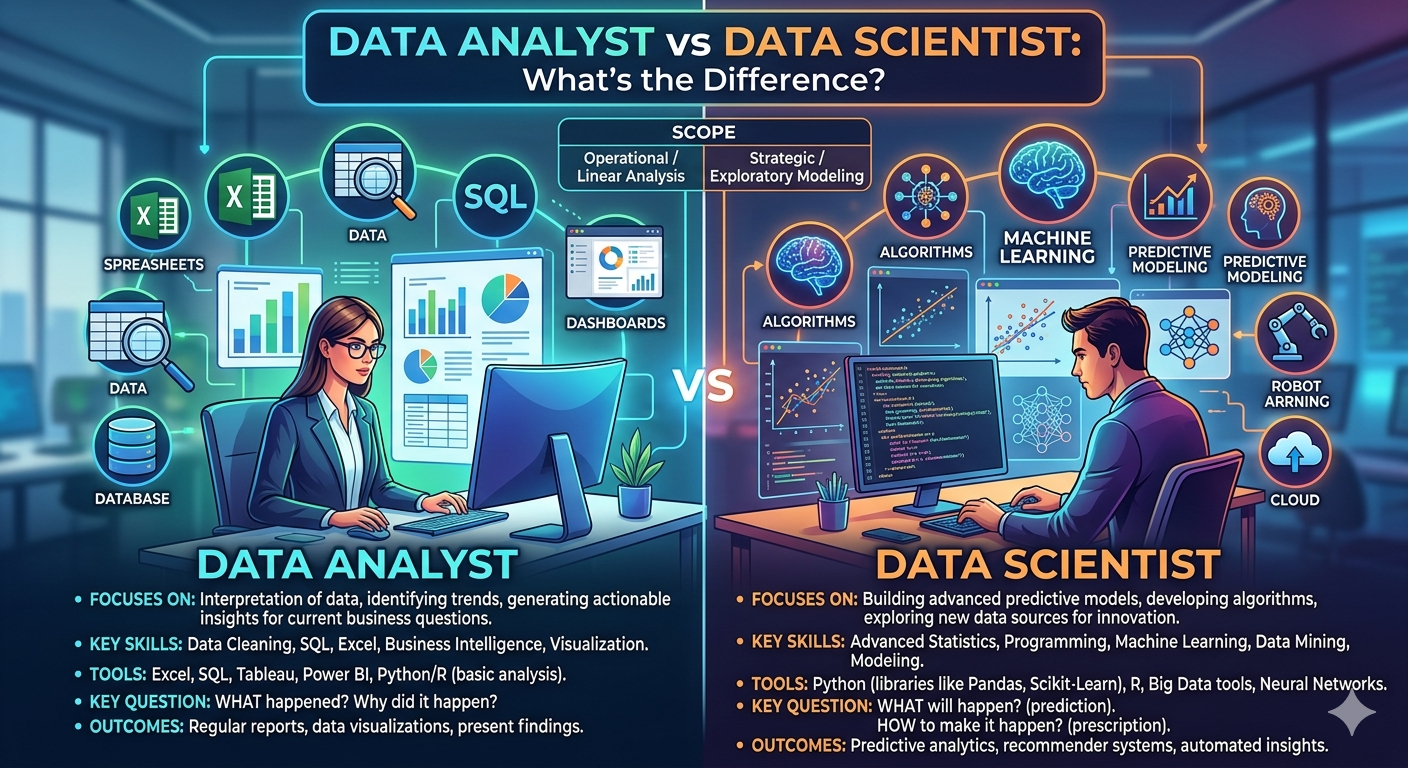
Data Analyst vs Data Scientist: What's the Difference?
Thinking about a career in data but can't figure out if you should become a data analyst or data scientist? You're not alone. These two roles get mixed up all the time, even though they're quite different in what they actually do day-to-day.
This guide is perfect for career changers, recent graduates, and anyone curious about data careers. We'll break down the real differences between data analysts and data scientists, covering the core skills each role needs and the typical daily responsibilities you can expect.
You'll also get a clear picture of the educational paths that can get you there and what kind of career growth to expect in each field.
By the end, you'll know exactly which role fits your interests, skills, and career goals better.
Understanding Core Definitions and Purposes
What Data Analysts Do in Organizations?
Data analysts dig into numbers to find patterns and trends that help companies make smart decisions. They clean messy data, create reports, and build dashboards that show what's happening in the business right now. Think of them as translators who turn raw numbers into easy-to-understand stories that managers can actually use.
What Data Scientists Accomplish for Businesses?
Data scientists take a bigger-picture approach, using advanced math and machine learning to predict what might happen next. They build models that can forecast sales, recommend products to customers, or detect fraud before it happens.
While analysts focus on describing the past and present, data scientists engineer solutions for future challenges.
How Each Role Serves Different Business Needs?
Analysts support day-to-day operations by answering specific questions like "Why did sales drop last month?" or "Which marketing campaigns work best?" Data scientists tackle complex problems that require building new systems, like creating recommendation engines or automated decision-making tools.
Companies often need both roles working together - analysts keep the lights on while data scientists build the future infrastructure.
Essential Skills and Technical Requirements
Programming Languages Each Role Demands
Data analysts typically master SQL for database queries and Excel for basic analysis, with Python or R as valuable additions. Data scientists need stronger programming foundations, requiring Python or R proficiency plus knowledge of libraries like pandas, scikit-learn, and TensorFlow. Scientists often work with multiple languages including Java or Scala for big data processing.
Statistical Knowledge Differences
Analysts focus on descriptive statistics, hypothesis testing, and basic inferential methods to interpret existing data patterns. Scientists dive deeper into advanced statistical modeling, probability distributions, and experimental design.
They need expertise in multivariate analysis, Bayesian methods, and statistical learning theory to build predictive models and validate complex algorithms.
Machine Learning Expertise Expectations
Data analysts rarely build machine learning models, instead focusing on applying pre-built tools for basic predictive tasks. Data scientists design, implement, and optimize machine learning algorithms from scratch.
They understand model selection, feature engineering, cross-validation, and deployment strategies. Scientists work with supervised, unsupervised, and reinforcement learning across various domains and problem types.
Data Visualization Tool Proficiencies
Analysts excel in business intelligence tools like Tableau, Power BI, and Excel dashboards for stakeholder reporting. Data scientists use programming-based visualization libraries such as matplotlib, seaborn, and plotly for exploratory analysis.
Scientists create interactive visualizations and custom graphics to communicate complex model results. Both roles need strong storytelling abilities to translate data insights into actionable business recommendations.
Career Growth and Salary Expectations
Entry-Level Compensation Comparisons
Data analysts typically start with salaries ranging from $50,000-$70,000, while entry-level data scientists command higher starting wages between $80,000-$110,000. The premium reflects the advanced technical skills and business strategy focus that data scientists bring from day one.
Senior-Level Earning Potential
Senior data scientists can reach $150,000-$250,000+ at major tech companies, often including substantial stock options and bonuses. Senior data analysts peak around $90,000-$130,000, though specialized roles in finance or healthcare can push higher. The gap widens significantly as professionals advance through their careers.
Career Advancement Opportunities Available
Data scientists have clearer paths to leadership roles like Chief Data Officer or VP of Analytics, given their strategic business exposure. Data analysts often pivot into specialized domains, product management, or business intelligence leadership. Both roles offer excellent growth potential, with data scientists having slightly more diverse exit opportunities into executive positions.
Choosing the Right Path for Your Goals
Assessing Your Current Skill Set
Start by honestly evaluating your existing technical abilities and experience with data tools. Data analysts typically need strong Excel skills, basic SQL knowledge, and proficiency with visualization tools like Tableau or Power BI. Data scientists require deeper programming skills in Python or R, statistical modeling expertise, and machine learning knowledge. Consider which skills you already possess and which ones excite you to learn.
Identifying Your Interest in Technical Depth
Think about how deep you want to dive into the technical side of data work. Data analysts focus more on interpreting existing data and creating reports that drive business decisions.
Data scientists spend time building predictive models, developing algorithms, and conducting complex statistical analyses. Ask yourself whether you prefer working with established datasets or creating new analytical frameworks from scratch.
Evaluating Long-Term Career Aspirations
Consider where you see yourself in five to ten years. Data analyst roles often lead to business intelligence management, operations analysis, or consulting positions.
Data scientist paths typically evolve toward machine learning engineering, research roles, or chief data officer positions. Think about whether you want to stay close to business operations or move toward more research-oriented work.
Market Demand Considerations
Research job opportunities in your geographic area and preferred industries. Data analyst positions are widely available across most sectors, from healthcare to retail. Data scientist roles are often concentrated in tech companies, startups, and large corporations with significant data infrastructure. Check salary ranges and growth projections for both paths in your target market to make an informed decision.
Data analysts and data scientists both work with data, but they serve different purposes in organizations. Analysts focus on interpreting existing data to answer specific business questions, while scientists build predictive models and create new ways to extract insights from complex datasets.
The skill requirements reflect these differences too - analysts need strong SQL, Excel, and visualization tools, whereas scientists require programming languages like Python or R, machine learning knowledge, and statistical modeling expertise.
Your career choice should align with your interests, strengths, and long-term goals. If you enjoy working with data, identifying patterns, and helping businesses make smarter decisions, a data analytics course in Delhi can be the perfect starting point for a rewarding career.
At Madrid Software, students learn how to transform raw data into meaningful insights using industry-relevant tools like Excel, SQL, Python, Power BI, and real-world analytics techniques.
The data analytics course in Delhi at Madrid Software is designed to help beginners and professionals build practical skills through hands-on projects, expert mentorship, and real business case studies.
With structured learning, practical exposure, and career-focused training, Madrid Software prepares learners to confidently step into roles such as Data Analyst, Business Analyst, and Reporting Analyst.
If you want to build a future in data and work with technologies used by modern companies, Madrid Software offers the right platform to start your journey in data analytics.
