.png) Call Us
Call Us
.png) WhatsApp Us
WhatsApp Us

Dive deep into insights, trends, and latest trends on Data Science, Data Analytics, Artificial Intelligence, Generative AI & Agentic Intelligence and cutting-edge UI/UX Design. Stay ahead with expert content that bridges innovation and real-world impact.


BLOG
Author: Amit Kataria
Posted on: 04 Aug 2025
23 min readEverywhere you look, data is at work, whether it’s the personalized recommendations you get on Netflix or the lightning-fast delivery of your latest Amazon order. But have you ever wondered how companies like Zomato, Myntra, or HDFC Bank make sense of all that information to keep things running so smoothly? That’s where data analysts step in. Data analysts are like the detectives of the digital age, digging through numbers to uncover insights that shape everything from pricing strategies to marketing campaigns. As industries like e-commerce, healthcare, and banking become more data-driven, the need for talented analysts is growing faster than ever. If you’re exploring a career in data analytics or are already in the game, you’re probably curious about one thing: How much can you actually earn as a data analyst in India? Well, here’s the good news it’s not just a growing field, but it’s also one that offers some impressive earning potential. In this blog, we’ll take you through the salary trends for data analysts in India, from entry-level roles to seasoned professionals. By the end, you’ll have a clear idea of what to expect and how you can carve out a successful (and rewarding) career in this field. **Who Is a Data Analyst?** Data analysts sift through mountains of data numbers, trends, and patterns to help businesses make informed decisions. Whether it’s predicting customer behavior, optimizing supply chains, or improving healthcare outcomes, a data analyst’s job is to uncover the story behind the numbers. The role of a data analyst is as dynamic as it is crucial. At its core, it involves collecting, organizing, and interpreting data to answer specific business questions. For instance, why are sales dipping in one region? What marketing strategies are delivering the highest ROI? Data analysts dig into these questions and deliver insights that can change the course of a business. Their responsibilities often include cleaning and organizing raw data, creating visualizations, identifying trends, and presenting actionable insights to stakeholders. They rely on tools like Excel, SQL, Tableau, and Python, which are as much a part of their arsenal as a chef’s knives or a surgeon’s scalpel. From tech startups to retail giants, nearly every industry is on the lookout for skilled data analysts. Companies in e-commerce, finance, healthcare, and even entertainment are hiring analysts to stay ahead in a data-driven world. Whether it’s a fintech firm optimizing its loan approval process or a streaming service predicting what you’ll binge next, data analysts are the unsung heroes behind these innovations. **Average Salary for Data Analyst in India** In the ever-evolving world of data analytics, compensation varies significantly based on experience, location, and industry. Let's delve into the numbers to provide a clearer picture. **Global Average Salaries by Experience Level** Entry-Level Data Analysts salary (0-2 years of experience): On average, data analyst salary for freshers can be between ₹3.2 lakh and ₹4.2 lakh per annum. In Bengaluru, a major tech hub, salaries may be higher due to increased demand and living costs. For instance, data analysts in Bengaluru can earn an average salary of ₹5.5 lakh per annum. Mid-Level Data Analysts (2-4 years of experience): In India, mid-level data analysts with 2 to 4 years of experience can expect to earn an average annual salary ranging from approximately ₹4.8 to ₹6.0 lakhs. Senior Data Analysts (5-7 years of experience): On average, professionals in this role can expect annual compensation ranging from approximately ₹12 lakhs to ₹13 lakhs per annum. Principal Data Analysts (8+ years of experience): In India, the salary for a Principal Data Analyst with over 8 years of experience the annual compensation ranges from approximately ₹14 lakhs to ₹70 lakhs. For instance, at Walmart, Principal Data Analysts with 9 to 16 years of experience earn between ₹44 lakhs and ₹1 crore per year. **Region-Wise Salary Breakdown** United States: The average salary for data analysts is around $85,000 per year, though this can vary by state and city. United Kingdom: Data analysts earn an average salary ranging from £29,619 to £42,497, depending on the source and experience level. Canada: Salaries for data analysts average between CAD $60,930 and CAD $70,256 annually. Australia: Data analysts in Australia earn an average salary of approximately AUD $128,735 per year. India: While specific figures vary, data analysts in India can expect a competitive salary of ₹20 lakhs per annum. **Location:** Salaries also vary by city. For example: Bengaluru, Karnataka: Average salary is ₹7.5 lakhs per year. Gurgaon, Haryana: Average salary is ₹8.5 lakhs per year. Mumbai, Maharashtra: Average salary is ₹6.5 lakhs per year. **Salary Comparison Across Industries** Data analyst salary per month hitting their bank can vary significantly across sectors, reflecting the demand and complexity of roles. Here's a quick sector-wise comparison: Finance and Insurance: Mid-level data analyst professionals with expertise in Python, R, advanced analytics, and domain-specific knowledge (Finance or Insurance) earn about ₹6 to ₹9 lakh per year. IT industry: The average salary of a mid to senior-level data analyst in the Internet/IT industry in India typically ranges between ₹10 to ₹18 lakh per year, depending on factors like location, company size, and years of experience. Software Product Companies/ SaaS: The average salary of a Data Analyst in India working in software product companies at a mid to senior level typically ranges between ₹10 lakhs to ₹25 lakh per year. Entertainment: The average salary of a mid to senior-level Data Analyst in the Entertainment Industry in India typically ranges between ₹8 to ₹15 lakh per annum. Energy and Mining: This sector offers some of the highest salaries for data analysts, with averages ranging from ₹8 to ₹30 lakh per annum. Healthcare: The average salary of a data analyst in the healthcare industry in India typically ranges between ₹8 to ₹20 lakh per annum. E-commerce: The average salary for a Data Analyst in the E-commerce industry in India typically ranges from ₹8 to ₹20 lakh per annum. **Factors Influencing a Data Analyst’s Salary** Data analyst salary in India can vary significantly based on several factors. Understanding these key influences can help professionals strategize their career growth and maximize earning potential. 1. Education and Certifications A solid educational background in fields like computer science, statistics, or economics often lays the foundation for a data analyst career. However, certifications can play a game-changing role in boosting salary prospects. Credentials such as the Google Data Analytics Certificate, Tableau Desktop Specialist, or Microsoft Power BI Certification not only enhance your skillset but also signal your expertise to potential employers. For instance, professionals with advanced certifications earn 15-20% more than those without (Source: Simplilearn). 2. Years of Experience Experience remains one of the biggest determinants of salary. Entry-level data analysts with less than two years of experience typically earn modest starting salaries, but this can increase exponentially as they gain expertise. Senior analysts with over five years of experience can earn 2-3 times more than their junior counterparts (Source: Coursera). 3. Technical Skills The more versatile your technical skills, the higher your earning potential. Mastery of tools like Python, SQL, Excel, Tableau, and R is often a prerequisite for higher-paying roles. For instance, professionals skilled in Python and SQL earn 25-30% more on average compared to those without these skills (Source: Glassdoor). Keeping up with the latest technologies and trends in data analytics is crucial for staying competitive. 4. Geographic Location Where you work can significantly impact your salary. Data analysts in metropolitan cities or regions with a higher cost of living tend to earn more. For example: In India, data analysts in cities like Bangalore or Mumbai earn up to ₹9-12 LPA, while smaller cities may offer ₹5-7 LPA (Source: Naukri). In the U.S., data analysts in cities like San Francisco or New York see salaries around $90,000-$110,000 annually (Source: Glassdoor). 5. Company Size and Reputation The size and reputation of a company can also influence salaries. Large corporations like Google, Amazon, and Deloitte typically offer higher packages to attract top talent. Conversely, startups may offer slightly lower salaries but can compensate with equity or growth opportunities. Analysts working in renowned tech firms often earn 20-40% more than those in smaller organizations (Source: PayScale). **Top-Paying Industries for Data Analysts** The top-paying industries for data analysts in India include finance, technology, and healthcare. In finance, companies like JPMorgan Chase and Goldman Sachs offer competitive salaries, leveraging analysts for risk modeling and portfolio management. The technology sector, led by firms like Google and Amazon, compensates analysts well for driving insights in customer behavior and system optimization. Healthcare giants like Apollo Hospitals utilize analytics for patient data management and predictive care, rewarding expertise generously. Additionally, emerging fields such as e-commerce (Flipkart, Meesho) and consulting (Deloitte, PwC) provide lucrative packages, often enhanced by bonuses and stock options. **How to Boost Your Data Analyst Salary** While the role of a data analyst is already lucrative, there are several ways to level up and secure even higher compensation. Here’s how you can maximize your earning potential: 1. Acquire Advanced Certifications and Skills Upskilling is a proven way to boost your salary. Take a course like [Data Analytics](https://www.madridsoftwaretrainings.com/data-analytics-course-training-in-delhi) to get hands-on training in data analytics core concepts, or take advanced training in tools like SQL, Python, and Tableau to make you stand out. Certified professionals often earn 15-25% more than their uncertified counterparts. Additionally, acquiring skills in cutting-edge fields like machine learning or artificial intelligence can open doors to high-paying roles, such as data scientists or machine learning engineers. 2. Transition to Specialized Roles Moving from a generalist role to a specialized one often comes with a salary hike. Many data analysts evolve into roles such as data scientists, business analysts, or data engineers. These positions not only demand niche skills but also offer higher pay. For instance, data scientists earn an average salary of $100,560 annually in the U.S., significantly higher than the average data analyst salary (Source: Glassdoor). 3. Networking and Building an Impressive Portfolio Your portfolio and professional network are invaluable tools for career advancement. Create a strong portfolio showcasing your best projects, such as predictive models or insightful dashboards. Use platforms like GitHub, Kaggle, or Tableau Public to display your work. Additionally, networking through platforms like LinkedIn or attending data science meetups and hackathons can connect you with industry leaders and potential employers. Building relationships often leads to referrals, which can land you higher-paying opportunities. 4. Leverage Negotiation Skills During Hiring Effective salary negotiation is crucial. Research industry standards for your role and experience level before heading into interviews. Highlight your certifications, successful projects, and quantifiable contributions to your previous roles. According to a study, candidates who negotiate their salaries earn 7-10% more on average than those who don’t (Source: Harvard Business Review). Additionally, timing matters—discussing salary after you’ve demonstrated your value in the interview process often leads to better offers. Future of Data Analyst Salaries The demand for data analysts continues to grow at a rapid pace, driven by the digital transformation across industries. As businesses rely more on data-driven decision-making, the future of data analytics—and the salaries associated with it—looks highly promising. **Trends in Data Analytics Demand** Data analytics has become an indispensable part of industries like healthcare, finance, retail, and technology. According to a report by the U.S. Bureau of Labor Statistics, jobs in the data analytics field are projected to grow by 23% from 2021 to 2031, much faster than the average for all occupations (Source: BLS). In India, a 2024 NASSCOM report revealed that demand for analytics professionals is growing at 35% annually, particularly in industries like e-commerce, banking, and consulting. **Emerging Technologies Shaping the Role** The evolution of technologies like artificial intelligence (AI), machine learning (ML), and big data is reshaping the data analyst’s role. Soon enough these skills will become the basic qualifications needed to be a data analyst. Analysts are now expected to work alongside advanced tools such as: * AI-powered analytics platforms for predictive modeling. * Natural Language Processing (NLP) tools for deriving insights from unstructured text. Cloud-based data platforms like Snowflake and Google BigQuery for managing and analyzing large datasets. * With the rise of automation, data analysts who upskill in these emerging technologies will be in higher demand and command better salaries. **Predictions for Salary Growth** The future is bright for data analysts in terms of earning potential: * Globally, data analyst salaries are expected to grow by 20-30% over the next decade as companies increasingly rely on data to drive business strategies (Source: Market Research Future). * In India, average salaries for data analysts are projected to reach ₹15-20 LPA by 2030, especially for those with expertise in AI, ML, and data engineering (Source: Analytics India Magazine). * According to Gartner, businesses worldwide are predicted to invest over $300 billion annually in data analytics by 2030, further boosting job opportunities and salary scales (Source: Gartner). **Conclusion** The data analytics field offers tremendous opportunities for growth, both professionally and financially. From understanding the role of a data analyst to exploring how factors like education, skills, and industry impact salaries, we’ve covered the essentials of what you can expect from this career. Whether you’re just starting out or looking to level up, the potential for salary growth in data analytics is undeniable, especially as demand continues to rise globally. As industries embrace data-driven decision-making and emerging technologies reshape the landscape, the need for skilled data analysts will only grow. Now is the perfect time to invest in your future. Upskilling with a course like Master in Big Data Analytics, mastering advanced tools, and staying updated on trends can help you unlock your full earning potential. Ready to take the next step in your data analytics journey? Start by exploring educational resources, online courses, and certifications that align with your career goals. With the right skills and mindset, a lucrative and fulfilling career in data analytics awaits you.
BLOG
Author: Amit Kataria
Posted on: 06 Aug 2025
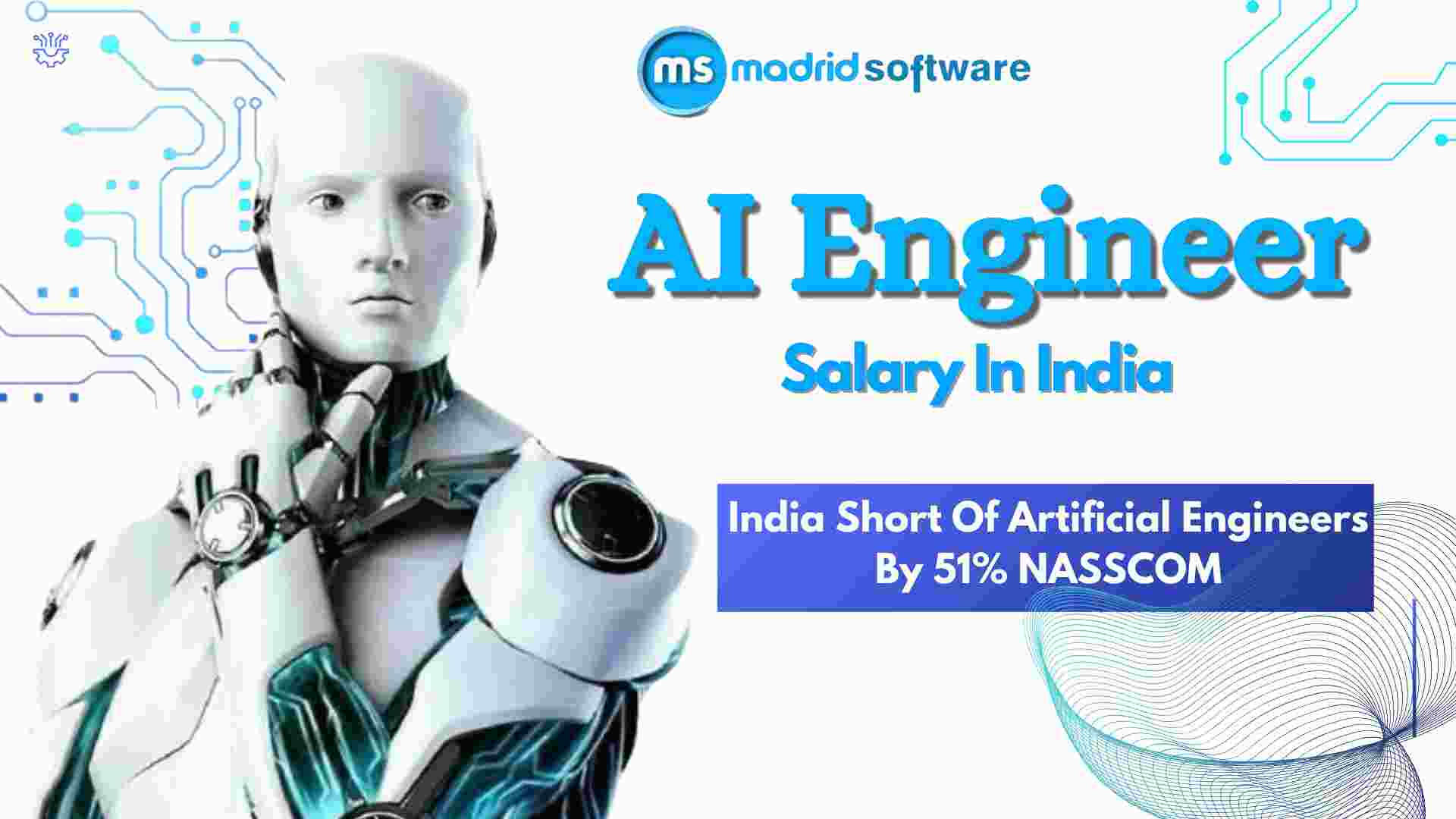
13 min readAI is in high demand across India. Businesses are increasingly relying on AI to enhance operational efficiency and make more informed decisions, driving a surge in the need for skilled AI engineers making it one of the most sought after skill in industry. From startups to multinational corporations, organizations are actively seeking professionals who can implement AI solutions effectively. Among all emerging fields, AI stands out as one of the most in-demand career paths, offering immense opportunities for those with the right skills. The rise and integration of artificial intelligence (AI) have dramatically transformed India's technology and innovation landscape. This powerful force is revolutionizing business operations and having a significant impact on the job market, particularly in terms of demand for **AI engineers and their salaries**. This article explores the growth of AI in India, the role of AI engineers, salary trends, and the key factors influencing compensation for these professionals. Artificial Intelligence (AI) engineers in India are among the highest-paid professionals in the tech industry. The salary for AI engineers can vary based on factors like experience, education, location, and the type of company. Here’s a general overview: **1. Entry-Level AI Engineer Salary**: Freshers or entry-level AI engineers with less than 1-2 years of experience can expect to earn between ₹5,00,000 to ₹12,00,000 annually. This range depends on the company, location, and the skills of the candidate. **2. Mid-Level AI Engineer Salary:** AI engineers with 3-5 years of experience typically earn between ₹12,00,000 and ₹20,00,000 per year. At this level, professionals have gained significant expertise in machine learning, neural networks, and natural language processing (NLP). **3. Senior AI Engineer Salary:** Experienced AI engineers with 5+ years of experience can earn anywhere from ₹20,00,000 to ₹40,00,000 or more annually. Senior roles often include leadership responsibilities, advanced AI system development, and research. **4. AI Research Scientist Salary:** Professionals working in AI research and development in India, often at top companies or institutions, may earn ₹15,00,000 to ₹30,00,000 or more per year, depending on their role and level of expertise. **Is AI a High Paying Job?** Yes, AI is a high-paying job in India. With the rise of automation, machine learning, deep learning, and data science across industries such as technology, finance, healthcare, and manufacturing, AI engineers are in high demand. Due to the scarcity of highly skilled AI professionals and the complexity of the skills required, AI engineers often command premium salaries, especially in leading global companies like Google, Microsoft, Amazon, and various startups. AI roles, especially those focused on deep learning, NLP, and computer vision, tend to be among the highest-paying jobs in the tech field in India. Additionally, AI professionals with niche skills or advanced degrees from prestigious institutions can expect even higher compensation. **Is AI a Good Career in India?** AI is increasingly considered one of the best career options in India due to several reasons: **1. High Demand:** AI technology is revolutionizing industries and is being increasingly adopted in sectors like healthcare, finance, automotive, e-commerce, and more. This has led to a significant demand for skilled AI professionals. **2. Job Opportunities:** There is a growing need for AI engineers, machine learning engineers, data scientists, and AI researchers in India. Companies are investing heavily in AI technologies to stay competitive in the global market. **3. Career Growth:** AI offers a diverse range of career paths, from research and development to practical applications in business. This diversity means professionals can specialize in areas like robotics, data analytics, computer vision, and natural language processing, leading to significant career growth opportunities. **4. Job Satisfaction:** AI professionals often report high job satisfaction due to the intellectual challenges of working with cutting-edge technologies, solving complex problems, and contributing to impactful innovations. **5. Global Impact:** AI professionals in India have the opportunity to work on global projects, collaborate with international teams, and contribute to innovations that affect industries worldwide. **Demand for AI Engineers in India** The demand for AI engineers is not limited to the tech industry alone; it also includes e-commerce, automotive, and entertainment, bringing in more opportunities. A core task of AI engineers is developing the models of machine learning, designing the AI algorithms, and workflows to automate, which plays a crucial role in modern business operations. The **demand for AI engineers in India** has skyrocketed in recent years. Several factors contribute to this high demand: **1. Industry Adoption:** AI has become integral to industries like e-commerce, healthcare, fintech, and more. Companies are leveraging AI for everything from customer service chatbots to predictive analytics, and automation tools. **2. Startups and Big Tech:** India has seen a surge in AI-driven startups, particularly in cities like Bengaluru, Hyderabad, and Pune. Additionally, global giants like Google, Microsoft, and Amazon have established AI research centers in India, increasing job opportunities for AI professionals. **3. Government Initiatives:** The Indian government is also investing in AI and related technologies, which will further boost demand for AI talent. Programs such as "Digital India" and "Atmanirbhar Bharat" aim to promote AI in various sectors. **4. Data Availability:** With the exponential growth of data and the need to make sense of it, companies are turning to AI and machine learning algorithms for insights, driving the demand for skilled engineers. **Career Growth in AI** The career growth in AI is exceptional, enabling professionals to specialize in very advanced fields, such as natural language processing, computer vision, or robotics. There is a need to continuously learn and be updated on the most recent developments to survive within this fast-changing environment. Career growth in AI in India is not just promising but also fast-paced. The opportunities for advancement are vast, with various career trajectories available: **1. Specialization:** AI professionals can specialize in various domains like machine learning, natural language processing (NLP), computer vision, or robotics. Specializing in these high-demand areas can result in higher salaries and roles like AI Architect or Research Scientist. **2. Leadership Roles:** As AI engineers gain experience, they can move into leadership positions such as AI Team Lead, AI Manager, or Head of AI, where they oversee projects, mentor junior engineers, and contribute to strategic decision-making. **3. Cross-Industry Growth:** AI skills are transferable across industries. A machine learning engineer working in healthcare may transition to working in finance or automotive industries, allowing for career mobility and diversification. **4. Educational and Certification Opportunities:** With many online courses, certifications, and postgraduate programs in AI, professionals can continue to grow their expertise and open doors to new opportunities. Continuous learning in AI is crucial, given the rapid advancements in the field. **5. Entrepreneurship:** Many AI professionals with entrepreneurial aspirations are founding AI-based startups, taking advantage of India's booming startup ecosystem. This offers not just job growth but also the potential for high financial rewards. **What does an AI engineer do? ** They basically design and develop AI models and systems. The task involves solving intricate problems. It encompasses duties such as data analysis, model training, and deployment of AI solutions. One should be a strong programmer with profound knowledge of frameworks for machine learning. Artificial intelligence in India seems to have a promising future. The widespread use of AI is being encouraged by the government, and as AI becomes more integrated into most industries, those who develop it will have more job options. Enhancements to this financial benefits from an AI, this area more over offers chance to work on some exceptional and innovative technologies that influence future To conclude in simple terms **career in AI** is exceptional, it offers a very bright future in India, the Future of AI now leading to a stable and great rewarding careers AI is a high-paying and lucrative career in India, with strong job demand and rapid growth potential. Professionals with the right skills, experience, and specialization can expect great career advancement, competitive salaries, and opportunities to work in cutting-edge technologies across a range of industries. Choosing AI career is the biggest decision it’s the stepping stone towards a successful career.

BLOG
Author: Amit Kataria
Posted on: 09 Aug 2025
8 min readThe education landscape in 2025 looks nothing like it did just a few years ago. With rapid advancements in Artificial Intelligence, particularly **[Generative AI](https://www.madridsoftwaretrainings.com/generative-ai-course-in-delhi)**, classrooms have evolved from traditional, one-size-fits-all models into dynamic, personalized learning environments. Students are now learning with AI tutors, educators are designing smarter lesson plans, and assessments are being generated in real time. So what exactly is Generative AI, and how is it revolutionizing education in 2025? Let’s dive in. **💡 What is Generative AI?** Generative AI refers to advanced AI systems that can create new content such as text, images, videos, code, or even music by learning from existing data. Instead of just analyzing information, it can generate human-like responses, explanations, visuals, and even simulations. **Some well-known generative AI models include:** • ChatGPT for natural language tasks • DALL·E and Midjourney for image generation • Suno and Udio for music • Sora for video creation • GitHub Copilot for code generation In the context of education, these tools have the potential to enhance creativity, automate tasks, personalize instruction, and make learning more accessible to everyone. **🚀 Key Ways Generative AI is Transforming Education in 2025** **1. 📚 Personalized Learning for Every Student** One of the biggest challenges in education has always been meeting individual students' needs. With generative AI, schools can now offer truly personalized learning experiences based on each student’s: • Learning pace • Knowledge level • Interests • Strengths and weaknesses **Platforms using generative AI can generate:** • Customized quizzes • Real-time feedback • Personalized study plans • Adaptive content recommendations **Example:** A 10th-grade student struggling with algebra gets an AI-generated interactive lesson tailored to their weak areas, complete with examples and follow-up questions. **2. 👩🏫 AI Teaching Assistants for Educators** Teachers in 2025 are no longer burdened with repetitive administrative work. Generative AI tools can now: • Draft lesson plans • Generate assignments • Summarize classroom discussions • Create slide decks • Suggest engaging activities based on curriculum goals Educators are using tools like **ChatGPT**, **MagicSchool.ai**, and **Khanmigo** to save time and focus more on mentoring and creative instruction. “AI won’t replace teachers, but teachers using AI will replace those who don’t.” **3. 🧠 24/7 Tutoring and Support** Students now have access to AI tutors anytime, anywhere. These virtual assistants: • Answer academic questions • Break down complex topics • Provide writing feedback • Help with coding and math • Offer career and college prep advice The best part? These AI tutors are available 24/7, eliminating barriers caused by time zones, location, or costs. **Example:** A student working on an essay at midnight gets instant grammar feedback and improvement suggestions using an AI writing assistant. **4. 📝 Smarter Assessments and Instant Feedback** Generative AI enables on-demand quiz and test creation, adaptive assessments, and real-time grading. Instead of waiting days for results, students receive instant insights on their performance. **AI can now:** • Detect conceptual gaps • Suggest remedial content • Track progress over time • Offer differentiated challenges This not only saves teachers time but improves learning outcomes through data-driven feedback. **5. 🌐 Bridging Language and Accessibility Gaps** Generative AI tools can: • Translate lessons into multiple languages • Convert text to speech for visually impaired learners • Summarize content for students with learning disabilities • Create interactive transcripts and subtitles in real time This ensures inclusive learning for all, regardless of language barriers, physical challenges, or cognitive differences. **Example:** A deaf student watches a science video with AI-generated captions and sign language overlays. **6. 💻 Project-Based and Creative Learning with AI** Students are now using generative AI to: • Create documentaries with AI video editors • Write stories and poems with AI co-writers • Build apps with AI coding assistants • Design art with DALL·E or Midjourney This allows for deeper engagement in STEM, humanities, and the arts. Students become creators, not just consumers of knowledge. **⚠️ Challenges & Ethical Concerns** While the benefits are vast, generative AI in education also brings challenges: **🔸 1. Academic Integrity** AI tools can write essays and solve problems, making it harder to detect plagiarism or original thought. **Solution:** Educators must teach AI literacy and ethical usage, not just ban the tools. **🔸 2. Bias in AI Outputs** Generative models may reflect societal biases present in their training data. **Solution:** Choose tools trained on diverse, high-quality datasets and monitor outputs critically. **🔸 3. Data Privacy** AI tools often require access to student data. Improper usage could breach privacy laws. **Solution:** Ensure tools are FERPA, COPPA, and GDPR compliant and safeguard student information. **🔸 4. Overreliance on AI** Excessive dependence on AI might hinder critical thinking and problem-solving skills. **Solution:** Use AI to support, not replace, human interaction and independent thought. **✅ Final Thoughts** Generative AI is not a trend—it’s a transformative force reshaping education in real-time. In 2025, students aren’t just learning about AI—they’re learning with it, through it, and from it. Whether you're an educator, student, parent, or policymaker, embracing generative AI means preparing for a smarter, more inclusive, and personalized learning future. The question isn’t if AI should be in education—it’s how we can use it responsibly and effectively.

BLOG
Author: Amit Kataria
Posted on: 14 Aug 2025
14 min readAI-powered tools are reshaping how we create and edit content, and **Remaker AI** is one such platform that is causing a stir. It is an advanced AI tool designed for content transformation, offering features like video upscaling, background removal, image enhancement, and more. This blog deepens into **Remaker AI features, benefits, pricing**, and real-world applications to help you understand its potential. If you’re interested in exploring AI-driven content creation further, you might also want to check out this [Generative AI course](https://www.madridsoftwaretrainings.com/generative-ai-course-in-delhi) to gain hands-on expertise. Let’s get started! **Core Features of Remaker AI** Remaker AI is designed to simplify and enhance digital content creation using advanced AI capabilities. From refining images to enhancing videos, it provides a range of tools that cater to photographers, designers, content creators, and marketers. Let’s explore its core features and how they work. **AI Face Swapping** This feature allows users to seamlessly swap faces in images and videos. It utilizes deep learning to ensure realistic blending, maintaining natural expressions and lighting. Face swapping can be useful for content creators, entertainment professionals, and even for privacy protection in certain cases. **AI Headshot Generator** With AI-powered enhancements, this tool generates professional-quality headshots from regular images. It improves details like lighting, background, and sharpness, making it ideal for LinkedIn profiles, resumes, and business portfolios without requiring a studio setup. **AI Background Removal** Removing backgrounds from images manually can be time-consuming. This feature uses [Artificial Intelligence](https://www.madridsoftwaretrainings.com/artificial-intelligence-course-training-in-delhi) to accurately detect and separate subjects from backgrounds within seconds. It’s particularly helpful for e-commerce product images, marketing materials, and graphic design. **AI Image Upscaler** Low-resolution images can lose clarity when enlarged. The AI Image Upscaler enhances image resolution while preserving details, reducing pixelation, and improving overall quality. This feature is valuable for photographers, web designers, and anyone working with old or compressed images. **AI Watermark Removal** This tool helps clean up images by removing watermarks, text overlays, or unwanted objects. It uses AI-based inpainting to reconstruct the missing parts of an image, making it useful for restoring visuals or repurposing content for professional use. **AI Video Enhancer** Blurry or low-quality videos can be improved using AI-driven upscaling and enhancement. This feature sharpens details, enhances colors, and reduces noise, making old or low-resolution videos more visually appealing. It is widely used in video restoration, social media content creation, and filmmaking. **Step-by-Step Guide to Using Remaker AI** Remaker AI is designed to be user-friendly, making content enhancement accessible to professionals and beginners alike. Here’s a step-by-step breakdown of how you can use its features efficiently. **Step 1: Access the Platform** Visit the Remaker AI website and sign in or create an account. Some features may require a subscription, while others might have free or trial options. **Step 2: Choose a Tool** Once logged in, you'll see a dashboard with different AI-powered tools like face swapping, background removal, image upscaling, and more. Select the feature that suits your needs. **Step 3: Upload Your Media** Click on the upload option to add your image or video. Ensure the file format is supported for smooth processing. For example, image tools typically accept formats like JPG, PNG, or WebP, while video tools support MP4 and MOV. **Step 4: Customize Settings** Depending on the tool you’ve selected, you’ll see various options to adjust the effect. * Face Swapping: Select a source and target face. * Background Removal: Choose transparency or replace the background. * Image Upscaler: Adjust the level of enhancement (e.g., 2x, 4x upscaling). * Watermark Removal: Highlight the watermark area for AI processing. **Step 5: Process and Preview** Click on the process button, and the AI will analyze and modify your file. A preview is generated, allowing you to check the results before finalizing. **Step 6: Download the Final Output** Once satisfied with the edits, download the processed file in your preferred format. Some tools may offer additional export options, such as different resolutions or formats. This structured approach makes using Remaker AI simple and efficient. **Pros and Cons of Remaker AI** Like any AI-powered tool, Remaker AI comes with its strengths and limitations. Understanding both sides can help users decide how effectively it fits their needs. **Pros of Remaker AI** **✅ Easy to Use –** The interface is straightforward, making it accessible for beginners and professionals alike. Most tools require just a few clicks to get results. **✅ Multiple AI Features in One Platform –** From face swapping and background removal to image upscaling and video enhancement, it offers a range of tools without needing multiple software programs. **✅ Saves Time and Effort –** AI automates complex editing tasks that would otherwise take hours with manual software like Photoshop or Premiere Pro. **✅ Good for Content Creators –** Social media managers, marketers, and designers can quickly enhance visuals without requiring advanced editing skills. **✅ Web-Based Convenience –** Since it runs online, there's no need for heavy software downloads, making it accessible from different devices. **Cons of Remaker AI** **❌ Limited Free Access –** Some advanced features are locked behind a paywall, requiring a subscription for full functionality. **❌ AI Accuracy Varies –** While the results are impressive, occasional errors in face swaps or background removal may need manual corrections. **❌ File Size and Format Restrictions –** Some tools have limits on image or video resolutions, which might not suit high-end professional needs. **Pricing and Subscription Model** Remaker AI operates on a credit-based system, which means you purchase credits to use the various tools. This pay-as-you-go model provides flexibility for users who only need occasional access to the platform. The credits are spent as you use each tool, and the number of credits required depends on the task you’re performing. For example, background removal may cost fewer credits than video enhancement or image upscaling. **Credit-Based System** 📌Starter Pack: 100 credits for $10 📌Pro Pack: 500 credits for $40 📌Premium Pack: 1,000 credits for $75 Each feature on Remaker AI uses a set number of credits, and unused credits roll over to the next month, providing some flexibility. **Comparison with Competitors** Compared to traditional subscription-based tools like Adobe Photoshop or Canva Pro, Remaker AI’s credit system is more flexible for occasional users who don’t need ongoing access. However, for heavy users, a fixed subscription model—like Runway ML or Deep Dream Generator—may be more cost-effective. While the credit system gives users control over spending, those working on large-scale projects might prefer platforms with unlimited access. Understanding these differences helps in choosing the right tool based on usage patterns. In comparison, **Remaker AI** offers competitive pricing with flexible credit packs, which can be more economical for users who don’t need constant access to the platform. **Future of Remaker AI** As AI technology continues to evolve, so too does the potential of tools like Remaker AI. The platform is expected to release several updates and new features aimed at improving accuracy, enhancing user experience, and broadening its capabilities. **Upcoming Features and Improvements** One anticipated improvement is the AI-powered object recognition tool, which will enable users to remove or replace not just backgrounds but also specific objects from images or videos. Enhanced image restoration features are also on the horizon, allowing users to revive old or damaged photos with greater precision. Additionally, customizable AI settings may be introduced to give users more control over the final output, improving personalization for specific projects. **The Role of AI in Image and Video Editing** The integration of AI in editing tools like Remaker AI is transforming the way images and videos are created and enhanced. AI is making traditionally complex tasks, such as background removal, face swapping, and video upscaling, much simpler and faster. As AI continues to learn and improve, we can expect even more accurate results with greater efficiency, offering more options for creators, marketers, and professionals in visual industries. The future holds potential for even more advanced, intuitive tools that can automate tasks, saving time while improving content quality. This evolving landscape positions Remaker AI to stay relevant and effective in the rapidly advancing world of digital content creation. **Final Thoughts on Remaker AI** **Is Remaker AI Worth It?** For those looking to streamline their image and video editing tasks, Remaker AI offers a practical solution. Its easy-to-use tools, combined with AI-powered features, make it a solid choice for content creators, marketers, and small businesses. However, for users needing high-end, intricate edits, the platform might have some limitations. **Who Should Use Remaker AI?** Remaker AI is ideal for individuals and businesses in need of quick, effective editing without professional-level software. Social media managers, graphic designers, and content marketers can greatly benefit from the efficiency it offers. If you're looking to dive deeper into AI tools, consider exploring courses like the Generative AI Course to expand your understanding of AI's broader applications.

BLOG
Author: Amit Kataria
Posted on: 16 Aug 2025
28 min readData analytics has become more important in today's business world. Companies are using this technology in their operations to gain insights into how they can work more efficiently, set better prices, and improve customer service. Many companies are now developing data analytic platforms that automate the process of extracting insights from raw data. These platforms act as central repositories for all sorts of analytical functions and enable organisations to build sophisticated analytical models without having to invest in expensive data science teams or toolsets. In general, data analysis is a technique that is used to explore and examine data for useful information. It can be used when analysing various aspects of the business, such as marketing, finance, operations, or customer service, in order to determine how well they are performing and what changes may need to be made. For the same task, a company needs to get a data analyst available at their place with all the knowledge considering the aspects. When one wishes to join it, they must get well versed in the data analytics course too. But gaining insights from the course is not possible without a "top analytics training institute in India". If you are planning to become a data analyst and are having confusion about where to go to learn all the skills, choose the best institute around. Keep reading because we are sharing the best analytics institute in India where you can enrol and take the first step towards the journey of becoming a data analyst. Let’s get started! **Role of the Data Analyst:** Before heading towards the list mentioning the **best institutes for analytics courses in India**, do know the role of a data analyst. The role of a data analyst is as follows: **• Gathering data:** The data required by the company to function properly needs to be gathered and the data analyst do the same. They conduct different surveys and also track the company website to know how things are functioning currently. This helps them to get a clear idea about how to present things for better understanding and can come up with insights that can help them with their owner’s business too. **• Cleaning data:** When a data analyst is collecting data, no doubt they will encounter some duplicate reports, some errors, and others. It is their responsibility to clean the data before the final presentation. It simply means that the quality of data must be retained in a spreadsheet so that the interpretations must not go wrong. **• Modeling data:** Modeling data is an art form that every data analyst must be aware of. This is simply a process through which they create and design the structures of the database. It is entirely up to the data analyst to decide what format to use for storing and collecting data, as well as how to create categories to present relationships between them. But it is important to present the precise information to gather results in one go. Complicated procedures are not entertained. **• Interpreting data:** Interpreting data simply indicates that the data analyst is good enough to find out the patterns or trends in the data. This helps them to answer all the queries that might arise during the final presentation. If a data analyst is not aware of interpreting the data, they can’t think of answering the asked queries during the final presentation. **• Present:** The last step that a data analyst needs to master is presenting the data. You cannot conclude everything on your own, and it is important that the higher officials are engaged in it. The visuals have been put in the proper format so that they can be understood and the final outcome can be decided immediately. It is also important for an analyst to give the proper presentation so that things can be tried seamlessly. This is a flowchart that needs to be followed by the person looking forward to becoming a data analyst. When you join the analytics training institute in India, they will help you to understand how things function properly. You can simply learn about it and everything during the course and master it. **A skilled data analyst needs to develop** It is not only having knowledge about the course that is enough to become a data analyst. There is a proper set of skills required. When you attend analytics courses in India, you will be able to learn about all of them in detail. The following are the majority of the skills required to become a data analyst: **• SQL:** SQL (Structured Query Language) is one of the top skills required by a data analyst. Every company is looking forward to hiring a data analyst and accepts that the data analyst must be aware of it. This is helpful in managing and storing the data and relating it to the database as well. One can consider it the first step to becoming a data analyst. **• Microsoft Excel:** Microsoft Excel is not only confined to spreadsheets; there is a lot more in it. As a data analyst, you need to be sure about each of them. Over the years, this tool has come up with enormous features, helping businesses to grow and also get insights into their business. When you have mastered Microsoft Excel, you can simply present data in the best format. **• Critical thinking:** Critical thinking does not indicate that you may need to go deep down and think about the topic. But it is important that you are aware of what can take place and that you must have an answer for it. A data analyst is not someone who just gives answers ruthlessly. Therefore, be ready to think about the concept in detail and also try to remember whatever you have learnt. Don’t worry, during the analytics training in India, you will be able to try your hands at critical thinking too. **• Python statistical programming and R:** Python statistical programming and R knowledge are also important for a data analyst. It successfully handles all the tasks that cannot be handled by Microsoft Excel. As a data analyst, it is important to upgrade your skills and learn about them. **• Data visualization:** Data visualisation is the process by which collected data is presented to officials. It is also important to understand that you are also aware of the visualisation software helping as an industry standard analytics tool. **• Presentation skills:** Presentation skills are also very important to learn. After gathering the data, visualising the presentation matters a lot. If you have no clue how to present it, the officials will not be able to see it at all. The following are the basic skills that need to be acquired by the analyst: During analytics training in India, you will be able to acquire all these skills along with some new skills that are required to be a successful data analyst. **List of Top Analytics training institute in India:-** Here we are presenting a compelling list of all the best analytics institutes in India that you can visit and enroll in for the course. All these institutes have top-notch faculties and also help students learn all the skills required for building a successful career as a data analyst. **1. Madrid Software:** Madrid Software is a leading top analytics training institute in India with top-notch professionals. They have been in existence since 2011 and ex-Cognizant employees are the ones behind establishing this topnotch institute. They are developing various courses and focusing on analytics courses in India.They have all the viable resources available for it and are helping students acquire the best skills to stand out from the competition. Every year, 1000+ students become part of Madrid Software and acquire all the skills. After learning all the best skills, they are ready to be a part of the competition and acquire a good post as well. **Course content:** The course is designed by keeping present requirements into consideration. Different technologies are integrated, including • Python Concepts • Analytics Pandas Concept • Analytics by Numpy Concepts • Mataplotlib Concepts • Data Visualisation • Data Cleaning Techniques: • Jupyter • Text Analytics • My SQL • Techniques for Data Manipulation • Predictive Analysis • Case studies Students will be able to learn about all of them in detail. After completing the course, they are in a state to try their hands on the live projects. When you are a part of Madrid Software, you have some additional perks too, like working on multiple case studies and developing different real-world projects. The certificate you get after course completion will act as a resource to secure a good position as a data analyst in any reputed company across the country. **2. Great learning:** Great Learning is also among the top analytics training institutes in India, and students will acquire a dual certificate from the University of Texas and Great Lakes. They have created an assessment focusing on all the required skills for a data analyst. The programme is comprised of top academicians in the area of artificial intelligence along with some experienced industry professionals to help students learn about the concepts in detail. **Course content:** The course is designed by keeping present scenarios like artificial intelligence and machine learning in consideration, along with some data tools. The duration of the course is 11 months, and students will be able to learn it only through an online mode. If a student is facing any problem, they can raise the query and get it resolved. Also, after completing the course, students can try their hands on some live projects to learn about concepts in detail. **3. Upgrad:** Upgrad is also among the best institutes for analytics training in India. It was founded by Ronnie Screwvala. They are organising the online-only programme in collaboration with IIIT Bangalore. The faculty at IIT Bangalore discusses all the concepts related to data science, artificial intelligence, and machine learning and helps students learn about new projects and case studies easily. **Course content:** The course is focusing more on current demand. The duration of the course is 11 months, and the mode of training considered is online. After completing the course, students will be able to be a part of different projects to learn about things practically. **4. Simplilearn:** Simplilearn came into existence in 2010, and they are coming up with outcome-based online and training sessions by integrating digital technologies. The major fields on which they are focusing include cloud computing, machine learning, artificial intelligence, cyber security, and so on. Numerous students have received certification here and are currently performing well. **Course content:** The course prepared by them has all the concepts and tools related to Python, including machine learning and more. They are helping students to try their hands on projects and clear all their concepts as well. The programme they use comes from Purdue University and IBM, and it has all the required skills. The capstone project will last less than 3 months. In their learning sessions, they are coming up with live virtual classes and some self-paced videos. 24 x 7 teaching assistance and elements and online webinars are also available for students. **5. Analytixlabs:** Analytixlabs came into consideration in 2011 and is working under the Edutech Company. The faculties are comprised of members from IIM, ISB, FMS, McKinsey, and IIT alumni with industrial concepts and help students learn about each and everything in detail. **Course content:** The course here is designed by keeping students in mind and also helping them to learn about each and every concept in detail. After preparing for the course, they are ready for various analytics job rules. The course is further divided into modules, each of which includes assignments and some real-life projects. The duration of the project is more than 3 months, and the course is updated at a frequency of six months. Students will be a part of case studies and some tests to understand their capabilities after completing the course. It gives them an idea of which aspect they need to prepare more for. The automated learning management system is also presented by them for students. **6. Jigsaw Academy** Since its inception in 2011, Jigsaw Academy has been ranked as one of the best analytics training institutes in India. It was founded by Gaurav Bohra and Sarita Digumarti. The idea behind opening the institution is to let students understand that data science is a necessary life skill and that it is helpful in preparing for a career in data analysis. The best part is that they are coming up with top-notch faculties and the best resources. They organise LMS and online webinars for students so that they can learn about things in detail. **Course content:** The course focuses on providing high-level exposure to students and in-depth sessions on data science concepts. They are focusing on considering all the concepts, including data analysis, Python, statistics, data scraping, machine learning, and so on. Every 3 months, the capstone project lasts longer than 3 months, and every 6 months, they update the course. At the end of the course, there will be an assessment programme where 50% of the grade will be from internal assessment and 50% from the term-end examination. This helps them evaluate the performance of the student. The answer sheets given by students are evaluated by the Manipal Academy of Higher Education, Manipal. **7. Edvancer:** Edvancer came into existence in 2013 and is among the leading analytics training institutes in India. They are coming up with different courses focusing on data science, big data, visual intelligence, and machine learning. They have trained over 10,000 professionals in 25 countries. Every year, thousands of students take admission and fulfil the requirements to become data analysts. **Course content:** The course is designed by keeping analytics, deep learning, machine learning, big data development, and data visualisation tools in consideration. The capstone project will last more than three months. After completing the course, you will be part of final exams and fellow learners will help you work on 10 different projects. After that, a final exam will be conducted to test your knowledge and skills, which you have acquired throughout. **8. Imarticus Learning:** Imarticus learning came into existence in 2012. This is a leading professional education company that is coming up with different courses, especially analytics courses in India. They are focusing on providing individuals with advanced skills, helping them to secure a good place as data analysts. The course has all the aspects covered for better learning. **Course content:** The course designed by them has a high degree of relevance and will also meet the needs and demands of the current industry. Different projects, including 18 industrial ones, are integrated along with classroom discussion and case studies. Students need to be sure of assignments. Their capabilities and understanding of whether they are learning well or not. The capstone project will last less than three months. **9. Edureka:** Edureka came into existence in 2011 and they are coming up with an online method to train students. The course has been divided by keeping global demand in consideration. Switch off. 24 x 7 lifetime support is also available for students so that they can ask about the queries arising. **Course content:** The course designed by them has all the basics integrated, which are required to be a successful data analyst. They are training students in different programming languages, including Python and R, for Apache Spark, followed by Deep Learning. The capstone project will last less than three months. Also, they upgrade the course every six months. **10. Ivy Professional School:** Ivy professional schools came into existence in 2007. They are the leaders among the analytics institutes in India. They have more than 18000 alumni available to them. The course has been designed by them to be a combination of different skills required to become a successful data analyst. **Course content:** The course revolves around all the different skills that are required to become a data analyst. Various topics are covered, including data manipulation tools, problem solving fundamentals, case studies, big data tools, research projects, and so on. The capstone project duration is more than 3 months, and it is updated frequently every 6 months. After completing the course, weekly home cases and graded exercises are conducted to know how much they have learnt. The learning resources considered by them include LMSs and online webinars. The following are the top analytics training institutes in India. If you are planning to become a data analyst, choose any of them. As per the evaluation present in "Madrid Software", it is among the best institutions where you can go. They not only assist students in learning about new technologies, but they also assist them in attempting to complete some life projects. There is a 99.99% possibility that you will be able to develop real world projects on your own. Online training and classroom sessions are integrated by them for better understanding.

BLOG
Author: Amit Kataria
Posted on: 19 Aug 2025
21 min readIn the fast-paced world of software development, AI-powered tools are changing the game, and **Blackbox AI code** is one such innovation making coding smarter and faster. It acts as an AI coding assistant, helping developers write, debug, and optimize code efficiently. By automating repetitive tasks, reducing errors, and suggesting relevant code snippets. If you're looking to deepen your understanding of AI-driven development, exploring a [Generative AI course](https://www.madridsoftwaretrainings.com/generative-ai-course-in-delhi) can be a great step. Learning how AI shapes coding can give you an edge in leveraging tools like Blackbox AI for real-world projects. **What is Blackbox AI?** Blackbox AI is an advanced AI-powered coding assistant designed to make software development faster and more efficient. It helps developers by generating code, debugging errors, and optimizing existing code. Instead of manually searching for solutions or writing repetitive lines of code, developers can rely on Blackbox AI code to suggest relevant snippets and improve workflow. One of its key capabilities is code generation, where it understands the context and provides accurate suggestions, saving time and effort. It also excels in debugging, identifying errors, and offering fixes to improve code quality. Additionally, Blackbox AI assists in code optimization, ensuring that the final output is efficient and scalable. For beginners, it acts as a learning aid by providing real-time coding support, while experienced developers can use it to enhance productivity and focus on more complex tasks. As AI continues to transform software development, tools like Blackbox AI are becoming essential for streamlining coding processes and improving overall efficiency. **Did you know?** > The term “black box” originally comes from aviation, where flight recorders were used to analyze system performance without knowing the internal mechanics. The concept was later applied to software testing and coding. > **How to Use Blackbox AI for Coding?** Blackbox AI is designed to streamline coding by generating precise code snippets, completing unfinished lines, and refining existing code for better efficiency. Let’s explore how to set it up, use its core and advanced features, integrate it with your IDE, and apply it in real-world coding tasks. **1. Setting Up Blackbox AI** **Step 1) :-** Access the Platform Action :- Visit the Blackbox AI website or install it as an extension in your preferred IDE (e.g., VS Code, PyCharm). **Step 2) :-** Create an Account Action :- Sign up using an email ID or integrate it with your GitHub account. Some features may require a subscription. **Step 3) :-** Enable IDE Integration Action :- If using an IDE, download and activate the Blackbox AI extension to start receiving code suggestions. **2. Exploring Basic Features** Once set up, you can leverage Blackbox AI’s essential features: ✅ Code Generation from Natural Language Simply type a prompt like "Generate a Python function to calculate factorial," and Blackbox AI will suggest the relevant code. ✅ Auto-Completion & Smart Suggestions As you write, the AI predicts the next lines, reducing effort and minimizing syntax errors. **3. Unlocking Advanced Features** Beyond basic suggestions, Blackbox AI helps refine and debug your code. 🔍 Debugging & Error Detection It highlights errors in your code and offers potential fixes, making debugging quicker. Example: If you write incorrect syntax in JavaScript, Blackbox AI suggests corrections in real time. ⚡ Code Optimization & Refactoring The tool enhances code efficiency by suggesting better ways to structure functions and loops. Example: If you write a nested loop in Python, Blackbox AI might suggest a more efficient approach using list comprehensions. **4. Integrating Blackbox AI with Popular IDEs** Blackbox AI seamlessly integrates with multiple coding environments: IDE - VS Code Integration Method - Install the Blackbox AI extension from the marketplace. IDE - PyCharm Integration Method - Enable the plugin via the PyCharm settings. IDE - Jupyter Notebook Integration Method - Use the browser-based extension for seamless coding support. **Blackbox AI** is revolutionizing the way developers code by making it faster, more accurate, and less error-prone. From simple code completions to advanced debugging, it serves as a reliable assistant for both beginners and experienced developers. If you integrate Blackbox AI code into your workflow, coding can become a much smoother and more efficient process. **Benefits of Using Blackbox AI** Coding can be complex, but AI-powered tools like Blackbox AI are making the process smoother, faster, and more efficient. From speeding up development cycles to improving code accuracy, Blackbox AI brings multiple benefits for both beginners and experienced developers. Let’s explore some key advantages. **1. Faster Development Cycles** One of the biggest advantages of using Blackbox for coding is its ability to speed up the coding process. 🔹 Automated Code Suggestions – Blackbox AI predicts and completes code as you type, reducing manual effort. 🔹 Instant Code Generation – Instead of writing functions from scratch, developers can generate complete code blocks with simple prompts. 🔹 Quick Debugging – It identifies issues in real-time, allowing for immediate corrections and faster testing. For example, if a developer needs a sorting algorithm, instead of writing it manually, they can use a simple prompt like "Generate a Python function for quicksort," and Blackbox AI will provide the code instantly. **2. Improved Code Quality and Accuracy** Even experienced developers make mistakes, and debugging can be time-consuming. Blackbox helps in multiple ways here: ✅ Error Detection – Highlights syntax and logical errors before execution. ✅ Code Optimization – Suggests efficient ways to improve structure and performance. ✅ Standardization – Ensures consistency in coding style and best practices. Consider a scenario where a JavaScript function has a missing bracket. Instead of manually searching for the error, Blackbox AI flags the issue and suggests a fix, reducing debugging time significantly. **3. Learning Tool for Beginners** For those new to programming, Blackbox acts as a valuable learning companion. 🟢 Understanding Code Structure – Beginners can input prompts and see how AI generates structured code, improving their grasp of syntax. 🟢 Hands-on Debugging Practice – By identifying and correcting errors, learners develop problem-solving skills. 🟢 Exploring Multiple Solutions – AI-generated alternatives help beginners compare different coding approaches. **Did you know?** > Game testers often use black box testing to identify bugs, glitches, and unexpected behaviors without needing to look at the game’s code. > **Tips for Maximizing Blackbox AI** Using Blackbox AI code efficiently requires more than just installing the tool. To get the best results, developers should follow certain best practices. Here are some key tips to help you make the most of Blackbox AI programming while maintaining control over your code quality. **1. Write Clear and Specific Prompts** AI models, including Blackbox AI code generator, perform better when given precise instructions. The more specific your prompt, the better the AI’s response will be. ✅ Instead of: "Write a sorting function." ✅ Try: "Generate a Python function to implement quicksort with a time complexity of O(n log n)." Clear prompts help the AI understand your intent and return code that closely matches your needs. **2. Combine AI with Manual Coding for Better Results** While Blackbox AI coding assistant is a great tool, it should not replace manual coding entirely. AI-generated code can sometimes miss context-specific requirements, so reviewing and refining the suggestions is essential. 🔹 Use AI for boilerplate code – Speed up development by automating repetitive tasks. 🔹 Manually review critical logic – Ensure the AI-generated code aligns with project needs. 🔹 Refactor and optimize – AI suggestions can be improved for better performance and readability. For example, if you're using Blackbox AI for developers, it might generate a working function, but you should always verify edge cases and performance optimizations. **3. Regularly Update Blackbox AI to Access New Features** AI tools evolve rapidly, and keeping them updated ensures you benefit from the latest enhancements. Regular updates improve: **1)** New AI Capabilities – Access the latest Blackbox AI features, such as improved debugging and auto-completion. **2)** Bug Fixes – Updates resolve previous errors and enhance reliability. **3)** Better Integrations – Compatibility with modern IDEs and frameworks improves over time. For example, an older version of Blackbox AI tool for coding may not support advanced debugging features, but a newer update might introduce improved bug detection and error handling. **Limitations of Blackbox AI** Blackbox AI can be a game-changer for developers, but like any tool, it has its limitations. While it can speed up coding, automate repetitive tasks, and assist with debugging, it’s not perfect. Let’s take a closer look at some of its key limitations. **1. Potential Inaccuracies in Generated Code** AI-generated code isn’t always spot-on. It might produce snippets that seem correct at first glance but contain logical errors or security vulnerabilities. Since Blackbox AI learns from existing codebases, it can sometimes reflect outdated or inefficient coding practices. This means developers need to double-check outputs, test rigorously, and refine the suggestions before integrating them into production. **2. Limited Understanding of Highly Complex or Niche Tasks** Blackbox AI excels at handling common coding patterns, but when it comes to highly specialized or deeply technical problems, it struggles. If you’re working on a cutting-edge algorithm, a highly customized software solution, or a unique integration, AI-generated code may not always provide the most effective solution. In such cases, human expertise is irreplaceable. **3. Lack of Context Awareness** Unlike a human developer who understands the bigger picture, Blackbox AI processes code in isolated chunks. It doesn’t always grasp the overall architecture of a project, the dependencies between different components, or the specific business logic behind a function. As a result, it might generate code that doesn’t fit seamlessly within your project’s structure. **4. Security and Ethical Concerns** AI-driven coding tools rely on large datasets, and sometimes, these datasets include code with security flaws or even snippets with licensing restrictions. Without proper review, there’s a risk of incorporating vulnerabilities or copyrighted code into your project. Developers need to stay vigilant and ensure that the generated code adheres to security best practices and legal standards. **5. Over-Reliance Can Hinder Learning** For beginners, Blackbox AI can be a helpful guide, but over-reliance on AI-generated solutions can slow down the learning process. Coding isn’t just about writing syntax—it’s about problem-solving, optimizing performance, and understanding how different components interact. Depending too much on AI can make it harder to develop critical thinking and debugging skills. **Conclusion** Blackbox AI is transforming the way developers approach coding. From automating repetitive tasks to generating quick solutions, it serves as a helpful companion for programmers of all skill levels. By using Blackbox AI, you can speed up development, reduce errors, and even gain new insights into different coding approaches. However, it’s important to stay mindful of its limitations, such as potential inaccuracies and its struggle with complex, niche programming challenges. A balanced approach—leveraging AI while applying human expertise—ensures the best results. If you're interested in diving deeper into AI-driven tools and their impact on development, exploring Generative AI can be a great next step. Understanding how AI models generate code and assist in problem-solving can give you an edge in today's tech landscape. Courses like this Generative AI program in Delhi can help you gain a structured understanding of AI's role in coding and beyond. So, why not give Blackbox AI a try? Experiment with its features, test its capabilities, and see how it fits into your coding workflow. The more you explore, the better you'll understand how to make AI work for you—enhancing productivity while keeping full control over your code. **FAQs** **Q 1. What is Blackbox AI, and how does it help with coding?** Blackbox AI is an AI-powered coding assistant that helps developers write, debug, and optimize code faster. It can generate code snippets, suggest improvements, and even detect errors. **Q 2. How do I get started with Blackbox AI?** You can access Blackbox AI through its website or integrate it with your favorite IDE, like VS Code or PyCharm. A simple Blackbox AI tutorial can walk you through the setup process. **Q 3. Can Blackbox AI write entire programs for me?** It can generate functional code snippets, but for complex projects, you’ll need to refine and integrate the suggestions manually. Think of it as a coding assistant rather than a full-fledged developer. **Q 4. What are some real-world Blackbox AI examples?** Developers use Blackbox AI for tasks like generating Python functions, debugging JavaScript, and optimizing SQL queries. It’s great for automating repetitive coding tasks! **Q 5. Is Blackbox AI suitable for beginners?** Absolutely! Blackbox AI programming helps beginners learn coding patterns, syntax, and best practices by providing instant suggestions and corrections. **Q 6. Does Blackbox AI work with all programming languages?** It supports multiple languages, but its accuracy varies. Popular languages like Python, JavaScript, and Java tend to have better support. **Q 7. Can Blackbox AI replace human programmers?** Nope! It’s a helpful tool, but human logic, creativity, and problem-solving are irreplaceable. Use it to speed up coding, not to skip learning!

BLOG
Author: Amit Kataria
Posted on: 21 Aug 2025
25 min readThere’s not a single ounce of doubt left that India’s digital landscape is booming. All the small businesses, start-ups and even hobbies now have their website where they can reach out to people across the world. Websites are the best way to accomplish this. And now people are experimenting with applications and whatnot. However, just because one has a website does not mean that people will now start engaging with the brand. So, what is it that plays a key factor? It’s the website’s UI/UX design. A well-designed UI/UX is the difference between a website that merely exists and one that captivates its audience. It’s not just about aesthetics; it’s about ensuring that every interaction feels intuitive and effortless, drawing users in and keeping them engaged. In 2025, as India’s digital ecosystem continues to thrive, the role of **UI/UX designers** has become more crucial than ever. But beyond the creativity and innovation, one question looms large: does a career in UI/UX design come with a high paycheck? Let’s dive into the numbers and trends shaping this profession in India. **Breaking Down the UI/UX Designing for Beginners ** To many, UI/UX designing sounds technical, but the same is not the case when you break both down. UI (User Interface) is all about the look and feel of a digital product. Think of it as the visual part—buttons, colours, fonts, images, and layouts. It’s what users see and interact with when they open a website or app. For example, how a “Buy Now” button looks or where it’s placed on a page falls under UI. A good UI makes sure the product looks attractive and is easy to use. UX (User Experience) is the bigger picture- it’s about how the product works and feels. It focuses on the journey a user takes while interacting with the product. Is it easy to find what you’re looking for? Does the process feel smooth and logical? For instance, when you order food online, UX ensures that finding a restaurant, adding items to the cart, and checking out is simple and hassle-free. A great UX makes people want to return because the experience feels effortless. Together, UI and UX create products that look good and work well. While **UI grabs the user’s attention, UX keeps them happy** and engaged. For beginners, understanding this difference is the first step toward mastering the art of creating amazing digital experiences. **Understanding the Job Description of a UI/UX Designer** Before you go on to search about the UI/UX jobs in India, it is necessary to understand what exactly the field demands from the designers. This will help you polish your skills and showcase yourself as a perfect fit for the brand. A UI/UX designer’s primary responsibility is to create digital products that are easy to use, visually appealing, and functional. This includes tasks like designing layouts, conducting user research, creating wireframes, and testing prototypes. Whether it’s improving the checkout process on an e-commerce site or designing the interface of a mobile app, UI/UX designers ensure that users have a seamless experience. The growing demand for UI/UX design in India has made this role a cornerstone in the tech and design industries. For freshers stepping into the field, the job often starts with assisting senior designers, learning to use tools like Figma or Sketch, and working on smaller parts of a project. There are plenty of UI/UX designer jobs for freshers, especially in startups, tech companies, and digital agencies. While the **UI/UX designer salary for freshers** may start at an entry-level range, the rapid growth of this field ensures room for quick progression. With India’s booming digital market, even freshers can look forward to strong opportunities to build a rewarding career. Looking ahead, many experts agree that UI/UX design is one of the best [careers in UI/UX design](https://www.madridsoftwaretrainings.com/ui-ux-design-course-training-in-delhi) in India due to its high earning potential and creative scope. In fact, for experienced professionals, it is often considered one of the highest-paying careers in UI/UX design in India. If you’re wondering Is UI/UX design a good career in India?- the answer lies in its immense growth potential. As businesses invest heavily in digital platforms, the scope of UI/UX design in India continues to expand, making it a promising choice for aspiring designers. **How Can You Become a UI/UX Designer in India? ** Being a UI/UX designer is a matter of skill. It is more creative and practical than theoretical. Many UI/UX designers hone their skills on their own, especially at the beginning of their careers. Now, you must be wondering how to get ready to apply for UI/UX designer jobs for freshers. Here’s all that you need to know and learn: **Grasp the basic knowledge of UI/UX designing ** As someone who will be managing the wireframe and designing a website, it is important to understand the fundamental concepts. Remember that the primary goal is to make the website navigation easy and an unforgettable experience for the user. If the person finds the navigation easy, they will return to your website. If not, they will hop on to another website to get answers to their queries. **Develop a sense of aesthetics** When you will study fundamental concepts, you will be able to learn about the principles of deigning. What goes where and how to accomplish it. But one thing that you cannot simply learn by this is how to incorporate the aesthetics in designing. Apart from making your website easy to navigate, you will have to make it easy on the eyes and memorable. Under the different colour schemes. Study different websites, applications and try to put a finger on why you will prefer one site over the other. **Learn about the softwares and how to use them ** For UI/UX designing, there are different tools and softwares out there. A good UI/UX designer should know about these tools and how to work with them. There are various best tools such as Adobe, Figma and Sketch. You should practice on them to make you eligible for the job in this field. **Make your portfolio ** To get a UI/UX designer job for fresher, and a good UI/UX design salary, having a good portfolio is a must. You must be able to showcase why you are a good pick and why you should be hired. Showcase diverse projects like wireframes, prototypes, and mock designs that highlight your creativity and problem-solving skills. Include work across industries to demonstrate versatility, and ensure the portfolio itself reflects excellent UI/UX principles- clean, intuitive, and professional. Use platforms like Behance or Dribbble to make your work accessible to recruiters. With the rising demand for UI/UX design in India, a polished portfolio can help you stand out. **Skills You Need to Become UI/UX Designer in India** UI/UX designing is a blend of creativity, problem-solving, and technical expertise. Here’s a rundown of the essential skills you need to thrive in this field: **Understanding of Design Principles:** Start with the basics—typography, color theory, layout, and spacing. A strong foundation in design principles helps you create interfaces that are visually appealing and easy to use. **User-Centric Approach:** At its core, UI/UX design is about the user. You need to understand user behavior, preferences, and pain points. Conducting user research and creating user personas are crucial skills to develop. **Wireframing and Prototyping:** Mastering tools like Figma, Adobe XD, or Sketch is a must. These tools help you create wireframes and prototypes that bring your ideas to life and allow stakeholders to visualize the end product. **Problem-Solving and Critical Thinking:** Good design solves problems. Whether it's simplifying a checkout process or improving app navigation, you need to think critically to create effective solutions. **Collaboration and Communication:** UI/UX designers often work with developers, product managers, and marketers. Being able to communicate your ideas and adapt to feedback is key to success. **Portfolio Development:** Your portfolio should showcase your best work and demonstrate your ability to create user-friendly designs. It's the first thing recruiters will look at, so make it count. **What is the UI/UX Design Salary in India?** If you’re considering a career in UI/UX design, you’re probably wondering, Is it a high-paying career in India? The short answer: yes! With the digital boom, the demand for UI/UX designers in India has skyrocketed, and the salaries reflect this trend. For freshers, the starting **UI/UX designer salary in India** typically ranges between ₹3.5 - ₹6 lakh per year. If you’re just getting started, there are plenty of opportunities to grow, especially in startups and tech companies where you can learn on the job. As you gain experience, your earning potential increases significantly. Designers with 3 - 5 years of experience can earn anywhere between ₹8 - ₹15 lakh per year. If you specialize or take on senior roles, like leading a design team, salaries can go well beyond ₹20 lakh annually. So, is UI/UX design a good career in India? Absolutely! It’s not just a high-paying field but also one of the most exciting and creative careers today. Plus, the **scope of UI/UX design in India** is only getting bigger as more companies prioritize user experience to stand out in a competitive market. In short, if you’re skilled and passionate about designing great user experiences, UI/UX design offers both financial rewards and endless career opportunities. **What is the Scope of UI/UX Design in India?** The scope of UI/UX design in India is growing rapidly as the country embraces digital transformation. Businesses across sectors; startups, tech companies, e-commerce platforms, and even traditional industries are investing heavily in creating seamless digital experiences. Whether it’s designing user-friendly apps, improving website navigation, or crafting engaging interfaces, UI/UX designers play a crucial role in shaping how users interact with products. With the rising demand for UI/UX designers, freshers can find plenty of opportunities in startups and mid-sized companies. As they gain experience, professionals can specialize in areas like product design, UX research, or interaction design, leading to rewarding career growth. The career opportunities in UI/UX design also extend to working with global clients, thanks to outsourcing and remote work trends. With advancements in design tools like Figma and Sketch and a growing focus on user-centric design, the future of UI/UX design in India is incredibly promising. **Different Career Opportunties for UI/UX Design in India** The career opportunities in UI/UX design are vast and diverse, thanks to the growing demand for user-friendly digital experiences. Here are some exciting paths you can explore: **UI/UX Designer:** The most common role, where you’ll create visually appealing interfaces and ensure a smooth user journey. These roles are in high demand, offering competitive UI/UX design salaries in India. **UX Researcher:** If you enjoy analyzing user behavior and preferences, this role focuses on gathering insights to improve product design and functionality. **Product Designer:** This involves end-to-end design responsibilities, combining UI, UX, and product strategy. It’s one of the highest-paying career options in UI/UX design in India. **Interaction Designer:** Focused on crafting seamless interactions between users and digital platforms, this role is perfect for those who love blending technology with creativity. **Freelance Designer:** For those who prefer flexibility, freelancing offers opportunities to work with diverse clients and projects, both locally and globally. **Various Markets for UI/UX Designer in India** Businesses across various sectors now realize the importance of intuitive design in attracting and retaining users. Here are some key markets: **IT and Tech Companies:** From software firms to tech giants, these companies are at the forefront of hiring skilled UI/UX designers to enhance their digital products and services. The scope of UI/UX design in India is especially prominent in this sector. **E-commerce and Retail:** Online shopping platforms like Flipkart and Amazon prioritize user experience to stand out in the competitive market, creating consistent demand for UI/UX professionals. **Startups and Small Businesses:** As India’s startup ecosystem grows, new ventures need designers to create visually appealing websites and apps, offering abundant UI/UX designer jobs for freshers. **Healthcare and Education:** With digital transformation in healthcare and edtech, the demand for UI/UX design in India has extended to platforms offering telemedicine, online courses, and more. **Gaming and Entertainment:** Apps for gaming, OTT platforms, and music streaming rely heavily on UI/UX design to deliver seamless user experiences. **Become a UI/UX Designer in India** As India cements its position as a global digital hub, the demand for exceptional UI/UX design has never been more pronounced. Beyond being a high-paying career, UI/UX design represents a fusion of creativity, technology, and user-centered innovation. With businesses increasingly prioritizing intuitive interfaces and seamless user experiences, this field is a golden opportunity for aspiring designers. If you're ready to channel your skills into shaping the future of digital interaction, UI/UX design promises not just financial rewards but also a fulfilling, ever-evolving career in 2025 and beyond. **Frequently Asked Questions** **Q 1. What is the average UI/UX design salary in India?** The average salary for UI/UX designers in India depends on experience. If you have 3–5 years of experience, you can earn around ₹6–12 lakh per year. Senior designers working with top tech companies can earn much more. **Q 2. Are there UI/UX designer jobs for freshers in India?** Yes, there are plenty of jobs for freshers in UI/UX design. Companies are always looking for junior designers to help create user-friendly designs and improve user experiences. **Q 3. Is UI/UX design a good career for creative people in India?** UI/UX design is a great career for anyone who loves creativity, technology, and solving problems. With a growing demand for skilled designers in India, it’s both exciting and rewarding. **Q 4. What are the highest-paying jobs in UI/UX design in India?** High-paying roles in UI/UX design include Lead UI/UX Designer, Product Designer, and Design Manager. These jobs, especially in tech cities like Bengaluru, can pay ₹20–30 lakh or more per year. **Q 5. What is the scope of UI/UX design in India?** The scope of UI/UX design in India is huge. Companies from all industries—like IT, e-commerce, and fintech—are investing in creating better digital experiences, making this field full of opportunities. **Q 6. What are the career options in UI/UX design in India?** In India, UI/UX design offers many career options, like UX Designer, UI Designer, Product Designer, Interaction Designer, or even a Design Consultant. There’s a growing demand for these roles across industries. **Q 7. Can a career in UI/UX design take me abroad?** Yes, a career in UI/UX design can lead to global opportunities. Many Indian designers work for international companies remotely or move to global tech hubs if they have a strong portfolio and skills. **Q 8. How do I get a job as a fresher in UI/UX design?** Build a portfolio with your best design work, even if it’s just practice projects. Learn popular tools, do internships, and apply to junior or trainee positions in companies. **Q 9. Is UI/UX design only for people with a tech background?** No, you don’t need a tech background to start a career in UI/UX design. Creative thinking, problem-solving skills, and a good understanding of design tools are more important. **Q 10. Can UI/UX design be a long-term career?** Absolutely! As technology evolves, the need for UI/UX designers will continue to grow. With experience, you can progress to roles like Design Manager, Product Designer, or even start your own design consultancy or agency.

BLOG
Author: Amit Kataria
Posted on: 24 Aug 2025
23 min readData science is one of the most sought-after skills in today’s world. **Data scientists** are in high demand because they are capable of developing new methods to process data, analyse data, and create mathematically-based models. But the supply of talent is still lagging behind the growing need. But how can we forget that now students can try their hands on a [data science course](https://www.madridsoftwaretrainings.com/data-science-training-institute-in-delhi) in India and can join the team of professionals easily? Yes, you heard it right. Right now, so many institutions are helping students seek the skills they require to become data scientists. If you are confused about whom to approach and feel like this confusion is keeping on increasing due to the availability of various institutes around you, then don’t worry anymore. This article is for you because we have covered the **top 10 data science institutes in India** where you can enrol and learn new skills. Don’t worry, we will also help you understand the duration and course content for a better understanding. Let’s get started! **The Top 10 Data Science Training Institutes in India** **1. Madrid Software** [Madrid Software](https://www.madridsoftwaretrainings.com) is one of the best institutions you can choose to learn for data science course in India. They are coming up with different models and you can enrol yourself in any of them as per your convenience. During the entire course, you will be able to learn from the experts. Online and offline are preferred, and students can choose as per their comfort zone. Students are majorly choosing **data science courses at Madrid Software** because they are starting from scratch and helping a student to become a professional in the same field. When you start with them, you just need to have an interest in learning the curriculum of data science and the rest is dependent on them. Modern technology is adapted by them to help students learn the course easily. They are coming up with the most advanced course curriculum along with assignments and assessment tests. You will be able to try your hands on capstone projects to understand whether you have learnt the skills sufficiently or not. Also, the professionals are available throughout to help students, and you can ask them if there is any query. **Course content:** • An Introduction to Data Science • Python Concepts • Analytics Concepts Of Python • Numpy Package • An Introduction to Pandas • Data Manipulation Using Pandas • Pandas Package • Data Munging With Pandas • Data Visualization With Matplotlib • Data Cleaning Techniques: • Predictive modelling concepts: • Machine Learning Concepts • Statistics • SQL • Unsupervised Learning • Supervised Learning • Principal component analysis • Random Forest • Support Vector Machine (SVM) • Tableau • Case Studies • Capstone Project **Course duration:** The duration of the course is dependent on the specialization students choose. It is as follows: • Advanced Data Science Course: 8 months • Data Science With Generative AI Course : 12 months **2. Intellipaat:** Intellipaat is a premier choice for those looking to master data science through a practical, hands-on approach. The course is specifically positioned for individuals who want to learn data science to solve real-world problems. It is designed to take you from the very basics to advanced model building, ensuring a comprehensive understanding of the field. The learning path is carefully structured to start with Python and Statistics foundations before moving on to Machine Learning and model building. One of the core highlights of this program is the emphasis on live instructor-led classes, which provide an interactive learning experience. Furthermore, the curriculum is built around real industry projects and case studies, allowing students to apply their skills to actual data sets. To ensure career success, Intellipaat also provides support for resume building and interview preparation. The course covers essential skills including Python programming, data analysis, and more, making it a complete package for aspiring data scientists. **Course content:** • Python Programming • Statistics • Data Analysis • Machine Learning • Model Building **Course duration:** The duration of the course is approximately 6 - 8 months. **3. Great Learning:** Great learning offers **data science** and business analytics courses, which are helpful for students in building a successful career. This course is specially designed for those who are amateurs in the field and have never learnt the skills at all. If you have an interest in learning the outcomes of data science, get yourself enrolled here. They have a comprehensive curriculum available along with knowledge of 9+ languages and tools. You will be able to learn everything under the best professionals, who will also help you learn how to deal with difficult situations in a simple manner. **Course content:** The course content entirely depends on the programme you are choosing. If you are going for MS, there will be a class on the basics, but if you are enrolling for the PG program, you will learn from scrap to basic. **Course duration:** • PG programme in data science training and business analytics: 9 months. • MS in Data Science Program: 7 months • PGP data Science training and Business analytics: 6 months There are various options they are coming up with. It is up to the students to decide where they want to apply their skills. **4. Simplilearn:** Simplilearn is also among the best institutes for data science training. The programme they are coming up ahead with is a master's programme in collaboration with IBM. The students will have a boost in their career in data science and will be able to learn the world-class training and skills that are helpful for them to become successful in the same field. From basic to advanced, all the skills are covered under the curriculum, helping students to understand the major objectives of the data science course. **Course content:** • Python for Data Science: • Data Science with Python • Machine Learning • Tableau Training • Data Science Capstone **Course duration:** The duration of the master’s course is 12 months. **5. Analytixlabs:** Analytixlabs is coming up with different models related to **data science courses in India**. When you start learning for the data science course here, you will see that people are starting from scratch. They are coming out on top with online and offline modes, which allow students to choose the option as per their budget and convenience. You will be able to learn all aspects of stock that are also taught at faculties, which will assist you in learning the course module without difficulty. **Course content:** • Analytics for MIS Reporting • Data Visualization • Data Blending and Manipulation • Mining and Analyzing Data • R Programming • Statistical Analysis and Modeling • Predictive modelling • Machine Learning with Supervision • Unsupervised Machine Learning • NLP and Text Mining • Python for Data Analysis: • Statistical Analysis • Methods for Data Science • Supervised learning models. • Unsupervised Learning Models • Reporting Analytics • Machine Learning Models **Course duration:** The duration of this course is 138 hours, along with 74 hours of e-learning. **6. Henry Harvin** Henry Harvin is also on the list of institutes for **data science courses in India**. The major reason students are choosing this is because they are partnered with leaders in education and students will get the Henry Harvin brand with their credentials. They have acquired affiliation from the American Association and the government of India as well, along with some other reputed firms. In the beginning, you may feel like you are not getting the content, but with time you will get it and be able to get a masters in the data science program. After completing the course, you will understand how to think and work like a data analyst. **Course content:** • Module 1: Introduction to Data Science • Module 2: Introduction to Python Exploratory • Module 3: "Getting and Cleaning Data" • Exploratory Data Analysis, Research, and Statistical Inference • Module 5: Regression Models and Practical Machine Learning • Complimentary Module 1: Development of Soft Skills • Complimentary Module 2: Resume Writing • Projects **Course duration: ** The duration of this course is 12 months. **7. Jigsaw Academy** Jigsaw Academy has been coming up with data science training in India for a very long time, and different certification integrated programmes and certification programmes are available with them considering data science. You can simply learn the course and apply for various jobs afterwards. Also, the best part is that they come up with a comprehensive curriculum considering all the basics to advanced topics. You can simply learn all of them and try your hands on some life projects to understand whether you have learnt them well or not. **Course content:** They are coming up with different modules, or specializations, and the course is dependent on the chosen specialisation only. **Course duration:** The duration of the course starts at 6 months and lasts up to 12 months. **8. Excelr** Excelr is providing you with a **data science course** from basic to advance. They are coming up with classroom and self-paced e-learning certification courses in which you can enrol yourself and learn the skills. Additionally, they have a dedicated placement cell that is in a corporation with 150+ corporations, and you can simply start learning the skills. Professionals are available to students to help them out with learning the course with simplicity. If there is any topic troubling you, you just ask the professionals, and they are all set to clear that out. Every year, so many students enrol in the course here, and after course completion, they apply for the best jobs and start a successful career. **Course content:** • Module 1-Data Science Project Lifecycle • Module 2-Introduction To Basic Statistics Using R And Python • Module 3-Probability and Hypothesis Testing • Module 4-Exploratory Data Analysis-1 • Module 5 Linear Regression • Module 6-Logistic Regression • Module - 7 Deployment • Module 8-Data Mining Unsupervised Clustering • Module 9: Dimension Reduction Techniques • Module 10-Association Rules • Module 11 - Recommender System • Module 12-Introduction To Supervised Machine Learning • Module 13: Decision Tree • Module 14-Exploratory Data Analysis-2 • Module 15: "Feature Engineering" • Module 16: Model Validation Methods • Module 17: Assembled Techniques • Module 18: KNN And Support Vector Machines • Module 19 Regularization Techniques • Module 20 - Neural Networks • Module 21: Text Mining • Module 22: Natural Language Processing • Module 23: Naive Bayes • Module 24 - Forecasting • Module 25: Survival Analysis • Module 26 - End To End Project Description With Deployment • Module 27-Assignments • Module 28-Projects • Module 29-Resume Prep and Interview Support • Module 30 - Basics Of Hadoop And Spark • Module 31-Basics Of R • Module 32: Basics of Python • Module 33-Basics Of MYSQL • Module 34-Tableau • Module 35: Artificial Intelligence (AI) **Course duration:** The duration of the course is 6 months. **9. Scaler:** Scaler data science institute is among those institutes which are always on the list when we are searching for the **top data science institutes in India**. They are coming up with a course from basic to advanced, and that is also divided into different models. If you have expertise in any particular module and you want to learn about the other one, you can simply enrol yourself and it. This is an industry-appropriate data science and machine learning institute where you can learn about the skills easily. Online and offline, both the most popular are entertained, and students can choose as per their convenience. **Course content:** • An Introduction to Programming • Programming – Intermediate • Statistical Analysis & Data Analytics • Data Science & Machine Learning • ML Engineering-Deep Learning & Big Data • Programming - Advanced **Course duration:** The duration of the course will last for 12+ months. **10. Innomatics:** Innomatics is last on the list and has the IBM certified data science programme available. The best part is that they are coming up with life-time LMS access for students and also training the students till the date they will get the placement. The IBM certification will be given to students so that they can apply for a post in any of the reputed industries around them. You will be able to learn from multiple industry experts, and there will be no problems at all. A 2 month internship programme is also available for students so that they can try their hands on live projects. **Course content:** Module 1: Python Core and Advanced Module 2: Data Analysis in Python Module 3: Advanced Statistics Module 4. SQL for Data Science Module 5: Machine Learning: Supervised Learning Module 6: Machine Learning Unsupervised Learning Module 7: Deep Learning Module 8: Computer Vision Module 9: Natural Language Processing (NLP) Module 10: Tableau for Data Science **Course duration:** The duration of the course will be 200+ hours. **Final Verdict:** Choosing an institute for Data Science training in India was never as easy as it is right now. One can easily search for the institution and start learning. Furthermore, to help you out, we suggest you enrol in Madrid Software, because here you can learn the skills under the top professionals and will be able to work on live projects too. The experience you gain here will be helpful for you to kickstart your career. They have also tied up with multiple companies where you can apply after course completion. 100% placement is guaranteed by them, which means you will have a job after completing the course. Without thinking twice, enrol yourself in the course now so that you can become a part of the industries around you and build a successful career! **FAQ:** **Q. What is the difference between data science and machine learning?** Data Science and Machine Learning are two different fields. Data science is a field that focuses on extracting knowledge from data and using it to make predictions. It is focused on understanding the data and predicting what will happen in the future. Machine learning, on the other hand, is a subset of data science where computer programmes learn from data without being programmed to do so. **Q. Who is the target audience for the Data Science Course training?** Data Science Course Training is for those who want to learn the skills of data science and apply them to their work or for those who are interested in pursuing a data science career. The target audience consists mainly of people with an interest in data science, but also includes people who are already working in the field and are looking to update their skills. **Q. From whom can I learn the data science course in India?** Madrid Software,One of the top data science institute in India offering the best job oriented data science course in India. **Q. Is it difficult to find a job with a data science degree?** It is not difficult to find a job with a data science degree. With the rise of AI, there are many opportunities for data scientists and machine learning engineers to work in various industries such as advertising, finance, retail, and healthcare.

BLOG
Author: Amit Kataria
Posted on: 29 Sep 2025
5 min readDelhi is a hub for tech education, with numerous institutes offering hands-on programming courses in languages like Python, Java, C++ and full-stack development. Based on recent reviews, rankings, and user feedback from various sources, here are the top 5 [coding institutes in Delhi](https://www.madridsoftwaretrainings.com/). These are selected for their practical training, placement support, experienced faculty, and positive student outcomes. **1) Madrid Software** :- Madrid Software, established in 2011 by ex-Cognizant employees, has built a strong reputation as a leading IT training provider in Delhi's competitive tech market. While "best" is subjective and depends on individual needs, it's frequently praised for its practical, industry-aligned coding and tech courses (like Python, Machine Learning, AI, Data Analytics and Data Science) that emphasize hands-on projects over theory. With over 20,000 alumni trained and a 4.4/5 Google rating from 482+ reviews, it stands out for career-focused outcomes in a market flooded with generic bootcamps. **2) Coding Ninja** :- Coding Ninjas, founded in 2015 and headquartered in Pitampura, Delhi, has earned a stellar reputation as a premier coding bootcamp in the city's vibrant tech education scene. With a 4.5/5 rating from over 2,500 Justdial reviews and alumni from top firms like Google and Amazon, it's frequently hailed for its structured, outcome-driven programs that turn beginners into job-ready developers. **3) Coding Blocks** :- Coding Blocks, founded in 2014 by IIT Delhi alumni, has solidified its position as a top-tier coding bootcamp in Delhi's dynamic tech ecosystem, particularly in Pitampura. With a 4.5/5 rating from over 1,160 Justdial reviews and consistent mentions in Shiksha's top programming institutes list, it's lauded for bridging the gap between college curricula and industry demands through rigorous, problem-solving-focused training. **4) Scaler Academy** :- Scaler Academy (formerly InterviewBit Academy), founded in 2019 by IIT alumni Abhimanyu Saxena and Anshuman Singh, has rapidly emerged as a powerhouse in India's edtech landscape, particularly for upskilling working professionals and freshers into high-paying tech roles. With a 4.5/5 average rating across platforms like Trustpilot (124+ reviews) and Quora (200+ responses), it's praised for its outcome-driven approach in a market where coding bootcamps promise (but often underdeliver) on placements. **5) upGrad** :- upGrad (often stylized as "upGrad") is a prominent online education platform in India, offering coding-related bootcamps in areas like full-stack development, data science, and AI/ML. It's partnered with universities like IIT Madras and Liverpool John Moores University, making it appealing for career switchers. However, calling it the "best" coding institute is subjective—it depends on your goals, budget, and learning style. Selecting the right **coding institute in Delhi** depends on your goals, experience level, budget, and preferred learning style.One can request a syllabus or attend a demo class (most offer free trials) to check the credibility of the institute.Choosing the right institute depends upon lot of factors like fees , location and age.

BLOG
Author: Amit Kataria
Posted on: 06 Dec 2025
16 min read**Top 10 Generative AI Institutes in India 2025: Unlocking the Best Generative AI Courses in India** In the rapidly evolving landscape of artificial intelligence, generative AI courses in India have become the cornerstone for professionals and fresh graduates aiming to harness the power of tools like ChatGPT, LangChain and Stable Diffusion. As of December 2025, the demand for skilled generative AI experts has surged by over 40% year-on-year, driven by industries from healthcare to entertainment seeking innovative content creation and automation solutions. If you're searching for the best generative AI institutes in India, this guide is your roadmap. We've curated the **top generative AI courses in India** based on curriculum relevance, faculty expertise, placement records, and hands-on projects, drawing from the latest industry reports and program updates. These institutes blend theoretical foundations with practical applications, ensuring you're not just learning but building deployable AI models. Whether you're a beginner dipping your toes into prompt engineering or an experienced developer eyeing agentic AI systems, these programs offer certifications from prestigious IITs and global partners. Let's dive into the top 10, ranked by their impact on career trajectories and innovation. **1. Madrid Software – Generative AI & Agentic AI Institute** Madrid Software a Delhi -based institute offers 6 months international certifications in generative ai, focusing on deep learning and LLM concepts and other tools like LangChain & Hugging face etc.It is considered as the top choice for [generative ai course in Delhi](https://www.madridsoftwaretrainings.com/generative-ai-course-in-delhi). Offline/online at ₹65,000, it guarantees 100% internships with global firms. As one of the top generative AI courses in India, its classroom intensity and expert-led workshops excel for hands-on enthusiasts. Grads land roles at IBM, praising the real-world simulations. **2. IIT Kanpur (via IFACET) – Certificate Course in Generative AI & Machine Learning** IIT Kanpur, a pioneer in AI education, tops our list for its compact yet comprehensive generative AI courses in India. The IFACET Certificate Course in GenAI & ML, launched with updates in early 2025, focuses on generative adversarial networks (GANs), transformers, and ethical AI deployment. Spanning 6 months in a hybrid format, it includes live sessions from IIT faculty and industry leaders from Google and Microsoft. What sets it apart? Hands-on labs using PyTorch and Hugging Face, plus capstone projects like building custom image generators for e-commerce. Fees hover around ₹1,50,000, with strong placement support yielding 85% absorption into roles at TCS and Infosys. Ideal for working professionals, this course emphasizes real-world scalability, making it one of the best generative AI institutes in India for mid-career upskilling. Graduates report an average salary hike of 30%, underscoring its ROI. **3. IIT Guwahati – Generative AI Data Analytics Program** IIT Guwahati's program merges generative AI with data analytics, perfect for data scientists transitioning to creative AI. This 8-month online course covers ChatGPT integration, diffusion models, and multimodal generation, with modules on bias mitigation in LLMs. Delivered via the institute's E&ICT Academy, it features collaborative projects like AI-driven predictive storytelling tools. At ₹1,20,000, it's accessible yet rigorous, boasting a 90% completion rate and partnerships with IBM for certifications. Why it's among the top generative AI courses in India? The emphasis on hybrid learning—blending GenAI creativity with analytical rigor—prepares learners for roles in fintech and media, where generative tools automate 50% of content workflows. Alumni placements at Deloitte highlight its edge in practical, industry-aligned training. **4. IISc Bangalore (with TalentSprint) – Advanced Certification in Agentic and Generative AI** The Indian Institute of Science (IISc) collaborates with TalentSprint for this 6-month powerhouse program, updated in October 2025 to include agentic AI frameworks like LangChain. Covering prompt engineering, RAG systems, and vision-language models, it's designed for deploying production-ready GenAI solutions. Hybrid delivery includes weekend masterclasses and peer coding sessions. Priced at ₹1,60,000, it offers IIT-level prestige with 100% placement assistance, targeting roles at startups like Neysa. As one of the best **generative AI institutes in India**, its focus on ethical AI and scalability—through projects like autonomous chat agents—addresses the 2025 talent gap in enterprise AI. Participants rave about the mentorship from IISc researchers, boosting innovation confidence. **5. IIIT Hyderabad (with TalentSprint) – Generative AI and Prompt Engineering Course** IIIT Hyderabad's course shines for its depth in LLM fine-tuning and responsible AI, a 5-month program refreshed with 2025 trends like multimodal prompting. Learners build apps using OpenAI APIs and explore agentic workflows for automation. Online with optional campus immersions, it costs ₹1,40,000 and includes hackathons for portfolio building. With 92% placement into AI engineering roles at Accenture, it's a staple in generative AI courses in India. The curriculum's balance of theory (e.g., transformer architectures) and practice (e.g., custom chatbot development) makes it ideal for software pros. **6. IIT Jodhpur (with Futurense) – PG Diploma in Generative AI** Futurense's tie-up with IIT Jodhpur offers a 12-month PG Diploma, emphasizing deep learning and GenAI deployment for research-oriented careers.It includes modules on diffusion models and ethical content generation, with campus residencies. At ₹2,85,000, it provides dual certification and 95% internship conversion to jobs at Wipro. This program's strength lies in its industry-academia blend, making it a top pick for the **best generative AI institutes in India**. Projects like AI-assisted drug discovery simulate real R&D, preparing grads for high-impact roles. **7. Simplilearn (with Purdue & IITs) – PGP in AI/ML/Generative AI** Simplilearn's postgraduate program, partnered with Purdue and IIT Kanpur/Guwahati, is a 11-month bootcamp for aspiring AI engineers. The iteration dives into GPT models, MLOps, and agentic AI, with 15+ Kaggle-based projects. Online at ₹2,99,000, it guarantees interviews at 500+ partners like Capgemini. Renowned for its generative AI courses in India, the course's live mentorship from Purdue faculty and focus on interview prep (e.g., mock sessions) yield 4.6/5 ratings. It's transformative for those with 2+ years' experience, turning theoretical knowledge into deployable skills like loan prediction via GenAI. **8. Great Learning (with UT Austin) – Advanced AI/ML Program with GenAI** Great Learning's 10-month program, certified by UT Austin, integrates generative AI for business, covering NLP, computer vision, and GPT applications. 2025 updates include 40 case studies from Netflix datasets. Hybrid format costs ₹2,50,000, with 1:1 mentorship from Google alumni and 85% placement uplift. As a leader in **top generative AI courses in India**, its alumni network and weekly live sessions foster connections, ideal for portfolio-driven careers. Projects like sarcastic news detection showcase creative GenAI uses, appealing to media and tech pros. **9. upGrad – Advanced Certificate in Generative AI** upGrad's 6-month certification targets content creators and developers, focusing on building AI apps with transformers and fine-tuning. The latest version incorporates ethics modules and real-time projects. Fully online for ₹1,00,000, it partners with IIIT Bangalore for credibility and offers job guarantees. Among the **best generative AI institutes in India**, its affordability and hands-on focus (e.g., image-to-text generators) make it beginner-friendly. High completion rates (88%) and salary boosts to ₹12LPA affirm its value. **10. GUVI – Generative AI Career Program** GUVI's multilingual 6-month program democratizes access, covering GANs and transformers in Tamil, Hindi, and English.It includes community-driven learning and placement drives. At ₹89,999, it's budget-friendly with 80% placement into IIT-backed startups. A standout in generative AI courses in India for its cultural relevance and practical tools like vernacular LLMs, it's perfect for diverse learners. Projects emphasize Indian use cases, like regional language chatbots. **FAQs - Generative AI.** **Q) What are the prerequisites for the best generative AI institutes in India?** Ans - Most programs, like those at IITs, require basic Python knowledge, but beginners can start with foundational modules. Non-tech backgrounds are welcome with math refreshers. **Q) How long do top generative AI courses in India typically last?** Ans - Duration varies: 6 weeks for entry-level (Internshala) to 12 months for PG Diplomas (IIT Jodhpur). Opt for 6 months for balanced depth, as in Madrid Software generative ai course. **Q) What is the average fee for generative AI courses in India?** Ans - Ranges from ₹40k (short certifications) to ₹3L (IIT programs). Budget options like Madrid Software at ₹65k offer high value. **Q) Do these courses provide certifications and job placement?** Ans - Yes—all top institutes provides jobs along with certificates. Placement rates hit 85-95%, with guarantees from Great Learning and Madrid Software, targeting ₹8-15LPA roles. **Q) Are generative AI courses in India available online or offline?** Ans - Hybrid dominates: 70% online for flexibility (IISc), with optional campus sessions. Fully offline at Madrid Software for immersive learning. **Q) What career prospects await after completing these programs?** Ans - Roles like GenAI Engineer or Prompt Specialist and ai generalist are some of the roles one can expect after completing generative ai course. **Q) How do I choose among the best generative AI institutes in India?** Ans - One can check the curriculum and reviews. Check for projects and mentorship—key for portfolios in current job market. **Q) Is coding mandatory for generative AI courses?** Ans - Basic python programming is required to master generative ai concepts. **Q) What about ethical considerations in these courses?** Ans - All 2025 updates include bias detection and responsible AI modules, aligning with NASSCOM guidelines. **Q) Can working professionals enroll?** Ans - Absolutely—weekend batches and self-paced options (e.g., upGrad) accommodate 9-5 schedules, with 60% enrollees being pros. **Conclusion: Your Next Step in the Gen AI Revolution** The top **generative AI courses in India** aren't just education—they're launchpads for a future where AI co-creates with humans. From IIT Kanpur to Madrid Software, these best generative AI institutes in India equip you with skills to thrive amid AI boom. With the market projected to hit $15B by 2029, investing now yields exponential returns. Research fees, align with your goals, and enroll today.

BLOG
Author: Amit Kataria
Posted on: 18 Dec 2025
33 min read**Multimodal AI Explained: Architecture, Benefits, and Real-World Applications ** **Table Of Content** Introduction to Multimodal AI What is Multimodal AI? Core Concepts of Multimodal AI How Multimodal AI Works Benefits of Multimodal AI Challenges in Multimodal AI Future of Multimodal AI Conclusion FAQs on Multimodal AI **Artificial Intelligence (AI)** has evolved dramatically over the years, reshaping industries and redefining how we interact with technology. It’s no longer just about machines performing tasks—they’re now learning, adapting, and even making decisions in ways that once seemed purely science fiction. From voice-controlled virtual assistants to advanced tools diagnosing diseases from medical images, [Artificial Intelligence](https://www.madridsoftwaretrainings.com/artificial-intelligence-course-training-in-delhi) has already proven its transformative potential. But what if AI could go a step further and understand the world like we do—by combining multiple sources of information? Enter Multimodal AI, a groundbreaking leap that brings together text, images, audio, and even video to create a more comprehensive and human-like way of interpreting data. Imagine trying to understand a recipe without pictures or watching a movie without sound—it wouldn’t be the same, right? Multi modal AI fills these gaps, enabling technology to process and respond more intuitively. This blog unpacks the essentials of multimodal AI, from its foundational concepts to its game-changing applications and its promising future. Whether you’re a tech enthusiast, a curious reader, or someone eyeing the next big thing in AI, this journey promises to be as enlightening as it is engaging. Let’s dive in! **What is Multimodal AI?** Artificial Intelligence (AI) is no longer limited to just text or images—it’s evolving into something much more versatile and impactful. Welcome to the world of Multimodal AI, where machines are designed to process and understand multiple types of data simultaneously. But what exactly does that mean? Let’s break it down. **Definition of Multimodal AI: What Does Multimodal Mean?** The term multimodal comes from the idea of multiple modes or forms of input. In AI, Multimodal AI refers to systems that can analyze and combine different types of data—like text, images, audio, and video—to understand and respond more intelligently. Think of it as a machine that doesn’t just read a book (text) but also watches a movie (video), listens to a podcast (audio), and interprets a photo album (images) all at the same time. By combining these inputs, Multimodal AI gains a richer understanding of context and can deliver more accurate and human-like responses. **What Is Multimodal Data?** Multimodal data simply refers to the variety of input types that Multimodal AI works with. By combining these diverse inputs, Multimodal AI can perform complex tasks—like identifying a person in a video based on both their appearance (image) and their voice (audio). **Multimodal AI vs. Traditional AI Systems** Traditional AI systems are typically single-modal. This means they focus on processing just one type of data. For example: • A text-based AI might excel at summarizing articles but won’t understand accompanying images. • An image recognition AI can identify objects in a photo but won’t grasp the story behind a caption. Multimodal AI, on the other hand, integrates these data types to provide deeper insights. This integration makes Multimodal AI particularly powerful in applications like self-driving cars (combining video, audio, and sensor data) and advanced chatbots. **Is ChatGPT Multimodal?** OpenAI’s **ChatGPT** started as a text-based AI, but with recent advancements, it’s becoming more multimodal. For example: • **ChatGPT with vision and speech capabilities:** Newer versions of ChatGPT can process images, recognize voice commands, and even interact with users through audio-visual inputs. This makes it more versatile in use cases such as: o Analyzing a photo and generating captions. o Transcribing and summarizing a podcast. **Why is this relevant?** Multimodal capabilities in tools like ChatGPT pave the way for more natural, human-like interactions. Imagine uploading a recipe video and asking the AI to not just transcribe it but also summarize the key steps, suggest alternatives, or adjust the measurements for fewer servings. That’s the power of Multimodal AI in action. **Why Should You Care About Multimodal AI?** From enhancing user experiences in apps like ChatGPT to driving innovations in fields like healthcare, autonomous vehicles, and content creation, Multimodal AI is shaping the future of technology. It’s not just smarter—it’s more human-like, versatile, and impactful. **Core Concepts of Multimodal AI** Multimodal AI is a game-changer, but to truly appreciate its potential, we need to unpack some core ideas. Let’s dive into key terminologies and concepts, all explained in a way that clicks. **1. Multimodal UI and Its Role in Human-Computer Interaction** A Multimodal User Interface (UI) allows humans to interact with systems using multiple input methods—like voice, text, gestures, and visuals—either individually or in combination. Think about how humans communicate: we use words, facial expressions, gestures, and sometimes even visual aids to convey meaning. Multimodal UI mirrors this natural communication process, making human-computer interaction seamless and more intuitive. **How it works in action: ** **• Example 1:** You ask your smart assistant, “What’s the weather today?” while pointing to a location on the map. The system processes both your voice command and gesture simultaneously to provide a weather update for the selected area. **• Example 2:** A fitness app tracks your movement using video input, provides real-time feedback through audio cues, and shows progress charts visually. **Why it matters:** • **Accessibility:** Helps users with disabilities interact more effectively. • **Efficiency:** Multiple modes mean less dependency on a single input method. • **Natural Interactions:** Aligns with how we naturally communicate, making technology feel less like a machine and more like a collaborator. **2. Multimodal vs Intermodal – Spotting the Differences** While multimodal and intermodal are often used interchangeably, they have distinct roles in AI. Multimodal AI is about integrating multiple inputs to create a unified understanding, while intermodal AI focuses on seamless modality-switching for adaptability. **3. Insights into Multimodal AI Architecture and Components** Let’s get technical—Multimodal AI architecture is the backbone of its functionality. It integrates various data types to generate insights and predictions. **How Multimodal AI Works ?** Multimodal AI combines data from multiple sources—like text, images, videos, and more—to create intelligent systems capable of understanding and responding in a human-like manner. To grasp its working, let’s break it down step by step: **Data Integration from Multiple Modalities** At its core, Multimodal AI works by integrating data from different modalities (forms of information). For instance, a text caption paired with an image might be used to train a model to understand visual and textual contexts together. This integration involves: **1. Feature Extraction:** Each type of data (text, image, video, audio) is processed using specialized tools—like natural language processing (NLP) for text or convolutional neural networks (CNNs) for images. **2. Fusion Techniques:** Once extracted, features from different modalities are combined using techniques like concatenation or attention mechanisms. **3. Cross-Modality Understanding:** The AI learns relationships between modalities. For example, matching the word “cat” to an actual image of a cat. This layered approach allows the model to grasp nuanced relationships, enabling richer interactions. **Multimodal Generative AI: What Does It Mean?** Multimodal generative AI takes things a step further by generating outputs across multiple modalities. For example: **1. Creating Text from Images:** Given a picture, the model writes a descriptive caption. **2. Generating Images from Text Prompts:** Tools like DALL-E can create visuals based on textual descriptions. **3. Complex Interactions:** For instance, a model could analyze a video, extract key scenes, and summarize them in a report. In simpler terms, it’s like having an AI storyteller that can seamlessly switch between different forms of expression based on the input it receives. **Benefits of Multimodal AI** **1. Enhanced Human-Like Understanding and Interaction** Multimodal AI bridges the gap between humans and machines by combining multiple data inputs, mimicking how we naturally process information. Think about how we rely on both visual cues and spoken words to understand a conversation. Multimodal AI does the same, making its interactions more intuitive and human-like. For instance, a virtual assistant equipped with multimodal capabilities could analyze a customer’s spoken query while simultaneously interpreting their facial expressions or gestures. This creates a more empathetic and precise response, revolutionizing customer service, healthcare, and education. In real-life applications, such systems are already making waves. Medical diagnostics leverage multimodal AI to combine text-based patient history with visual data from scans and audio insights from doctor-patient conversations, delivering quicker, more accurate results. **2. Improved Multimodal UI and Seamless Experiences** The user experience is the backbone of any technology, and Multimodal User Interfaces (UIs) are taking it to the next level. These systems allow users to interact with technology using a combination of voice, touch, gestures, and visual inputs. Take smart home systems as an example. You can command your smart assistant to dim the lights with your voice while adjusting the brightness on your phone’s interface or through hand gestures captured by a camera. This seamless integration of multiple input methods not only makes interactions more natural but also caters to diverse user needs. Another example is in e-learning platforms. Multimodal AI can process textual course content, analyze associated diagrams, and even evaluate a learner’s spoken answers. This holistic approach creates a dynamic and interactive learning environment, improving comprehension and engagement. The result? Technology that feels less like a tool and more like an attentive, proactive assistant. **3. Efficiency in Processing and Decision-Making** At its core, Multimodal AI is about doing more with less effort. By combining multiple data types, it builds a comprehensive context, which leads to faster and more accurate decisions. This efficiency is invaluable in industries like autonomous vehicles, where systems must analyze visual data from cameras, audio inputs from traffic sounds, and sensor data simultaneously. The benefits extend to content creation and moderation too. Platforms like YouTube and TikTok use multimodal AI to analyze video content, captions, and audio simultaneously to detect inappropriate content or recommend videos more effectively. In the business world, multimodal AI enables smarter decision-making by analyzing text-based reports, visual graphs, and even verbal presentations. This holistic analysis reduces the risk of errors and ensures that no data point is overlooked. **Challenges in Multimodal AI** While Multimodal AI is undoubtedly transformative, it comes with its own set of challenges. Let's unpack these complexities in a simple and relatable way. **1. Handling Multimodal Data Complexities** Combining different types of data—like text, images, audio, and video—is not as simple as it sounds. Each modality has its unique structure, format, and processing requirements. For instance: • Text is linear and sequential, requiring natural language processing. • Images are spatial, relying on computer vision models to identify objects or patterns. • Audio is temporal, involving analysis of pitch, tone, and frequency over time. Integrating these distinct formats into a unified system is like assembling a puzzle where no two pieces are the same shape. Synchronizing the modalities to make sense of the data together adds another layer of complexity. A misalignment, such as mismatched text and video timing, can lead to inaccurate results and poor user experiences. **2. Training Multimodal AI Models: Data Annotation and Bias** Training Multimodal AI requires vast amounts of high-quality, labeled data. This sounds straightforward, but it’s easier said than done: • Data Annotation: Annotating multimodal datasets is labor-intensive and costly. For example, tagging a video might require linking frames to text descriptions and audio cues, which demands precision and significant manual effort. • Bias in Data: Multimodal systems inherit biases from their training data. If the dataset leans heavily toward specific demographics or scenarios, the AI may struggle with real-world diversity. For example, an AI trained primarily on Western cultural contexts might misinterpret gestures or expressions from other regions. Balancing datasets across languages, cultures, and environments is critical, but achieving that balance is one of the most persistent hurdles. **3. Ethical Concerns and Security Challenges** As Multimodal AI evolves, so do the ethical and security concerns tied to its use: • **Privacy Issues:** Multimodal systems often require collecting and processing sensitive data, such as voice recordings or facial images. Without proper safeguards, this data could be misused, raising significant privacy concerns. • **Deepfakes and Misinformation:** Multimodal AI has made it easier to create highly convincing deepfakes by combining audio and video seamlessly. While this technology has legitimate uses, it also poses threats in spreading false information or manipulating public opinion. • **Transparency and Accountability:** The “black-box” nature of AI models makes it difficult to understand how decisions are made, particularly when multiple modalities contribute to the output. This lack of transparency can complicate accountability, especially in critical applications like healthcare or law enforcement. **Overcoming These Challenges** Despite these obstacles, researchers and developers are finding ways to address them: • **Advanced Fusion Techniques:** New methods like attention mechanisms and hierarchical fusion models are making it easier to handle data integration. • **Ethical AI Frameworks:** Organizations are developing guidelines to ensure ethical use, from bias mitigation to transparent data handling. • **Open-Source Datasets:** Collaborative efforts are improving access to diverse, high-quality datasets, reducing the risks of bias and enabling better training. **Future of Multimodal AI** The future of Multimodal AI holds incredible promise, marked by several exciting trends and advancements that are set to redefine how we interact with technology. As we move forward, we can expect significant developments in how AI understands and responds to the world around us. Let’s take a closer look at some of the key predictions and visions shaping this future. **Trends and Predictions for Multimodal Generative AI** One of the most exciting trends in the world of Multimodal AI is the rise of generative models that can seamlessly blend multiple types of data. We’re already seeing applications where AI generates not just text but also images, audio, and even videos based on a single input. For example, a prompt asking for a story could lead to a detailed narrative complete with an image, background music, and even a video summarizing the plot. As the capabilities of AI continue to improve, we can expect even more sophisticated and creative outputs, such as fully interactive experiences that combine virtual reality (VR) and augmented reality (AR) with real-time data processing. The horizon of possibilities is vast, and the impact will likely be felt across industries from entertainment to education to healthcare. **Vision for Multimodal AI Architecture Evolution** The evolution of multimodal AI architecture will bring about a significant transformation in how AI systems are structured. As the demand for more sophisticated AI systems grows, the architecture is moving toward a more integrated and flexible model that can handle an even wider range of data types. One promising direction is the development of "unified" architectures where various input modalities—such as text, images, video, and audio—are processed together from the start rather than separately. This approach will enable AI systems to better mimic the way humans process information, which involves understanding and combining input from multiple senses simultaneously. With such an architecture, AI could perform complex tasks like interpreting a video with both visual cues and sound and making contextually accurate decisions based on both. **Conclusion** In conclusion, Multimodal AI is revolutionizing how machines understand and interact with the world. By integrating multiple data types like text, images, audio, and video, it creates more human-like, versatile, and insightful AI systems. From enhancing user experiences in virtual assistants to reshaping industries like healthcare, autonomous driving, and content creation, the potential of Multimodal AI is limitless. As we move toward a future where AI systems can seamlessly combine and understand diverse inputs, we can expect even more advanced, intuitive technologies that not only mimic human understanding but also unlock new possibilities across sectors. Whether it's enhancing customer interactions or driving innovations in research, the future of Multimodal AI promises to be dynamic, exciting, and transformative. **FAQs on Multimodal AI ** **1. What are multimodal large language models? ** Multimodal large language models are advanced AI systems that can process and generate outputs based on multiple data types. Unlike traditional large language models, which work primarily with text, these models incorporate visual, auditory, or other data inputs. For example, OpenAI’s GPT-4 (Multimodal) can analyze text and images together to provide contextually relevant answers. **2. What are some examples of multimodal AI? ** Multimodal AI examples include: • Healthcare: AI analyzing X-rays alongside patient medical history for accurate diagnosis. • Education: Virtual tutors providing both verbal explanations and visual demonstrations. • Entertainment: AI-powered platforms generating subtitles for videos by understanding both audio and visual cues. • Customer Support: Chatbots that use text, images, and voice inputs to resolve customer queries efficiently. **3. What does multimodal generative AI refer to?** Multimodal generative AI refers to systems that create content across multiple modalities. This could include generating a descriptive text from an image, creating an image based on a written prompt, or synthesizing video clips based on audio cues. For example, a multimodal generative AI might produce a marketing video by combining text descriptions, product images, and background audio. **4. Can multimodal AI be applied to conversational systems?** Yes, multimodal AI has revolutionized conversational systems. Tools like multimodal large language models allow chatbots to understand text-based queries combined with images or voice inputs. This capability enhances natural conversations, especially in customer support and educational applications. **5. How is multimodal AI transforming careers in AI and technology? ** Multimodal AI is reshaping careers by expanding the scope of AI applications. Professionals skilled in building multimodal large language models, integrating multimodal data, or working on AI-driven user interfaces are in high demand. These roles are critical in industries like healthcare, entertainment, and education, where multimodal AI is driving innovation. **6. What skills are needed for a career in multimodal AI?** To pursue a career in multimodal AI, you should focus on the following skills: • Data Science and Machine Learning: Understanding AI models and data preprocessing. • Deep Learning Frameworks: Proficiency in TensorFlow, PyTorch, or similar tools. • Multimodal AI Architecture: Familiarity with designing and implementing systems that integrate text, image, audio, and video data. • Programming Languages: Expertise in Python, R, or Java. • Problem-Solving: The ability to develop innovative solutions using multimodal AI models. **7. What career roles are emerging due to multimodal AI?** The rise of multimodal AI is creating new opportunities in roles such as: • AI Researcher: Focused on developing multimodal generative AI and improving AI architectures. • Data Scientist: Specializing in multimodal data analysis and feature extraction. • AI Product Manager: Overseeing the development of AI products leveraging multimodal systems. • AI Trainer/Annotator: Training models with multimodal datasets. • UI/UX Designer: Crafting multimodal UI for intuitive user experiences. **8. How does multimodal AI influence job opportunities in creative fields? ** Multimodal AI is unlocking opportunities in creative industries by enabling tools that combine text, visuals, and audio to produce content. For instance: • Video editing and post-production are becoming more automated using multimodal generative AI. • Marketing professionals can create hyper-personalized campaigns using insights from multimodal AI examples like targeted ads combining image and text. • Writers and content creators can leverage AI tools to generate interactive, multimodal stories. **9. Can knowledge of multimodal AI help in leadership roles?** Absolutely. Professionals in leadership positions, such as AI Product Managers or Chief Data Officers, benefit greatly from understanding how multimodal AI works. This knowledge helps them guide teams in developing innovative products and make strategic decisions about adopting AI technologies. **10. How can I start a career in multimodal AI?** Here’s a roadmap to get started: • Learn the Basics: Study AI fundamentals, machine learning, and data science. • Specialize in Multimodal AI: Take courses focused on multimodal systems, including multimodal generative AI and multimodal AI architecture. • Build Projects: Work on real-world projects that integrate text, image, and audio data, showcasing your ability to develop multimodal AI models. • Stay Updated: Follow industry trends, research papers, and innovations in multimodal large language models.

BLOG
Author: Swati
Posted on: 20 Dec 2025
6 min readArtificial intelligence and data-driven decision-making are no longer future skills they are present-day requirements. Companies across various industries, including IT, healthcare, finance, e-commerce, and marketing, are actively hiring professionals who understand AI, data science, and analytics. **Madrid Software** has positioned itself as a trusted **AI institute in Delhi**, offering industry-oriented training programs designed to prepare students for the job market. For learners seeking an [AI course in Delhi](https://www.madridsoftwaretrainings.com/artificial-intelligence-course-training-in-delhi), a data science course in Delhi, or a practical data analytics institute nearby, Madrid Software offers structured learning, hands-on projects and real-world exposure. **AI Course in Delhi Designed for Real Industry Use.** Madrid Software offers a comprehensive AI course in Delhi that focuses on practical implementation rather than just theory. The curriculum is built to help students understand how artificial intelligence is actually used in businesses today. **What the AI Training Covers:-** Fundamentals of Artificial Intelligence Machine Learning algorithms Deep Learning concepts Python for AI Real-world AI applications For students searching for **AI training near me** or AI institutes near me, Madrid Software provides a learning environment where concepts are taught with clarity and applied through projects. **Data Science Course in Delhi with Practical Exposure.** The [data science course in Delhi](https://share.google/HpIBmR6U8JxYo20AU) at Madrid Software is structured to help learners build strong analytical thinking and technical skills. Instead of focusing only on tools, the course emphasizes data interpretation, problem-solving, and decision-making. **Key Highlights of the Data Science Program:** Data analysis using Python Statistics and probability for data science Machine learning fundamentals Data visualization techniques Capstone projects with real datasets This approach makes Madrid Software a preferred choice for students and working professionals. **Data Analytics Institute in Delhi for Career Growth.** Madrid Software also operates as a specialized data analytics institute in Delhi, catering to learners who want to enter analytics roles without deep programming backgrounds. **Data Analytics Course Highlights:- ** Excel for data analysis SQL for data querying Power BI & Tableau Business analytics concepts Real-time dashboards and reporting Students looking for a data analyst course in Delhi or a data analytics institute near me benefit from step-by-step training that aligns with industry requirements. [Data Analyst Course in Delhi](https://share.google/HpIBmR6U8JxYo20AU) with Job-Oriented Skills. **The data analyst course in Delhi at Madrid Software is ideal for:** 👉 Fresh graduates 👉 Commerce and management students 👉 Working professionals switching careers The course focuses on practical skills used by data analysts in real organizations, ensuring learners are not just certified but employable. AI Institutes Near Me with Local Support & Mentorship. One major advantage of choosing Madrid Software is local accessibility. For learners searching for AI institutes near me or AI training near me, **Madrid Software offers:** Classroom and hybrid learning options Direct interaction with trainers Doubt-clearing sessions Career guidance and mentorship This local presence creates accountability and better learning outcomes compared to purely online courses. **Why Madrid Software Is a Trusted Institute in Delhi.** Many institutes promise placements but focus only on marketing. Madrid Software focuses on skills first, then career support. **Key Reasons Why Students Choose Madrid Software:** Industry-experienced trainers Structured curriculum Hands-on projects Career guidance support Practical, not theoretical, teaching Clear learning roadmap This makes Madrid Software a reliable name among [AI institutes near me](https://share.google/HpIBmR6U8JxYo20AU), data science institutes near me, and data analytics institutes in Delhi. **Conclusion:** If you seek a reliable, practical, and career-focused institute for AI, data science, or data analytics in Delhi, Madrid Software stands out for its structured, hands-on training.

BLOG
Author: Amit Kataria
Posted on: 27 Dec 2025
35 min read**Artificial Intelligence**, commonly referred to as AI, is no longer a concept of sci-fi movies. If you look around closely, you will observe and learn that it’s the invisible and omnipresent force that shapes our lives, work, thoughts, and interactions. Be it the algorithm on your Instagram page, clothes on e-commerce websites, to cars that can drive on their own, artificial intelligence applications have seamlessly become an ever-present part of our lives that we don’t really wish to part ways from. But what makes AI truly fascinating isn’t just its ubiquity - it’s the sheer scope of its potential. Whether it’s diagnosing diseases with uncanny accuracy, transforming the creative arts, or revolutionizing customer experiences, artificial intelligence applications and innovations are unlocking possibilities that once belonged to the imagination. Read ahead to find out more about the importance of artificial intelligence business applications, how these applications are taking over the job markets, the best examples of applications of artificial intelligence, and more in this article.One cal also learn more about artificial intelligence by joining any [ai course in delhi](https://www.madridsoftwaretrainings.com/artificial-intelligence-course-training-in-delhi) or in any other city. **What is Artificial Intelligence? ** Artificial Intelligence (AI) is the simulation of human cognitive functions - such as reasoning, learning, perception, and decision-making - by machines. It is not a singular technology but an evolving ecosystem encompassing machine learning (ML), neural networks, natural language processing (NLP), and deep learning architectures that enable systems to process vast amounts of data, recognize patterns, and refine their responses through continuous self-improvement. Modern **artificial intelligence applications** have transcended their traditional role of automating routine tasks. Cutting-edge developments like Generative AI and Multimodal AI are pushing the boundaries of machine intelligence, enabling systems to generate human-like content, interpret multimodal data streams (text, audio, images, and video), and provide complex decision-making support. This rapid evolution is driving a paradigm shift across industries - revolutionizing diagnostics in artificial intelligence applications in healthcare, fortifying artificial intelligence applications in cyber security with predictive threat analysis, and transforming artificial intelligence applications in education through adaptive learning platforms. As AI advances, the line between human and machine capabilities is continuously being redefined. With the accelerating pace of innovation and intensifying competition in artificial intelligence business applications, the market is poised to witness an influx of sophisticated real world artificial intelligence applications tailored to meet a vast spectrum of personal and enterprise needs. AI is no longer just a tool - it is becoming an indispensable collaborator, augmenting human intelligence and reshaping the way we interact with technology. **How Important is Artificial Intelligence in Today’s World?** Artificial intelligence applications are increasing day by day. There are the latest artificial intelligence applications in the market such as the newly launched DeepSeek, that are said to overthrow the other AIs such as ChatGPT or Gemini. From predictive analytics in financial markets to autonomous systems in transportation, artificial intelligence business applications are enhancing efficiency and decision-making at an unprecedented scale. The rapid adoption of **artificial intelligence applications** in e-commerce, cybersecurity, and education underscores its growing necessity in an interconnected world. However, with advancements come challenges. Ethical concerns around data privacy, misinformation, and algorithmic bias remain key topics of debate. Governments and organizations are now investing in regulatory frameworks to ensure responsible artificial intelligence applications and innovations. Moreover, AI is not just automating tasks - it is redefining job roles, requiring professionals to upskill and collaborate with intelligent systems rather than compete against them. The rise of generative AI, which can create human-like content, further highlights the evolving nature of work and creativity. **Is Artificial Intelligence Taking Over the Job Market?** Artificial Intelligence (AI) is transforming industries at an unprecedented pace, raising both opportunities and concerns about its impact on employment. While artificial intelligence applications enhance efficiency, reduce costs, and streamline processes, they also disrupt traditional job roles, sparking fears of widespread job displacement. The question is no longer if AI will reshape the job market, but how and to what extent. Artificial intelligence applications in daily life thrive in automating repetitive, rule-based tasks, making roles in manufacturing, customer service, data entry, and logistics particularly vulnerable. Chatbots and virtual assistants now handle routine customer inquiries, robotic process automation (RPA) is replacing administrative tasks, and AI-powered algorithms analyze vast datasets faster than human analysts. Industries like finance, retail, and transportation are increasingly leveraging artificial intelligence applications for cost efficiency, reducing reliance on human labor for mundane tasks. While automation eliminates certain roles, it simultaneously generates demand for AI-specialized jobs. Fields such as AI engineering, machine learning, data science, and artificial intelligence applications in cyber security are experiencing a surge in demand. Moreover, AI is enhancing creative and strategic roles rather than replacing them - copywriters, designers, and marketing professionals are using AI tools to optimize content, analyze trends, and generate insights rather than losing their jobs outright. Historically, technological advancements have always displaced certain jobs while creating new ones. The Industrial Revolution, for example, phased out many manual labor jobs but gave rise to new industries. Similarly, [artificial intelligence](https://share.google/JiRx4A2OvSgBzVJOo) business applications are expected to eliminate some roles but drive innovation and create employment in areas we are only beginning to explore. The World Economic Forum predicts that while AI and automation may displace 85 million jobs by 2027, they will also generate 97 million new roles, leading to a net positive effect in the long run. **What is Generative AI and Multimodal AI? ** Artificial Intelligence (AI) is evolving beyond automation and analytics, now entering the field of creativity and advanced decision-making. Two of the most groundbreaking advancements in this field are **Generative AI and Multimodal AI**. These technologies are pushing the boundaries of what machines can do, from creating human-like text and images to interpreting and integrating multiple forms of data seamlessly. Generative AI refers to **artificial intelligence applications** that can create new content - text, images, music, videos, and even code - by learning from vast datasets. Unlike traditional AI, which primarily classifies or predicts based on existing information, generative AI produces original, contextually relevant outputs. [Generative AI](https://www.madridsoftwaretrainings.com/generative-ai-course-in-delhi) is revolutionizing industries such as content creation, design, marketing, and software development by enhancing efficiency, creativity, and personalization. Whereas, **Multimodal AI** goes a step further by enabling artificial intelligence applications to process and integrate multiple types of data simultaneously - text, images, audio, video, and even sensory inputs like touch. Unlike traditional AI models that focus on a single modality (e.g., text-based chatbots or image-recognition software), multimodal AI can interpret, analyze, and generate outputs across different formats. Multimodal artificial intelligence applications are particularly transformative for artificial intelligence applications in healthcare, autonomous vehicles, robotics, and augmented reality, where understanding and responding to diverse data sources is crucial. **Top 20 Applications of Artificial Intelligence in 2026 & 2027 ** Artificial Intelligence (AI) is at the forefront of technological advancement, transforming industries and daily life. From **artificial intelligence business applications** to real-world artificial intelligence applications in healthcare, cybersecurity, and defense, AI-driven innovations are setting new benchmarks. Below are 20 cutting-edge AI applications in 2026, along with the latest Artificial Intelligence applications and platforms revolutionizing these domains. **1) AI in Healthcare – IBM Watson Health, PathAI, Qure.ai & Aidoc** Artificial intelligence is revolutionizing healthcare, making diagnosis faster, more accurate, and personalized. IBM Watson Health and PathAI are leading the way by analyzing medical imaging, diagnosing diseases, and recommending treatments with unparalleled precision. Indian AI tool Qure.ai specializes in detecting abnormalities in radiology scans, helping doctors diagnose diseases like tuberculosis and lung disorders. Aidoc, another AI-powered solution, assists radiologists in identifying critical conditions such as strokes and pulmonary embolisms in real-time. AI enhances early detection of cancers, neurological disorders, and cardiovascular diseases, improving patient outcomes and saving lives. **2) AI-Powered Virtual Assistants – OpenAI's ChatGPT, Google Assistant, Amazon Alexa & Haptik** Virtual assistants have evolved beyond setting reminders and playing music. OpenAI's ChatGPT-4, Google Assistant, and Amazon Alexa leverage natural language processing (NLP) and deep learning to handle complex queries, schedule tasks, and provide real-time insights. Indian AI-powered chatbot Haptik helps businesses automate customer interactions, offering AI-driven support for banking, healthcare, and e-commerce. These virtual assistants are integral to our daily lives, enhancing productivity and customer engagement. Although these are also some of the artificial intelligence applications in daily life. **3) AI in Agriculture – Taranis, FarmLogs, CropIn & Gramophone** Smart farming is transforming the agricultural landscape with AI-driven solutions like Taranis and FarmLogs. These tools use computer vision, satellite imagery, and predictive analytics for crop monitoring, pest detection, and precision farming, boosting yield and sustainability. Indian startups like CropIn and Gramophone help farmers make data-driven decisions by offering weather insights, crop health analysis, and supply chain optimization, making AI an indispensable part of modern agriculture. **4) AI in E-Commerce – Amazon Personalize, Shopify AI, Vue.ai & Netcore** E-commerce giants leverage AI to enhance personalization, recommend products, and optimize customer engagement. Amazon Personalize and Shopify AI analyze user behavior to predict purchasing patterns and improve marketing strategies. Indian AI solutions like Vue.ai and Netcore use deep learning to provide visual search, automated product tagging, and dynamic pricing, helping businesses drive conversions and enhance customer experiences. **5) AI in Cybersecurity – Darktrace, Microsoft Defender AI, Seqrite & Kratikal** With rising cyber threats, AI-powered cybersecurity tools like Darktrace and Microsoft Defender AI use machine learning to detect anomalies, prevent phishing attacks, and strengthen network security. Indian cybersecurity firms Seqrite and Kratikal provide AI-driven solutions for threat intelligence, phishing simulation, and endpoint protection, ensuring robust defense mechanisms for enterprises. **6) AI in Defence – Palantir, Anduril, DRDO AI & HAL AI** National security and defense operations increasingly rely on AI for surveillance, predictive analytics, and autonomous warfare systems. Palantir and Anduril provide real-time threat assessment and battlefield intelligence. India’s Defence Research and Development Organisation (DRDO) is developing AI-driven surveillance drones, while Hindustan Aeronautics Limited (HAL) is integrating AI into unmanned combat aerial vehicles (UCAVs), ensuring advanced defense capabilities. **7) AI in Finance – Kensho, Zest AI, FinBox & Rubique** Financial institutions utilize AI for risk assessment, fraud detection, and algorithmic trading. Kensho and Zest AI analyze market trends and optimize investment strategies. Indian fintech firms like FinBox and Rubique use AI-driven credit scoring models and loan automation, enabling better financial decision-making and improving lending efficiency. **8) AI in Autonomous Vehicles – Tesla AI, Waymo, Tata Elxsi & Flux Auto** Self-driving technology is a major AI innovation. Tesla AI and Waymo leverage computer vision, deep learning, and sensor fusion for autonomous navigation. In India, Tata Elxsi is developing AI-driven driver assistance systems, while Flux Auto is working on self-driving trucks, bringing autonomous mobility closer to reality. **9) AI in Education – Squirrel AI, Carnegie Learning, Embibe & Byju’s AI** AI-powered education platforms personalize learning experiences. Squirrel AI and Carnegie Learning adapt lesson plans to individual student needs. Indian ed-tech leaders like Embibe and Byju’s AI analyze student performance and suggest customized study plans, enhancing learning efficiency and engagement. **10) AI in Robotics – Boston Dynamics, NVIDIA Isaac, GreyOrange & Asimov Robotics** AI-driven robotics is transforming industries, from manufacturing to healthcare. Boston Dynamics and NVIDIA Isaac develop human-like robots for logistics, healthcare assistance, and automation. Indian robotics firms GreyOrange and Asimov Robotics focus on AI-powered warehouse automation and service robots, making robotics more accessible and efficient. **11) AI in Marketing – HubSpot AI, Persado, Mad Street Den & Unmetric** AI-driven marketing solutions analyze consumer behavior and automate content creation. HubSpot AI and Persado enhance ad targeting and engagement. Indian AI startups like Mad Street Den and Unmetric use deep learning to optimize marketing campaigns, generate data-driven insights, and improve brand strategies. **12) AI in Supply Chain – ClearMetal, Llamasoft AI, LogiNext & Shipsy** AI optimizes logistics and inventory management. ClearMetal and Llamasoft AI improve demand forecasting and real-time tracking. Indian AI firms LogiNext and Shipsy provide AI-powered route optimization and logistics automation, ensuring faster deliveries and efficient supply chain management. **13) AI in Drug Discovery – BenevolentAI, Atomwise, Innoplexus & Elucidata** AI accelerates drug research by analyzing vast datasets and predicting molecule interactions. BenevolentAI and Atomwise lead AI applications in pharmaceutical research. Indian biotech startups like Innoplexus and Elucidata use AI for genomic analysis, drug discovery, and clinical trials, expediting medical breakthroughs. **14) AI in Human Resources – HireVue, Pymetrics, Param.ai & HireSure.ai** AI transforms recruitment with automated applicant screening and personality assessment. HireVue and Pymetrics enhance resume filtering and video interview analysis. Indian HR-tech firms like Param.ai and HireSure.ai use AI for candidate matching, employee retention analytics, and unbiased hiring decisions. **15) AI in Smart Cities – Neurala, CityBrain, Staqu & Quantela** AI enhances urban planning, traffic control, and energy efficiency. Neurala and CityBrain optimize smart city infrastructure. Indian AI solutions like Staqu and Quantela focus on traffic management, crime prediction, and waste management, contributing to sustainable urban development. **16) AI in Gaming – Unity AI, OpenAI Five, HashCube & Gameberry Labs** AI-driven gaming engines create adaptive gameplay and real-time strategy generation. Unity AI and OpenAI Five revolutionize NPC behavior and AI-driven competition. Indian gaming startups like HashCube and Gameberry Labs integrate AI to enhance user experience and engagement in mobile games. **17) AI in Legal Tech – Ross Intelligence, Casetext, MikeLegal & Legitquest** Law firms use AI for legal research, contract analysis, and case predictions. Ross Intelligence and Casetext streamline legal workflows. Indian AI tools like MikeLegal and Legitquest automate legal documentation, case law research, and compliance monitoring, increasing efficiency in the legal industry. **18) AI in Customer Service – Zendesk AI, Drift, Verloop.io & Yellow.ai** AI chatbots and virtual agents enhance customer interactions. Zendesk AI and Drift handle sentiment analysis and automated responses. Indian conversational AI platforms like Verloop.io and Yellow.ai enable businesses to provide personalized customer support at scale. **19) AI in Manufacturing – Siemens MindSphere, Bright Machines, Grene Robotics & Asimov AI** AI-driven automation in production lines, predictive maintenance, and quality control is revolutionizing manufacturing. Siemens MindSphere and Bright Machines lead AI applications in industrial automation. Indian AI firms like Grene Robotics and Asimov AI focus on smart factories and industrial robotics, improving operational efficiency. **20) AI in Content Creation – Jasper AI, Grammarly, Peppertype.ai & Writesonic** AI-powered content generation tools help businesses create high-quality content. Jasper AI and Grammarly refine written communication and marketing copy. Indian AI startups like Peppertype.ai and Writesonic assist with AI-generated articles, ad copy, and creative storytelling, making content creation more efficient and engaging. **The Future of Artificial Intelligence in India** Artificial Intelligence (AI) is revolutionizing multiple sectors in India, shaping the future of industries, governance, and everyday life. With increasing government initiatives, a thriving startup ecosystem, and expanding AI research, India is on the brink of an AI-powered transformation. From artificial intelligence business applications to real-world artificial intelligence applications, the country is embracing AI-driven innovations across various domains. The Indian government recognizes AI's potential and has launched initiatives such as the National AI Strategy by NITI Aayog, which aims to position India as a global AI leader. Investments in AI research and development are growing through organizations like the National AI Portal and the establishment of Centres of Excellence (CoEs). Programs such as Digital India and AI for All encourage AI adoption, promoting artificial intelligence applications in daily life and driving technological advancements. Despite its immense potential, AI adoption in India faces challenges. Data privacy, cybersecurity, and the demand for skilled AI professionals remain key concerns. Ethical considerations, such as AI bias and job displacement, require strategic policies and workforce reskilling. However, with increasing investments and the integration of artificial intelligence applications and innovations, AI is poised to enhance economic growth and societal progress. **AI in Key Sectors in India** **Healthcare** AI-driven diagnostics, predictive analytics, and telemedicine are set to transform healthcare accessibility. Startups like Qure.ai and Niramai leverage artificial intelligence applications in healthcare for early disease detection and cost-effective diagnostics, making healthcare more efficient and scalable. **Agriculture** Artificial intelligence applications in agriculture are helping Indian farmers optimize crop yields, predict weather patterns, and reduce losses. Platforms like CropIn and Gramophone use AI to provide real-time insights, improving agricultural productivity and sustainability. **Education** Personalized learning platforms such as Byju’s AI and Embibe showcase artificial intelligence applications in education by using adaptive learning models. These AI-driven platforms ensure tailored educational experiences, bridging accessibility gaps and enhancing student engagement. **Finance and Banking** The latest artificial intelligence applications in cyber security and banking include fraud detection, automated customer support, and credit risk analysis. Indian fintech startups like Paytm AI and ZestMoney use AI to enhance digital payments and financial inclusion. **Manufacturing and Automation** AI-driven automation optimizes industrial production, predictive maintenance, and supply chain management. Robotics and AI-powered systems are transforming Indian manufacturing firms by improving efficiency and reducing costs through common artificial intelligence applications. **E-commerce** AI is reshaping online shopping with artificial intelligence applications in e-commerce, from personalized recommendations to chatbots and inventory optimization. E-commerce giants in India use AI-driven analytics to enhance customer experience and streamline operations. **Defence and Cybersecurity** AI is playing a crucial role in national security, with artificial intelligence applications in defence strengthening surveillance, autonomous systems, and threat detection. Additionally, artificial intelligence applications in cyber security are fortifying digital infrastructure against cyber threats and fraud. **Smart Cities** With urbanization on the rise, AI-driven smart city solutions are becoming a necessity. AI is used for traffic management, waste disposal optimization, and energy efficiency. Initiatives such as CityBrain in India leverage real-world artificial intelligence applications to enhance city planning and reduce congestion. **The Road Ahead for Artificial Intelligence** As AI continues to evolve, the conversation around its impact on jobs remains as crucial as the technology itself. While automation reshapes traditional roles, artificial intelligence applications and innovations create new opportunities, redefine skill sets, and push industries toward greater innovation. The key to thriving in an AI-driven world lies in adaptability. As industries embrace the latest artificial intelligence applications, professionals must pivot toward roles demanding critical thinking, creativity, and emotional intelligence—qualities that machines cannot yet replicate. Reskilling and continuous learning will be essential to stay relevant in the workforce. Ultimately, artificial intelligence is not just a disruptor—it is an enabler. From artificial intelligence business applications to examples of applications of artificial intelligence in daily life, AI is unlocking possibilities that were once inconceivable. The future belongs to those who embrace this change, leveraging AI to enhance productivity, streamline workflows, and build a more intelligent, interconnected world. **Frequently Asked Questions** **1. Will AI completely replace human jobs?** Not entirely. While AI and automation may replace certain repetitive or routine tasks, they are also creating new job opportunities that require human creativity, critical thinking, and problem-solving skills. The future of work will likely be a collaboration between humans and AI rather than a full replacement. **2. What types of jobs are most at risk due to AI?** Jobs that involve routine, predictable tasks such as data entry, basic customer service, and assembly line work are more susceptible to automation. However, new roles in AI ethics, data analysis, and human-AI collaboration are emerging in response to these changes. **3. How can workers prepare for an AI-driven job market?** Reskilling and upskilling are key. Developing skills in problem-solving, adaptability, and digital literacy, especially in AI, data science, and automation can help workers stay relevant in an evolving job market. Soft skills like communication and emotional intelligence will also be valuable. **4. What industries will be most affected by AI?** AI is transforming nearly every industry, but fields like manufacturing, finance, healthcare, retail, and transportation are seeing particularly significant changes. However, rather than eliminating jobs, AI is often enhancing productivity and efficiency in these sectors. **5. Are there any jobs that AI won’t be able to replace?** Yes. Jobs that require human creativity, emotional intelligence, strategic thinking, and complex decision-making such as leadership roles, counseling, artistic professions, and advanced medical care are less likely to be replaced by AI. **6. How will AI impact salaries and job security?** It depends on the industry and role. While automation may reduce demand for some lower-skilled jobs, AI-driven industries may see increased demand for specialized talent, potentially leading to higher salaries in those areas. Continuous learning will be key to job security. **7. Can AI create more jobs than it eliminates?** Yes. Historically, technological advancements have disrupted some jobs while creating entirely new industries and opportunities. AI is expected to generate demand for new roles, such as AI specialists, robotics engineers, data scientists, and AI ethicists. **8. What role will AI play in workplace collaboration?** AI will enhance teamwork by automating routine tasks, improving communication, and providing data-driven insights. It will enable employees to focus on strategic, creative, and interpersonal aspects of work rather than mundane processes. **9. Will AI lead to a shorter workweek?** Possibly. As AI improves efficiency and automates time-consuming tasks, some industries may shift toward shorter workweeks. However, this depends on economic, corporate, and societal factors influencing how AI is integrated into workflows. **10. How can businesses balance AI integration with employee retention?** Businesses should focus on upskilling employees, fostering a culture of lifelong learning, and ensuring that AI is used to augment rather than replace human roles. Transparency, ethical AI deployment, and workforce development programs can help ease the transition.

BLOG
Author: Amit Kataria
Posted on: 31 Jan 2026
15 min readAI chatbots🤖have taken the world by storm, transforming how we search, learn, and interact online. From answering complex queries to generating creative content, these AI models are pushing the boundaries of human-machine communication. In this showdown, we pit Deepseek vs. ChatGPT, two powerful AI chatbots, against each other. Which one delivers better responses? Which is smarter, faster, and more accurate? We’re about to find out! If you’re fascinated by AI and want to build your own intelligent chatbot, check out this [Generative AI course](https://www.madridsoftwaretrainings.com/generative-ai-course-in-delhi) for a deeper understanding of artificial intelligence. **What is Deepseek?** As AI chatbots continue to evolve, new contenders are emerging to challenge the dominance of established models. Deepseek is one such powerful AI assistant, designed to compete with top-tier chatbots like ChatGPT. With its advanced natural language processing (NLP) capabilities and deep contextual understanding, Deepseek is quickly gaining attention. **Overview of Deepseek** 🧑💻 Deepseek is an advanced AI chatbot developed with state-of-the-art natural language processing (NLP) capabilities. It focuses on delivering deep, insightful, and accurate responses by understanding user intent better than traditional AI models. With a strong emphasis on context retention and nuanced answers, Deepseek is gaining traction among AI enthusiasts, researchers, and businesses. **Key Features of Deepseek** Advanced Context Understanding – Deepseek excels at maintaining conversation flow, ensuring responses remain relevant even in long discussions. Multilingual Capabilities – It supports multiple languages, making it ideal for global users. Highly Customizable – Businesses can fine-tune Deepseek for specific needs, enhancing customer interactions. AI-Powered Research Assistant – It can analyze large datasets and summarize complex information quickly. Creative Content Generation – From drafting blogs to scripting code, Deepseek can generate diverse content efficiently. **Use Cases of Deepseek ** Customer Support – Automating responses to FAQs and resolving common queries. Content Creation – Assisting writers, marketers, and developers in generating high-quality content. Education & Research – Helping students and professionals with academic queries and in-depth research. Business Intelligence – Analyzing trends and summarizing reports for strategic decision-making. **What is ChatGPT?** 🤖 If you’ve interacted with an AI chatbot before, chances are it was ChatGPT. Developed by OpenAI, ChatGPT is one of the most widely used AI chatbots, known for its human-like responses, deep contextual understanding, and versatility. But how does it stack up against Deepseek? Let’s explore what makes ChatGPT a dominant player in the AI space. **Overview of ChatGPT** ChatGPT is an AI-powered conversational model designed to generate natural, engaging, and context-aware responses. Built on advanced machine learning techniques, it has evolved through multiple versions, each improving its accuracy, creativity, and problem-solving abilities. Whether you need quick answers, detailed explanations, or creative writing, ChatGPT delivers with impressive efficiency. **Key Features of ChatGPT** 📋 Conversational Fluency – ChatGPT can understand and generate text that mimics human-like conversations with high accuracy. Multimodal Capabilities – The latest versions support text, images, and even voice interactions. Customizable & Scalable – Businesses can fine-tune ChatGPT for specific needs, making it adaptable to various industries. Creative Content Generation – From writing articles to drafting scripts, ChatGPT excels at content creation. Code Assistance – Developers can use ChatGPT for coding help, debugging, and generating snippets in multiple programming languages. **Use Cases of ChatGPT** Customer Support – Enhancing automated responses, chatbots, and virtual assistants for businesses. Content Marketing – Assisting with blogs, social media captions, ad copies, and SEO optimization. Education & Learning – Helping students and professionals with study materials, explanations, and tutoring support. Software Development – Assisting programmers with coding solutions, debugging, and best practices. Personal Assistance – Managing schedules, summarizing emails, and generating ideas for personal projects. **Feature Comparison: Deepseek vs ChatGPT** ⚡ Both Deepseek and ChatGPT have their strengths and weaknesses. If you prioritize deep contextual understanding and customizable AI, Deepseek could be a great fit. However, if you’re looking for a well-rounded AI with strong accuracy, speed, and better multilingual support, ChatGPT might be the winner. **Pricing and Accessibility**💰 When choosing an AI chatbot, pricing and accessibility are key factors. Whether you're an individual looking for free AI assistance or a business needing premium features, knowing the cost structure of Deepseek vs ChatGPT can help you make an informed decision. Let's break it down! **Deepseek Pricing and Availability** Deepseek is relatively new in the AI space, and its pricing structure may still be evolving. Currently, it offers free access for users to test its capabilities. However, advanced features, API access, or enterprise solutions might come with a cost in the future. **ChatGPT Pricing and Availability** ChatGPT, developed by OpenAI, comes with both free and paid options. The free tier offers access to GPT-3.5, while premium plans (ChatGPT Plus) unlock GPT-4 Turbo, delivering faster response times, better accuracy, and priority access during peak hours. Businesses can also integrate ChatGPT via API with flexible pricing based on usage. **Which One is Better for You?** Now that we’ve compared Deepseek vs ChatGPT across multiple factors, the big question remains—which AI chatbot is the best fit for you? The answer depends on your needs! Let’s break it down. **Best for Casual Users** If you're looking for an AI chatbot for casual conversations, brainstorming, or general knowledge queries, both Deepseek and ChatGPT (free version) are solid choices. Deepseek is completely free and provides strong responses, while ChatGPT (GPT-3.5) is polished and well-optimized for everyday use. However, if you want better speed, accuracy, and access to GPT-4 Turbo, you’ll need to opt for ChatGPT Plus ($20/month). Verdict: Deepseek is a great free option, but ChatGPT offers more refinement and versatility. Best for Developers and Businesses 👩💻 For developers and businesses, API access, customization, and fine-tuning are critical. ChatGPT already offers a robust API that allows developers to integrate AI into apps, chatbots, and customer support systems. It also supports fine-tuning for specific business needs, making it a go-to choice for enterprises. On the other hand, Deepseek’s API is still evolving, and its customization options are limited for now. If you're a developer or business owner looking for a reliable and scalable AI, ChatGPT is the safer bet—even though it comes at a price. Verdict: ChatGPT wins for businesses and developers due to its powerful API and customization options. **Best for Research and Academia** 🔍 For students, researchers, and educators, the ideal AI chatbot should be factually accurate, well-versed in academic topics, and capable of generating structured responses. ChatGPT (GPT-4 Turbo) is excellent for summarizing research papers, writing essays, and explaining complex topics. However, Deepseek’s strong contextual understanding also makes it a solid free alternative for academic assistance. One major concern with both AI models is accuracy—always verify AI-generated information, as hallucinations (incorrect responses) can happen. Verdict: ChatGPT (GPT-4 Turbo) is ideal for research and academia, but Deepseek is a solid free alternative. **Conclusion** As we wrap up the Deepseek vs ChatGPT showdown, it’s clear that both AI chatbots offer unique strengths that cater to different needs. Deepseek provides an accessible, free option for casual users, with strong contextual capabilities. It’s an ideal choice for those who want to explore AI without a financial commitment. On the other hand, ChatGPT shines with its advanced features, including a refined API, customization options, and access to GPT-4 Turbo—perfect for developers, businesses, and academic users who need high performance and tailored responses. Looking ahead, the future of AI chatbots is incredibly exciting. Both tools are evolving rapidly, with innovations that will continue to improve their capabilities. As AI becomes more integrated into our daily lives, understanding how to leverage these tools effectively will be key. If you're interested in diving deeper into AI, check out the [ai course in delhi offline](https://www.madridsoftwaretrainings.com/artificial-intelligence-course-training-in-delhi) to stay ahead of the curve. Ultimately, the right AI chatbot for you depends on your specific goals and use cases. Whether you need a free tool or an enterprise solution, both Deepseek and ChatGPT have something to offer—your next step is deciding which one aligns with your needs! **FAQ** **Was DeepSeek trained on ChatGPT?** No, DeepSeek is a different AI model from ChatGPT. While both are based on similar AI technologies, they were trained independently, meaning DeepSeek has its own unique approach and capabilities. **What is DeepSeek used for?** DeepSeek is used for a range of tasks including answering questions, providing detailed explanations, and helping with content generation. It's ideal for casual users who need AI assistance for everyday queries and tasks. **Is DeepSeek safe to use?** Yes, DeepSeek is designed to be safe for users. However, like any AI, it’s important to remember that it may sometimes provide incorrect or biased responses. Always verify critical information when using any AI tool. **Which is better for coding – DeepSeek or ChatGPT?** For coding, ChatGPT stands out. It has a more advanced understanding of programming languages and offers better support for code-related queries, debugging, and generating code. DeepSeek is useful but is not as robust when it comes to coding tasks.
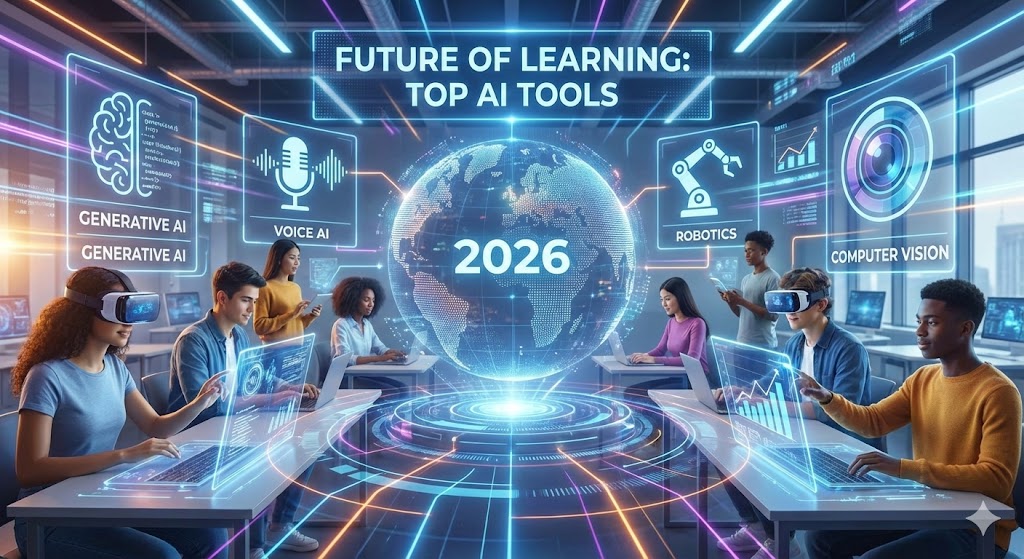
BLOG
Author: Amit Kataria
Posted on: 10 Feb 2026
17 min read**Top 10 AI Tools to Learn in 2026 to Boost Your Career** The AI Shift Is No Longer Coming — It’s Already Here The way we work is being restructured in a way we have never seen before. Automation, machine learning, and generative ai are no longer stuck in research labs and the hands of the tech giants. They have become integrated within everyday workflows. This is evident across industries, including marketing, design, finance, healthcare, HR, software development, and operations. In 2026, among professionals who advance in their [career in artificial intelligence](https://www.madridsoftwaretrainings.com/artificial-intelligence-course-training-in-delhi), the key differentiator will often be the mastery of the right AI tools. The fast-growing and evolving tech field will contribute to the great divergence in the labor market, widening the gap between those who will thrive and those who will struggle. Employers are no longer looking for degrees or years of experience. They are far more interested in role-defining problem-solvers who utilize the most effective AI tools to improve organizational efficiency, save costs, and achieve specific results. This is evident in the growing hiring data. The presence of AI-assisted workflows in a job description is linked to higher compensation and quicker promotion opportunities compared to roles without AI. The question is no longer if AI will affect your career. Instead, the question is: in order to remain relevant in the evolving tech field, which AI tools should you become proficient in? This is the area of great divergence. **Why Learning AI Tools in 2026 Is a Career Imperative?** AI Skills Are Becoming a Baseline, Not a Bonus Employers are moving AI proficiency from ‘preferred skill’ to ‘expected capability’ for candidates. AI tools, both free and paid, in business operations range from content optimization and data analysis to design automation and code generation. Over 68% of surveyed employers in 2025 reported the use of at least three different AI tools across departments. Employees utilizing free AI tools for automation reported a productivity boost of 30-45% over a 6-month period. There are, therefore, clear distinctions in the labor market. - Professionals leveraging AI to optimize productivity. - Professionals stuck in the labor-intensive, manual process. In 2026, only the former will continue to advance. **The Career Risk of Ignoring AI Tools** Stagnation Is the New Obsolescence The greatest danger modern professionals will face, yet most do not recognize, is not complete automation that removes jobs. It is gradual, creeping, attrition of relevance. When professionals utilizing AI complete tasks in half the time, with greater accuracy and more insightful analysis, the workflow of others becomes inefficient. Let us examine this case where both applicants are equally qualified and possess the same level of experience. - One applicant spends time manually analyzing reports, making visuals, and writing reports. - The other applies the latest AI tools to automate, research, stimulate and improve creativity, and increase speed of execution. **How would you expect the outcome of this scenario to play out?** In today’s competitive landscape, candidates are expected to have experience with tools that enable and expedite the decision-making process. This is particularly true for the areas of marketing, analytics, design, engineering, and operations. ai tools free Mastering the use of AI is no longer an adventurous exercise; it is for career survival and progression. **What Makes an AI Tool Worth Learning in 2026** Not All AI Tools Create Career Value The AI tools market is expanding tremendously with hundreds of tools released each year. However, the professional world only responds to a limited number of tools. The tools that will remain highly sought after in 2026 will have a combination of the following: **Workflow Integration –** They fit into existing professional processes **Skill Amplification –** They enhance human judgment, not replace it **Scalability –** They grow in value as responsibilities increase Starting with the free versions of any tool is common, and in the case of AI, this is particularly useful because it allows the user to build confidence and experiment in order to develop the desired basic skills before progressing to other, more sophisticated tools. **Top 10 AI Tools to Learn in 2026** **1. Generative AI Platforms for Knowledge Work** Augmented intelligence platforms help knowledge workers streamline their workflow. These platforms assist with synthesizing research, composing reports, outlining strategies, and planning. They help workers with communications and planning streamline the generational workflow. Knowledge workers who outperform their peers, lead in the depth and speed of their output. **2. AI-Powered Data Analysis Tools** The most current analytics tools can interpret, extract insights, and visualize patterns without the use of advanced coding. They are changing the function of analytics in finance, operations, HR, and marketing. These types of tools influence decreased reliance on specialized analysts and shifts of quicker cycle decisions. **3. AI Design and Creative Tools** Visual communication has always been the domain of designers. Now, everyone can create visually appealing communications with tools like draggan ai. They allow marketers, branders, and product designers to create visual designs and communications with simple commands. **4. AI Video and Audio Production Tools** For the same reasons that visual communication did not belong to designers, so to the same reasons, video communication is the domain of designers. The AI tools in video are in the same domain of assisting with the same kinds of complex activities—putting together the script, shooting the video, and editing the video. draggan ai editing tool **5. AI Coding and Development Assistants** The range of automation scripts, minor tweaks to websites, and logic building in applications provides functionality that even non-programmers appreciate. For programmers, they help minimize time wasted during debugging cycles and improve time to deploy applications. By 2026, it will be commonplace to have assistance from AI in coding applications. **6. AI Productivity and Workflow Automation Tools** These assist in the management of monotonous, repetitive duties. Examples include automated scheduling, sorting of emails, prioritization of tasks, and the documentation of processes. For managers and team leads, these tools help in offloading the burdens that come with managing multifaceted tasks. To be truly efficient, it require the intelligent integration of orchestrated systems, and not simply doing more tasks. **7. AI Marketing and SEO Tools** There is an increasingly large amount of automation taking place in search, content distribution, and optimization of performance. Behavioral forecasting and audience segmentation, along with these predictive tools, have become central to content and placement optimization. Before implementing more scalable strategies, professionals can test many of the tools available to help with SEO and marketing. **8. AI HR and Recruitment Tools** Tools that assist in recruitment and hiring make the initial screening of resumes, assessment of requisite skills, and forecasting of performance outcomes the primary function of the tool. For HR professionals and managers, these tools can provide a more competitive managerial advantage. There is a growing trend to move from hiring based on gut feelings to data-driven decisions. **9. AI Customer Experience Tools** The use of chatbots, sentiment analysis, and predictive support tools improve communication with clients. Customer journey managers improve response time and gain better understanding of user patterns and behaviors. With AI, customer satisfaction improvements become easier. **10. AI Learning and Personal Development Tools** The acquisition of skills has improved with AI. Learning systems that personalize the experience modify content based on the user’s progress, the knowledge gaps, and the user’s goals. draggan ai editing tool Learning is no longer a linear process. It is adaptive, targeted, and driven by AI. **Why Free AI Tools Are a Strategic Starting Point?** Low Risk, High Skill Accumulation AI tools that are free and accessible are a starting point for many users. They are simple to use and have multiple advantages: Experiment without financial commitment Build portfolios demonstrating AI-enhanced work Understand limitations before investing in premium solutions Most users only need the free tools and a little time. Today's leaders mastered the simple free AI tools before moving on to more complex tools. The primary factor is frequency of use and purpose.AI Tools and An Individual’s Career Growth **How AI Tools Directly Translate Into Career Growth?** From Skill Acquisition to Professional Leverage Learning AI tools creates compounding benefits: Tasks are completed faster Output quality improves Strategic thinking replaces manual effort Strategic thinking, in which manual efforts are replaced by thinking through a task, improves. Professionals who demonstrate AI proficiency most often and most easily transition into higher-impact roles because they are trusted with addressing more challenging and complex problems, driving cross-functional initiatives, and spearheading leadership roles. draggan ai editing tool AI literacy and, consequently, a strong correlation to performance outcomes, will be seen more and more in reviews. It achieves this devoid of subjective elements referring to the effort surmised to be an ‘all-in’ contribution. **The Future Belongs to AI-Augmented Professionals** Human Judgment Enhanced by Machine Intelligence AI tools are not replacing creativity, reasoning, or leadership. They are amplifying them. Combining human insight with intelligent systems will help the most successful professionals in 2026 to stand out. Knowing each tool will not guarantee success. Mixing human insight with intelligent systems will. Mastering the best AI tools is not about chasing trends. It is about building endurance and relevance in a volatile job market. **Frequently Asked Questions :-** **Q 1. What are AI tools?** AI tools are software applications that use Artificial Intelligence to perform tasks that normally require human intelligence. These tasks include writing, designing, [data analytics](https://www.madridsoftwaretrainings.com/data-analytics-course-training-in-delhi), customer support, automation, and decision-making. **Q 2. What is AI tools?** AI tools refer to intelligent programs that learn from data and help users work faster, smarter, and more efficiently. They are widely used in business, marketing, education, and technology. **Q 3. What are the AI tools?** Some popular AI tools include: ● ChatGPT – content writing, emails, and problem-solving ● Grammarly – grammar and writing improvement ● Canva AI – graphic design and presentations ● Midjourney – AI image generation ● Jasper AI – marketing copywriting ● Power BI AI – data analysis and insights **Q 4. How to use AI tools?** To use AI tools, follow these basic steps: 1. Choose the right AI tool for your task 2. Create an account on the platform 3. Enter clear instructions or prompts 4. Review and edit the AI-generated output 5. Apply the result to your work Using AI tools properly saves time and improves productivity. **Q 5. Which AI tool can be used for drafting business communication?** The best AI tool for drafting business communication is ChatGPT. It helps in writing: ● Professional emails ● Business proposals ● Reports and presentations ● Client messages Other useful tools include Grammarly (for polishing) and Jasper AI (for marketing communication).
BLOG
Author: Amit Kataria
Posted on: 12 Feb 2026
52 min readThe **data analytics** field is booming in 2026, and professionals who understand the latest trends are landing the best opportunities. This comprehensive guide is designed for aspiring data analysts, current professionals looking to advance their careers, and career changers exploring this high-demand field. You'll discover what skills employers actually want right now and how much you can expect to earn in different roles. We'll break down the hottest career paths and specializations that companies are hiring for, plus give you actionable strategies to stand out in today's competitive job market. Whether you're just starting out or ready to level up, this guide covers everything you need to know about building a successful **data analytics career in 2026**. **Current State of Data Analytics Industry in 2026** **Market growth and expansion trends** The data analytics industry has reached unprecedented heights in 2026, with global market valuation surpassing $350 billion and showing no signs of slowing down. This explosive growth represents a 180% increase from 2021 figures, driven by organizations' urgent need to harness vast amounts of data for competitive advantage. Small and medium enterprises now account for 40% of data analytics spending, a dramatic shift from previous years when large corporations dominated the market. This democratization happened because cloud-based analytics tools became more affordable and user-friendly, allowing smaller companies to compete on data-driven insights. The real estate and healthcare sectors lead expansion efforts, each investing over $45 billion annually in analytics infrastructure. Real estate companies use predictive analytics for market timing and property valuations, while healthcare organizations leverage data for personalized treatment plans and operational efficiency. Subscription-based analytics services experienced 250% growth, replacing traditional one-time software purchases. Companies prefer paying monthly fees for continuously updated tools rather than making large upfront investments in software that quickly becomes outdated. **Industry demand across sectors** Financial services continues dominating data analytics hiring, representing 28% of all new positions. Banks and fintech companies desperately need professionals who can detect fraud patterns, assess credit risks, and optimize trading algorithms in real-time. Retail and e-commerce follow closely with 23% of new roles, focusing heavily on customer behavior analysis and supply chain optimization. Companies like Amazon and Walmart doubled their analytics teams to better predict inventory needs and personalize shopping experiences. Manufacturing jumped to 18% of demand, up from just 8% in 2020. Smart factories generate massive data streams from IoT sensors, requiring analysts who can optimize production lines and predict equipment failures before they happen. Government agencies increased their analytics hiring by 300% as smart city initiatives expanded nationwide. These roles focus on traffic optimization, energy management, and public safety through data-driven decision making. **Technology advancements driving change** Artificial intelligence integration transformed how data analysts work daily. AutoML platforms now handle routine data cleaning and basic modeling, freeing analysts to focus on strategic interpretation and business recommendations. These tools reduced project timelines from weeks to days. Real-time analytics became the standard expectation rather than a luxury feature. Edge computing allows data processing at the source, enabling instant insights for time-sensitive decisions. Retail stores adjust pricing dynamically based on foot traffic patterns, while manufacturing plants modify production schedules based on real-time quality metrics. Natural language processing reached maturity, allowing business users to query databases using plain English. Executives can now ask "What drove our sales increase last quarter?" and receive comprehensive visual reports without involving technical teams. Quantum computing partnerships with major cloud providers introduced new possibilities for complex optimization problems. While still experimental, early adopters in logistics and pharmaceutical research report breakthrough results in route optimization and drug discovery timelines. Data mesh architecture replaced centralized data warehouses at forward-thinking companies. This decentralized approach gives individual business units control over their data while maintaining organization-wide standards and governance. **Remote work opportunities impact** Remote work fundamentally changed data analytics careers, with 85% of positions now offering full remote or hybrid options. This shift opened global talent pools, allowing companies in expensive cities to hire skilled analysts from anywhere worldwide. Collaboration tools evolved specifically for data teams, featuring shared notebooks, real-time code editing, and integrated video chat for discussing complex analyses. These platforms eliminated the productivity concerns that initially made managers hesitant about remote data work. Time zone advantages became strategic assets. Companies deliberately hire analysts across different continents to provide round-the-clock data monitoring and support. A financial firm might have morning analysts in Asia, afternoon teams in Europe, and evening coverage in the Americas. Remote work also sparked the rise of freelance data analytics, with platforms connecting businesses to specialized experts for project-based work. Many senior analysts now earn higher incomes working independently than they did in traditional corporate roles. Training and mentorship adapted to virtual environments through interactive online labs and virtual reality data visualization spaces. New graduates can now access top-tier mentors regardless of geographic location, accelerating their skill development and career progression. **Essential Technical Skills for Data Analytics Success** **Programming Languages Mastery Requirements** Python dominates the data analytics landscape in 2026, serving as the primary language for most analytics workflows. You'll need solid proficiency in core Python libraries including pandas for data manipulation, NumPy for numerical computing, and matplotlib/seaborn for basic visualizations. Beyond the basics, advanced Python skills like working with APIs, web scraping using BeautifulSoup or Scrapy, and understanding object-oriented programming principles will set you apart from entry-level candidates. R remains essential for statistical analysis and academic research environments. While Python handles most general analytics tasks, R excels in specialized statistical modeling and offers unmatched capabilities for complex statistical procedures. Mastering ggplot2 for advanced visualizations and dplyr for data transformation gives you significant advantages in research-heavy roles. SQL stands as the universal language for database operations. Modern data analysts work with massive datasets stored across various database systems, making SQL proficiency absolutely critical. You should be comfortable with complex joins, window functions, common table expressions (CTEs), and performance optimization techniques. JavaScript has emerged as surprisingly valuable for analysts working with web-based dashboards and interactive visualizations. D3.js knowledge opens doors to creating custom, interactive data presentations that static charts simply can't match. **Database Management and SQL Expertise** Database skills extend far beyond basic SELECT statements. Modern analytics roles require deep understanding of database architecture, indexing strategies, and query optimization. You'll regularly work with both relational databases (PostgreSQL, MySQL, SQL Server) and NoSQL systems (MongoDB, Cassandra) depending on your organization's data infrastructure. Cloud database platforms have become standard practice. Amazon RDS, Google BigQuery, and Azure SQL Database each have unique features and optimization strategies. Understanding how to leverage cloud-specific capabilities like BigQuery's column-based storage or Redshift's distribution keys can dramatically improve query performance and reduce costs. Data warehousing concepts are equally important. Modern analytics often involves pulling data from multiple sources into centralized repositories. Knowledge of ETL (Extract, Transform, Load) processes, data modeling techniques, and dimensional modeling helps you design efficient data pipelines and storage solutions. **Statistical Analysis and Modeling Capabilities** Statistical literacy forms the foundation of credible data analysis. You need strong command of descriptive statistics, probability distributions, hypothesis testing, and confidence intervals. These concepts aren't just academic exercises – they're essential for making valid inferences from your data and avoiding common analytical pitfalls. Regression analysis skills are particularly valuable. Linear regression, logistic regression, and more advanced techniques like ridge and lasso regression help you understand relationships between variables and build predictive models. Understanding when to use each technique and how to interpret results correctly separates skilled analysts from those who simply run code. Time series analysis has become increasingly important as businesses focus on forecasting and trend analysis. Skills in seasonal decomposition, ARIMA modeling, and modern techniques like Prophet for forecasting give you powerful tools for analyzing temporal patterns in business data. Experimental design and A/B testing methodology are crucial for analysts working in product and marketing teams. You'll need to understand sample size calculations, randomization strategies, multiple testing corrections, and how to design experiments that produce actionable insights. **Data Visualization Tools Proficiency** Tableau and Power BI dominate the enterprise visualization landscape. These tools require more than just drag-and-drop familiarity. Advanced users understand calculated fields, parameter controls, dashboard design principles, and how to optimize performance with large datasets. Creating compelling narratives through data storytelling separates good analysts from great ones. Python visualization libraries offer programming-based alternatives. Plotly creates interactive visualizations perfect for web deployment, while matplotlib and seaborn provide fine-grained control over statistical plots. Understanding when to use programmatic versus point-and-click tools depends on your audience and use case. Specialized visualization tools serve niche purposes. D3.js enables completely custom interactive visualizations for web applications. QlikView and Looker offer unique approaches to self-service analytics. Geographic visualization tools like QGIS or specialized mapping libraries become essential for location-based analysis. Dashboard design principles matter as much as technical skills. Understanding color theory, cognitive load, and user experience design helps you create visualizations that actually get used. The best technical visualization means nothing if stakeholders can't quickly understand and act on your insights. **Critical Soft Skills That Set You Apart** **Business Acumen and Strategic Thinking** Data analysts who truly stand out possess a deep understanding of how businesses operate and make strategic decisions. This goes far beyond knowing which metrics to track—you need to understand why those metrics matter and how they connect to broader business objectives. Strong business acumen means understanding your organization's revenue models, competitive landscape, and operational challenges. When you analyze customer churn rates, you should immediately connect that data to potential revenue loss, customer acquisition costs, and the resources needed for retention campaigns. This strategic perspective transforms you from someone who simply reports numbers into a valuable business advisor. The most successful data professionals think like mini-CEOs. They consider market dynamics, regulatory changes, and industry trends when presenting their findings. If you're analyzing sales data and notice a seasonal dip, business-savvy analysts will proactively research industry reports, competitor activities, and economic indicators to provide context that helps leadership make informed decisions. Strategic thinking also involves understanding resource allocation and prioritization. When you present multiple insights from your analysis, you should be able to recommend which initiatives deserve immediate attention based on potential impact, implementation complexity, and available resources. **Communication and Storytelling Abilities** Technical excellence means nothing if you can't communicate your findings effectively. The best data analysts are exceptional storytellers who can transform complex datasets into compelling narratives that drive action. Your audience doesn't care about your sophisticated algorithms or the hours you spent cleaning data. They want to understand what the data means for their specific challenges and opportunities. This requires adapting your communication style based on your audience—executives need high-level insights with clear business implications, while operational teams need detailed, actionable recommendations. Effective data storytelling involves creating a logical flow that guides your audience through the problem, your methodology, key findings, and recommended actions. You should master the art of data visualization, choosing charts and graphs that enhance understanding rather than confuse. A well-designed dashboard tells a story at a glance, while poorly chosen visualizations can mislead or overwhelm decision-makers. Building trust through communication is equally important. Be transparent about data limitations, confidence intervals, and potential biases in your analysis. Acknowledge when results are inconclusive or when additional data collection might be necessary. This honesty builds credibility and helps stakeholders make informed decisions. **Problem-Solving and Critical Analysis** Data analytics is fundamentally about solving business problems, and the most valuable analysts approach challenges with structured, critical thinking. This means looking beyond surface-level patterns to understand root causes and potential solutions. Critical analysis starts with asking the right questions. Instead of simply describing what happened, dig into why it happened and what it means for the future. If customer satisfaction scores dropped last quarter, explore potential correlations with product changes, service modifications, seasonal factors, or external market conditions. Strong problem-solving skills also involve hypothesis formation and testing. Develop multiple potential explanations for observed patterns, then systematically test each hypothesis with available data. This scientific approach prevents jumping to conclusions and ensures your recommendations are based on solid evidence. Creative problem-solving often involves combining datasets in innovative ways or applying analytical techniques from other industries. The most successful analysts stay curious about new methodologies and aren't afraid to experiment with unconventional approaches when traditional methods fall short. **Project Management Capabilities** Data analytics projects rarely exist in isolation—they require coordination with multiple stakeholders, adherence to timelines, and careful resource management. Strong project management skills separate good analysts from great ones. Effective project scoping is essential. Work with stakeholders to clearly define project objectives, success metrics, data requirements, and deliverables. Poorly scoped projects often expand beyond their original parameters, leading to missed deadlines and frustrated stakeholders. Time management becomes critical when working with multiple concurrent projects. You need to balance deep analytical work with stakeholder communications, data collection, and iterative refinements. Breaking large projects into manageable phases with clear milestones helps maintain momentum and provides opportunities for course correction. Risk management is often overlooked but extremely important. Identify potential obstacles early—missing data, changing business priorities, or technical limitations—and develop contingency plans. Regular communication with stakeholders about project progress, challenges, and timeline adjustments builds trust and prevents last-minute surprises. Collaboration skills are essential since data projects typically involve IT teams, business users, and executive sponsors. You need to coordinate data access, manage expectations, and ensure all parties understand their roles and responsibilities throughout the project lifecycle. **Career Paths and Specialization Options** **Entry-Level Analyst Positions** The data analytics field offers multiple entry points, each with distinct requirements and growth trajectories. Junior Data Analyst roles typically demand proficiency in SQL, Excel, and basic visualization tools like Tableau or Power BI. These positions focus on data cleaning, report generation, and supporting senior team members with routine analysis tasks. Expected starting salaries range from $55,000 to $75,000, depending on location and industry. Research Analyst positions provide another gateway, emphasizing market research methodologies and statistical interpretation. Companies across industries seek candidates who can transform raw data into actionable insights for decision-making. Business Analyst roles bridge technical skills with business acumen, requiring candidates to understand both data manipulation and organizational processes. Marketing Analysts represent a specialized entry path, focusing on customer behavior, campaign performance, and digital marketing metrics. These roles often require familiarity with Google Analytics, social media analytics platforms, and A/B testing methodologies. The e-commerce boom has created numerous opportunities in this specialization. Financial Analyst positions with a data focus offer another entry route, particularly attractive for those with finance backgrounds. These roles involve financial modeling, risk analysis, and performance metrics evaluation, typically offering higher starting salaries due to the specialized nature of financial services. **Senior Data Scientist Roles** Senior Data Scientist positions represent the pinnacle of technical expertise in analytics, requiring advanced programming skills in Python or R, machine learning expertise, and deep statistical knowledge. These professionals design and implement complex algorithms, lead analytical projects, and mentor junior team members. Compensation packages typically range from $130,000 to $200,000, with additional equity components in tech companies. Machine Learning Engineers focus specifically on deploying and maintaining ML models in production environments. This role requires expertise in cloud platforms like AWS or Azure, containerization technologies, and MLOps practices. The demand for these specialists has skyrocketed as companies scale their AI initiatives. Lead Data Scientists combine technical prowess with project management skills, overseeing analytical teams and strategic initiatives. These roles often require presenting findings to C-level executives and translating complex technical concepts into business language. Industry experience becomes increasingly valuable at this level. Research Scientists in corporate settings push the boundaries of analytical methodologies, often publishing papers and representing companies at conferences. These positions typically require advanced degrees and demonstrated research experience, with compensation reflecting the specialized nature of the work. **Business Intelligence Specialist Tracks** BI Developers focus on creating and maintaining data warehouses, ETL processes, and reporting infrastructure. These professionals work with tools like Microsoft Power BI, Tableau, QlikView, and various database management systems. The role requires strong SQL skills and understanding of data architecture principles. Starting salaries typically range from $70,000 to $95,000. BI Analysts concentrate on interpreting business metrics and creating dashboards that drive organizational decisions. They work closely with stakeholders across departments to identify key performance indicators and develop meaningful reporting solutions. These roles often serve as stepping stones to senior analyst or management positions. Data Visualization Specialists represent an emerging specialization focused entirely on transforming complex data into compelling visual narratives. These professionals combine analytical skills with design principles, working with advanced visualization tools and custom development frameworks. BI Architects design enterprise-wide data strategies and oversee large-scale implementation projects. These senior-level positions require extensive experience with multiple BI platforms and deep understanding of organizational data needs. Compensation packages often exceed $120,000 for experienced professionals. **Data Engineering Career Progression** Data Engineers build and maintain the infrastructure that enables data analysis, focusing on data pipelines, database optimization, and system architecture. Entry-level positions require programming skills in Python, Java, or Scala, along with database management expertise. Starting salaries typically range from $85,000 to $110,000. Senior Data Engineers lead infrastructure projects and mentor junior team members while working with big data technologies like Hadoop, Spark, and Kafka. These roles require expertise in cloud platforms and distributed computing concepts. Compensation often reaches $140,000 to $180,000 for experienced professionals. Data Platform Engineers specialize in building scalable data platforms that serve entire organizations. This role combines traditional data engineering with DevOps practices and requires expertise in containerization, orchestration tools, and cloud-native architectures. Principal Data Engineers represent the technical leadership tier, making architectural decisions and guiding organizational data strategy. These positions require extensive experience and often involve cross-functional collaboration with product and engineering teams. **Salary Expectations and Compensation Trends** **Entry-level salary ranges by region** Entry-level data analysts can expect significant variations in compensation depending on geographic location. In major tech hubs like San Francisco and Seattle, starting salaries typically range from $85,000 to $110,000 annually, reflecting the high cost of living and intense competition for talent. New York City follows closely with ranges of $75,000 to $95,000, while Austin and Denver offer competitive packages between $70,000 and $85,000. Mid-tier markets present attractive opportunities with better cost-of-living ratios. Cities like Atlanta, Phoenix, and Charlotte offer entry-level positions ranging from $60,000 to $75,000, while smaller metropolitan areas typically start between $50,000 and $65,000. Remote positions have changed the game significantly, with many companies now offering location-adjusted salaries that split the difference between high-cost and low-cost areas. Companies are also sweetening entry-level packages with signing bonuses ranging from $5,000 to $15,000, stock options, and comprehensive benefits that can add 20-30% to the total compensation value. **Mid-career earning potential** Data analysts with 3-7 years of experience see substantial salary growth as they develop specialized skills and industry expertise. The jump from entry-level to mid-career often represents a 40-60% increase in base salary, with total compensation packages becoming more complex and lucrative. In major markets, mid-career data analysts command salaries between $95,000 and $135,000, while those who've specialized in high-demand areas like machine learning, financial modeling, or healthcare analytics can push into the $120,000 to $150,000 range. The emergence of "senior data analyst" and "lead data analyst" roles has created clear progression paths with corresponding pay bumps. Stock compensation becomes more significant at this level, especially in publicly traded companies. Many mid-career professionals report that equity grants add $15,000 to $40,000 annually to their total compensation. Performance bonuses also increase, typically ranging from 10-20% of base salary for strong performers. Geographic arbitrage remains strong for remote workers. A mid-career analyst living in a lower-cost area while working for a Bay Area company can achieve exceptional purchasing power. Many professionals are strategically relocating to cities like Nashville, Raleigh, or Salt Lake City to maximize this advantage. Senior-level compensation packages Senior data analysts and those transitioning into management or specialized technical roles see compensation packages that extend well beyond base salary. Total compensation for senior professionals typically ranges from $140,000 to $220,000 in major markets, with exceptional performers and those at top-tier companies reaching $250,000 or higher. Base salaries for senior roles generally fall between $120,000 and $180,000, but the real value lies in variable compensation. Stock grants can add $30,000 to $80,000 annually, while performance bonuses often reach 20-35% of base salary. Companies are also offering retention bonuses, sabbatical programs, and executive-level benefits like company cars or housing allowances. Leadership roles in data analytics, such as Analytics Manager or Director of Data Science, command even higher premiums. These positions often include equity participation that can significantly multiply total compensation during successful company events or IPOs. **Freelance and consulting rates** The freelance data analytics market has exploded, with experienced practitioners commanding impressive hourly rates. Entry-level freelancers typically charge $40-65 per hour, while experienced analysts with strong portfolios command $75-120 per hour. Specialized consultants focusing on specific industries or advanced techniques can charge $125-200+ per hour. Project-based pricing has become increasingly popular, with small engagements ranging from $2,000 to $15,000 and larger transformational projects reaching $50,000 to $200,000. Many consultants are building recurring revenue through retainer agreements, typically charging $3,000 to $12,000 monthly for ongoing analytics support. The key to premium rates lies in developing niche expertise, building a strong portfolio of case studies, and establishing thought leadership through content creation and speaking engagements. Many successful freelancers report earning 1.5-2x their previous corporate salaries while enjoying greater flexibility and diverse project exposure. **Job Market Opportunities and Hiring Trends** **High-demand industries for analysts** Healthcare continues to dominate the data analytics hiring landscape in 2026, with hospitals, pharmaceutical companies, and health tech startups desperately seeking professionals who can interpret patient data, optimize treatment protocols, and navigate regulatory compliance. The explosion of telemedicine and wearable health devices has created an unprecedented need for analysts who understand both medical terminology and data science fundamentals. Financial services maintains its position as a top employer, but the focus has shifted dramatically. Traditional banks now compete with fintech unicorns and cryptocurrency platforms, all requiring analysts to detect fraud patterns, assess risk models, and personalize customer experiences. Investment firms are particularly hungry for professionals who can analyze alternative data sources like satellite imagery and social media sentiment. Retail and e-commerce companies have become sophisticated data powerhouses. Amazon, Walmart, and thousands of direct-to-consumer brands need analysts to optimize supply chains, predict seasonal trends, and create hyper-personalized shopping experiences. The integration of AI-powered recommendation engines means analysts must understand both customer behavior and machine learning outputs. Technology companies remain consistent heavy hitters, but the landscape has expanded beyond traditional software firms. Gaming companies analyze player behavior to increase engagement and monetization. Streaming services like Netflix and Spotify require analysts to understand content consumption patterns and predict hit shows or songs. Social media platforms need professionals who can balance user engagement with content moderation and advertising effectiveness. **Geographic hotspots for opportunities** Silicon Valley still commands premium salaries, but the cost-of-living equation has pushed many companies and professionals toward alternative tech hubs. Austin continues its meteoric rise, with Oracle, Tesla, and hundreds of startups offering competitive packages without California's housing costs. The city's "no state income tax" advantage translates to significant take-home pay increases. Seattle's data analytics market thrives beyond Amazon and Microsoft. The city hosts a robust ecosystem of smaller tech companies, healthcare organizations like Fred Hutchinson Cancer Center, and logistics companies that leverage the region's shipping infrastructure. Remote work policies have made Seattle-based positions accessible to professionals nationwide. New York City remains the undisputed leader for financial services analytics roles. Wall Street firms, hedge funds, and fintech companies like Stripe and Square offer some of the industry's highest compensation packages. The city's diverse economy also provides opportunities in media, advertising, and real estate analytics. Remote work has fundamentally changed the geographic equation. Companies like GitLab, Automattic, and dozens of analytics-focused startups hire globally, allowing professionals to access Silicon Valley salaries while living in lower-cost areas. This trend has created new opportunities in unexpected locations like Boise, Nashville, and Miami. International opportunities have expanded significantly. London remains Europe's analytics capital, while Singapore dominates the Asia-Pacific region. Dubai has emerged as a surprising hotspot for professionals willing to relocate, offering tax advantages and exposure to rapidly growing Middle Eastern markets. **Company size preferences and benefits** Large corporations offer stability and comprehensive benefits packages that smaller companies struggle to match. Fortune 500 companies typically provide robust health insurance, retirement matching programs, and professional development budgets exceeding $5,000 annually. These organizations also offer clear career progression paths and the opportunity to work with massive, complex datasets that provide valuable learning experiences. Mid-size companies (500-5,000 employees) often provide the sweet spot for many data professionals. They offer more responsibility and visibility than large corporations while maintaining better work-life balance than aggressive startups. These companies frequently allow analysts to wear multiple hats, developing skills across different business functions. Startups present unique advantages for ambitious professionals willing to accept higher risk. Equity compensation can result in life-changing payouts if the company succeeds. Early employees often receive significant stock grants that vest over four years, potentially worth hundreds of thousands of dollars. The learning curve at startups is typically steep, with analysts gaining experience equivalent to several years at larger companies. Benefits packages have evolved beyond traditional offerings. Many companies now provide mental health stipends, home office allowances, and unlimited vacation policies. Tech companies increasingly offer sabbatical programs and professional conference budgets to help employees stay current with rapidly evolving tools and techniques. **Contract versus full-time positions** Contract positions have gained significant momentum, particularly among experienced professionals seeking flexibility and higher hourly rates. Specialized analytics consultants can command $75-150 per hour, often exceeding full-time equivalent salaries when accounting for the premium rates. Contract work allows professionals to diversify their experience across multiple industries and build extensive professional networks. Full-time positions provide security and benefits that many professionals prefer. Health insurance, retirement contributions, and paid time off create significant value beyond base salaries. Full-time employees also receive priority for internal promotions and advanced training opportunities that contract workers may not access. The gig economy has created hybrid opportunities that didn't exist five years ago. Platforms like Upwork and Toptal connect analytics professionals with short-term projects ranging from one week to six months. These arrangements allow professionals to test different companies and industries before committing to full-time roles. Companies increasingly offer "contract-to-hire" arrangements that benefit both parties. These positions start as 3-6 month contracts with the option to convert to permanent roles. This approach allows companies to evaluate cultural fit and performance before making long-term commitments, while giving professionals the opportunity to assess company culture and growth opportunities. **Building Your Competitive Edge in 2026** **Portfolio Development Strategies** Creating a standout portfolio requires more than just showcasing your technical abilities. The most compelling portfolios tell a story about your problem-solving approach and business impact. Start by selecting 3-5 diverse projects that demonstrate different aspects of your skill set—predictive modeling, data visualization, business intelligence, and machine learning applications. Document your entire process, not just the final results. Walk viewers through your data collection methods, cleaning procedures, analytical decisions, and how you validated your findings. Include the business context and explain why your analysis mattered to stakeholders. This storytelling approach separates junior analysts from strategic thinkers. Interactive dashboards and visualizations create immediate engagement. Use tools like Tableau, Power BI, or Streamlit to build dynamic presentations of your work. GitHub repositories with clean, well-commented code demonstrate your technical proficiency and collaborative capabilities. Deploy at least one end-to-end project on cloud platforms like AWS, Azure, or Google Cloud to show real-world deployment skills. Don't forget the power of visual presentation. Create case studies with clear before-and-after scenarios, highlighting measurable business outcomes. Include testimonials or feedback from colleagues when possible. Your portfolio should answer three key questions: What problem did you solve? How did you solve it? What impact did your solution create? **Certification Programs Worth Pursuing** The certification landscape has evolved significantly, with employers now prioritizing practical skills over paper credentials. Focus on certifications that combine theoretical knowledge with hands-on application and industry recognition. Cloud certifications carry the most weight in 2026, as organizations continue migrating to cloud-based analytics platforms. The AWS Certified Data Analytics and Microsoft Azure Data Scientist certifications are particularly valuable, often correlating with salary increases of 15-25%. Programming certifications from respected platforms like DataCamp, Coursera, or edX provide structured learning paths with portfolio projects. The key is choosing programs that offer capstone projects you can showcase to employers. Avoid certification mills that focus purely on test-taking without practical application. Industry-specific certifications can set you apart in niche markets. Financial services professionals benefit from CFA Institute's Certificate in Investment Performance Measurement, while marketing analysts should consider Google Analytics and Adobe certifications. Healthcare analytics roles often require understanding of HIPAA compliance and electronic health records systems. **Networking and Professional Connections** Building meaningful professional relationships requires authentic engagement rather than transactional networking. Start by joining data science communities on platforms like Kaggle, Reddit's r/analytics, and Discord servers focused on data professionals. Participate in discussions, share insights, and help solve problems for others. Local meetups and conferences provide face-to-face networking opportunities. Organizations like Data Science DC, Women in Analytics, and industry-specific groups offer regular events where you can connect with peers and potential mentors. Virtual conferences have made industry leaders more accessible—take advantage of Q&A sessions and virtual networking rooms. LinkedIn remains the primary professional networking platform, but your approach needs refinement. Share original content about your projects, comment thoughtfully on industry posts, and reach out to professionals with specific questions rather than generic connection requests. Mentorship relationships often develop naturally from these interactions. Consider starting a data analytics blog or newsletter to establish thought leadership. Writing about industry trends, tool comparisons, or project experiences attracts like-minded professionals and potential employers. Guest posting on established platforms expands your reach and credibility within the community. **Continuous Learning Pathways** The data analytics field evolves rapidly, making continuous learning essential for career longevity. Create a structured approach to staying current with new tools, techniques, and industry developments. Subscribe to key industry publications and blogs: Harvard Business Review's data articles, Towards Data Science on Medium, and KDnuggets provide regular insights into emerging trends. Podcasts like "Data Skeptic" and "Linear Digressions" offer convenient learning during commutes or workouts. Hands-on experimentation drives deeper learning than passive consumption. Dedicate time each week to exploring new datasets, testing emerging tools, or reimplementing published research papers. Platforms like Kaggle Learn offer free micro-courses on cutting-edge topics, while university MOOCs provide more comprehensive coverage of advanced subjects. Join online communities focused on specific tools or techniques. Stack Overflow remains invaluable for troubleshooting, while specialized forums like Cross Validated for statistics or GitHub discussions for open-source projects provide targeted expertise. Contributing to these communities reinforces your own learning while building your professional reputation. Create learning goals aligned with your career trajectory. If you're targeting senior roles, focus on business strategy and leadership skills alongside technical advancement. Those pursuing specialized positions should deep-dive into domain-specific knowledge—financial modeling for fintech roles, A/B testing frameworks for growth positions, or natural language processing for content analysis roles. The data analytics field in 2026 offers incredible opportunities for those ready to adapt and grow. Technical skills like Python, SQL, and machine learning remain essential, but don't overlook the power of soft skills – communication, critical thinking, and business acumen often make the difference between good and great analysts. With salaries reaching new heights and companies desperate for skilled professionals, the job market strongly favors candidates who can blend technical expertise with real-world problem-solving abilities. Your success in this field depends on staying curious and committed to continuous learning. Whether you’re aiming for data science, business intelligence, or niche roles like healthcare analytics, the [Data Analytics Offline Course in Delhi](https://www.madridsoftwaretrainings.com/data-analytics-course-training-in-delhi) by [Madrid Software](https://www.madridsoftwaretrainings.com) helps you build a strong technical foundation along with the ability to tell powerful stories using data. Work on real-world projects, contribute to open-source initiatives, and keep asking, “What is this data really telling us?” In 2026, companies are hiring analysts who can transform numbers into actionable insights—and Madrid Software prepares you to deliver real business value.

BLOG
Author: Amit Kataria
Posted on: 18 Feb 2026
35 min readData science professionals and career switchers face a rapidly changing landscape that demands staying ahead of emerging trends. The field continues to evolve at breakneck speed, with new technologies and opportunities reshaping how companies approach data-driven decision making. This guide targets data scientists, tech professionals considering a career change, and recent graduates planning their next move. You'll discover how Madrid Software positions you at the forefront of industry developments. We'll explore the groundbreaking AI and machine learning innovations that will define 2026, from advanced neural networks to automated data processing systems. You'll also learn about the essential technical skills every data scientist needs to master, including cloud computing platforms and specialized programming languages. Finally, we'll examine the emerging industry applications creating new career paths, from healthcare analytics to sustainable technology solutions. The data science job market shows no signs of slowing down, making this the perfect time to invest in future-proof skills. **Revolutionary AI and Machine Learning Innovations Shaping 2026** **Advanced Generative AI Models Transforming Business Operations** Generative AI models are experiencing a dramatic evolution that will reshape how businesses operate by 2026. The next generation of large language models will demonstrate unprecedented multimodal capabilities, seamlessly integrating text, images, audio, and video processing into unified systems. Companies are already witnessing how these advanced models can generate complex business reports, create marketing content, and even develop entire software applications through natural language prompts. The real game-changer lies in domain-specific generative AI models tailored for particular industries. Healthcare organizations will leverage specialized models that understand medical terminology and regulatory requirements, while financial institutions will deploy AI systems trained on market data and compliance frameworks. These targeted models deliver accuracy rates significantly higher than general-purpose alternatives, making them indispensable for mission-critical applications. Business process automation will reach new heights through generative AI's ability to understand context and nuance. Customer service departments will employ AI agents capable of handling complex inquiries with human-like empathy and problem-solving skills. Sales teams will benefit from AI-powered proposal generation that adapts to client preferences and industry standards. Marketing departments will create personalized content at scale, with AI systems that understand brand voice and customer demographics to produce compelling campaigns that resonate with target audiences. **AutoML Platforms Democratizing Data Science Access** AutoML platforms are breaking down traditional barriers that have kept data science accessible only to highly technical professionals. By 2026, these platforms will feature intuitive drag-and-drop interfaces that allow business analysts and domain experts to build sophisticated machine learning models without writing a single line of code. This democratization is creating a new class of citizen data scientists who can extract valuable insights from their organizations' data. The latest AutoML platforms incorporate advanced feature engineering capabilities that automatically identify patterns and relationships in raw data. These systems can handle messy, real-world datasets and perform complex transformations that previously required extensive manual preprocessing. Automated hyperparameter tuning and model selection ensure that non-experts can achieve performance levels comparable to models built by experienced data scientists. Cloud-based AutoML services are making powerful computing resources accessible to organizations of all sizes. Small businesses can now leverage the same machine learning capabilities that were once exclusive to tech giants. These platforms offer pay-as-you-use pricing models, eliminating the need for expensive infrastructure investments. The integration with popular business intelligence tools creates seamless workflows where insights flow directly into decision-making processes. **Quantum Machine Learning Opening New Computational Possibilities** Quantum machine learning represents a paradigm shift that will unlock computational possibilities previously thought impossible. By 2026, quantum computers will demonstrate quantum advantage in specific machine learning tasks, particularly those involving optimization problems and pattern recognition in high-dimensional spaces. This breakthrough will enable data scientists to tackle complex problems that classical computers struggle with, such as drug discovery simulations and financial risk modeling. Hybrid quantum-classical algorithms are emerging as the most practical approach for near-term applications. These systems leverage quantum processors for specific computational bottlenecks while using classical computers for the remaining tasks. Data scientists will need to understand how to partition problems effectively between quantum and classical components, creating new opportunities for professionals who master these hybrid approaches. The quantum machine learning ecosystem is rapidly developing, with cloud-based quantum computing services making these technologies accessible to data scientists worldwide. Major tech companies are providing quantum development frameworks and simulators that allow practitioners to experiment with quantum algorithms before running them on actual quantum hardware. This accessibility is fostering innovation and preparing the workforce for a future where quantum-enhanced machine learning becomes mainstream. Training datasets for quantum machine learning require new preprocessing techniques that account for quantum properties like superposition and entanglement. Data scientists will develop expertise in quantum feature encoding methods that can represent classical data in quantum states efficiently. This specialization will create high-demand career paths for professionals who bridge the gap between quantum physics and practical machine learning applications. **Essential Technical Skills Every Data Scientist Must Master** **Advanced Python Libraries and Frameworks for Enhanced Productivity** Python continues to dominate the data science landscape, but the specific libraries and frameworks that separate elite practitioners from beginners are evolving rapidly. Beyond the standard pandas and scikit-learn stack, data scientists must master specialized tools like Polars for lightning-fast dataframe operations, which can outperform pandas by orders of magnitude on large datasets. The Hugging Face ecosystem has become non-negotiable for anyone working with natural language processing or computer vision. Transformers, Datasets, and Accelerate libraries provide seamless access to state-of-the-art models while handling the complexity of distributed training and inference. JAX represents a paradigm shift for numerical computing, offering automatic differentiation and XLA compilation that makes NumPy code run blazingly fast on GPUs and TPUs. Data scientists who embrace JAX can prototype algorithms that scale from research to production without rewrites. Streamlit and Gradio have revolutionized how data scientists share their work. Building interactive dashboards and model demos no longer requires web development expertise. These frameworks bridge the gap between technical analysis and stakeholder communication, making your insights immediately actionable. **Cloud-Native Data Engineering and MLOps Expertise** The days of running everything on local machines are over. Cloud platforms have become the backbone of modern data science, and fluency across AWS, Google Cloud, and Azure is no longer optional. Each platform offers unique advantages: AWS SageMaker for comprehensive ML lifecycle management, Google BigQuery for massive-scale analytics, and Azure's seamless integration with Microsoft's enterprise ecosystem. Containerization with Docker and orchestration with Kubernetes have transformed how data science workloads are deployed and scaled. Understanding how to package your models and experiments into containers means your work can run consistently across development, staging, and production environments. MLOps tools like MLflow, Weights & Biases, and Kubeflow have matured into production-ready platforms. These tools handle experiment tracking, model versioning, and automated deployment pipelines. Data scientists who can set up end-to-end ML pipelines become force multipliers for their teams. Infrastructure as Code using Terraform or CloudFormation allows data scientists to provision and manage cloud resources programmatically. This skill transforms you from someone who uses infrastructure to someone who creates and optimizes it. **Real-Time Analytics and Stream Processing Capabilities** Batch processing is giving way to real-time analytics as businesses demand immediate insights from their data streams. Apache Kafka has become the de facto standard for handling high-throughput data streams, and data scientists must understand how to consume, transform, and analyze data as it flows through these systems. Stream processing frameworks like Apache Flink and Spark Streaming enable complex analytics on data in motion. Whether you're detecting fraud in financial transactions or personalizing content recommendations in real-time, these tools process millions of events per second with millisecond latency. Event-driven architectures are reshaping how data systems communicate. Understanding how to design systems that react to data changes rather than polling for updates creates more responsive and efficient applications. Time-series databases like InfluxDB and TimescaleDB specialize in storing and querying temporal data. As IoT devices and monitoring systems generate massive time-series datasets, knowing how to work with these specialized databases becomes increasingly valuable. **Ethical AI Development and Bias Mitigation Techniques** Building fair and responsible AI systems requires technical skills that go beyond model accuracy. Bias detection and mitigation have evolved from academic concepts to practical requirements backed by regulations and business policies. Fairness metrics like demographic parity, equalized odds, and calibration must be measured throughout the ML pipeline. Libraries like Fairlearn, AIF360, and What-If Tool provide implementations of these metrics along with bias mitigation algorithms that can be integrated into existing workflows. Explainable AI techniques using SHAP, LIME, and integrated gradients help data scientists understand not just what their models predict, but why. These interpretability methods are crucial for building trust with stakeholders and meeting regulatory requirements in industries like healthcare and finance. Differential privacy provides mathematical guarantees about individual privacy in datasets. As privacy regulations tighten globally, data scientists who can implement privacy-preserving analytics techniques will be in high demand. Model governance frameworks track the lineage of training data, model versions, and deployment decisions. This audit trail becomes essential when models make decisions that affect people's lives, from loan approvals to medical diagnoses. Human-in-the-loop systems recognize that many AI applications work best when combining automated insights with human judgment. Designing these hybrid systems requires understanding both the technical capabilities of ML models and the cognitive strengths of human operators. **Emerging Industry Applications Creating Lucrative Career Opportunities** **Healthcare Analytics and Personalized Medicine Solutions** The healthcare industry is experiencing a massive shift toward data-driven decision making, creating unprecedented opportunities for data scientists. Personalized medicine represents one of the most promising frontiers, where professionals analyze genetic data, patient histories, and real-time biometrics to develop customized treatment plans. Companies are paying premium salaries for data scientists who can build models that predict drug responses, identify optimal dosages, and forecast treatment outcomes. Wearable technology has opened another goldmine for healthcare data science. Smart devices continuously collect heart rate, sleep patterns, activity levels, and other vital signs, generating massive datasets that need sophisticated analysis. Data scientists working in this space develop algorithms that can detect early signs of diabetes, cardiovascular disease, and mental health issues before symptoms become apparent. Clinical trials and drug discovery also rely heavily on data science expertise. Pharmaceutical companies invest billions in finding data scientists who can accelerate drug development timelines, reduce trial costs, and improve success rates through predictive modeling and patient stratification. **Climate Data Science and Sustainable Technology Development** Environmental sustainability has become a business imperative, driving explosive demand for data scientists specializing in climate analytics. Companies across industries need professionals who can analyze carbon footprints, optimize energy consumption, and develop predictive models for environmental impact assessment. Renewable energy companies offer particularly lucrative positions for data scientists who can forecast weather patterns, optimize wind turbine placement, and predict solar energy output. These roles often come with competitive salaries and the satisfaction of contributing to environmental solutions. Carbon trading markets have created another specialized niche where data scientists develop sophisticated models to price carbon credits, track emissions, and verify environmental claims. Financial institutions and consulting firms are actively recruiting professionals with expertise in environmental data analysis. Agricultural technology companies also seek data scientists to develop precision farming solutions, analyze soil conditions, and optimize crop yields while minimizing environmental impact. **Financial Technology and Algorithmic Trading Systems** The financial services sector continues to be one of the highest-paying industries for data scientists, particularly in fintech and algorithmic trading. High-frequency trading firms compete fiercely for talent that can develop microsecond-level trading algorithms, analyze market microstructure, and build risk management systems. Cryptocurrency and blockchain analytics represent rapidly growing fields where data scientists command premium salaries. These professionals analyze transaction patterns, detect fraud, develop automated trading strategies, and build decentralized finance protocols. Traditional banks are also investing heavily in data science capabilities for credit risk assessment, fraud detection, and customer analytics. Regulatory compliance has become increasingly data-driven, creating demand for professionals who can build models that meet strict financial regulations while optimizing business outcomes. Robo-advisory platforms and personal finance apps need data scientists to develop recommendation engines, portfolio optimization algorithms, and personalized financial planning tools. **Smart City Infrastructure and IoT Data Management** Urban planning and smart city initiatives have created entirely new career paths for data scientists specializing in IoT data management. Cities worldwide are installing sensors to monitor traffic patterns, air quality, energy usage, and public safety metrics, generating enormous datasets that require sophisticated analysis. Transportation optimization represents a particularly lucrative area where data scientists develop traffic flow models, optimize public transit routes, and design autonomous vehicle systems. These positions often come with opportunities to work on cutting-edge technology with significant social impact. Energy grid management has become increasingly complex as cities integrate renewable sources and smart meters. Utility companies need data scientists who can predict energy demand, prevent outages, and optimize distribution networks. Public safety applications include predictive policing, emergency response optimization, and disaster management systems. Government agencies and private contractors working with municipalities offer competitive packages for data scientists with expertise in these areas. **Supply Chain Optimization Through Predictive Analytics** Global supply chain disruptions have highlighted the critical importance of predictive analytics, creating high-demand careers for data scientists specializing in logistics optimization. E-commerce giants, manufacturing companies, and logistics providers are willing to pay top dollar for professionals who can build resilient supply chain models. Demand forecasting has become incredibly sophisticated, requiring data scientists who can analyze consumer behavior patterns, seasonal trends, and external factors like weather or economic indicators. These models directly impact company profitability, making these roles strategically important and well-compensated. Inventory management represents another lucrative specialization where data scientists develop algorithms to minimize carrying costs while avoiding stockouts. The rise of omnichannel retail has made this particularly complex and valuable. Warehouse automation and robotics require data scientists to optimize picking routes, predict maintenance needs, and coordinate autonomous systems. The growth of fulfillment centers and dark stores has created numerous opportunities in this space. **Strategic Career Development Pathways in Data Science** **Specialized Roles Offering Higher Compensation Packages** The data science landscape has evolved into a sophisticated ecosystem of specialized roles that command premium salaries. Machine Learning Engineers who can architect and deploy production-level ML systems are earning 20-30% more than generalist data scientists, with companies paying top dollar for expertise in MLOps, model optimization, and scalable inference systems. Data Engineers with cloud expertise, particularly in modern platforms like Snowflake, Databricks, and advanced ETL orchestration tools, find themselves in the highest-demand bracket. Research Scientists focusing on cutting-edge AI development, including generative AI, computer vision, and NLP, represent the pinnacle of compensation in the field. These roles typically require advanced degrees but offer compensation packages exceeding $200,000 annually in major markets. Product Data Scientists who can directly influence product strategy through experimentation design and user behavior analysis have become incredibly valuable to tech companies prioritizing data-driven decision making. Domain-specific expertise creates additional premium opportunities. Healthcare data scientists working with electronic health records, genomics, or clinical trial data command specialized rates. Financial data scientists with quantitative finance backgrounds and risk modeling expertise are highly sought after. The key differentiator lies in combining deep technical skills with industry knowledge that directly translates to business value. **Leadership Positions Requiring Business Acumen and Technical Expertise** Senior data science roles demand a unique combination of technical mastery and strategic business thinking. Data Science Managers and Directors must translate complex analytical insights into actionable business strategies while building and leading high-performing technical teams. These positions require deep understanding of project management methodologies, resource allocation, and stakeholder communication. Chief Data Officers and VP-level positions represent the apex of data science career progression. These executives shape organizational data strategy, establish governance frameworks, and drive digital transformation initiatives. They need fluency in board-level communication, budget management, and cross-departmental collaboration. The ability to articulate technical concepts to non-technical executives becomes paramount. Technical leadership roles like Principal Data Scientists or Staff ML Engineers bridge the gap between hands-on technical work and strategic guidance. They mentor junior team members, architect complex solutions, and serve as technical decision-makers for critical projects. These positions often involve defining technical standards, evaluating new technologies, and representing the organization at industry conferences and partnerships. The most successful leaders in data science maintain their technical edge while developing emotional intelligence, change management skills, and business strategy acumen. They understand that their role extends beyond model performance metrics to include team development, stakeholder alignment, and long-term organizational capability building. **Cross-Functional Collaboration Skills for Maximum Impact** Modern data scientists operate as integral members of cross-functional teams, working closely with product managers, software engineers, designers, and business analysts. The ability to communicate complex technical concepts to diverse audiences has become a core competency. Data scientists who can effectively collaborate with product teams to design experiments, work with engineering teams to implement solutions, and partner with marketing teams to measure campaign effectiveness find themselves indispensable. Agile methodology proficiency has become essential as data science teams integrate into broader product development cycles. Understanding sprint planning, story writing, and iterative development helps data scientists contribute more effectively to product teams. Knowledge of DevOps practices, including CI/CD pipelines, containerization, and infrastructure as code, enables smoother collaboration with engineering teams. Business partnership skills differentiate exceptional data scientists from their peers. This includes understanding financial metrics, market dynamics, and competitive positioning. Data scientists who can independently identify business opportunities, propose data-driven solutions, and quantify potential impact become trusted advisors to business leadership. The most impactful data scientists develop T-shaped expertise: deep technical skills combined with broad understanding of adjacent disciplines. They learn enough about product design to contribute to user experience discussions, enough about marketing to understand campaign optimization, and enough about operations to identify process improvement opportunities. This multidisciplinary approach maximizes their value and creates more diverse career advancement opportunities. **Madrid Software Competitive Advantage in Data Science Education** **Industry-Aligned Curriculum Designed by Practicing Experts** Madrid Software data science program stands apart because the curriculum comes directly from professionals who work in the field every single day. The course content gets updated quarterly based on what companies actually need right now, not what textbooks think they should need. Current practitioners from major tech companies, financial institutions, and startups shape every module. These experts bring fresh perspectives from their daily work with production systems, dealing with messy real-world data, and solving business problems that matter to the bottom line. You won't find outdated theoretical concepts that companies stopped using years ago. The program covers the exact tools and frameworks that hiring managers list in job descriptions today. Python libraries like Pandas and Scikit-learn get equal attention alongside newer technologies like MLflow and Docker for model deployment. Cloud platforms including AWS, Azure, and Google Cloud Platform feature prominently because that's where companies run their data infrastructure. **Hands-On Projects Using Real-World Datasets and Tools** Students work with actual datasets from partner companies facing genuine business challenges. One project might involve analyzing customer churn for an e-commerce platform, while another tackles fraud detection for a fintech startup. These aren't sanitized academic exercises - they include missing values, inconsistent formatting, and the kind of messy data that makes data science interesting. The project portfolio spans multiple industries including healthcare, finance, retail, and manufacturing. Students build recommendation engines, time series forecasting models, and computer vision applications using the same infrastructure and workflows they'll encounter in their careers. Each project follows industry best practices for version control, documentation, and code review. Students learn to work in teams, present findings to non-technical stakeholders, and deploy models to production environments. **Career Placement Support and Industry Network Access** [Madrid Software](https://www.madridsoftwaretrainings.com) maintains active relationships with over 200 companies actively hiring data scientists. The placement team works closely with these partners to understand their specific needs and match students accordingly. Career coaches provide personalized guidance on resume optimization, portfolio development, and interview preparation. Mock interviews with actual hiring managers help students practice technical questions and case studies they'll face in real interviews. The alumni network includes data scientists at Google, Microsoft, Netflix, and leading startups across multiple countries. Regular networking events, guest lectures, and mentorship programs connect current students with these successful graduates who often become their first professional contacts in the field. **Flexible Learning Formats for Working Professionals** Recognizing that many aspiring data scientists already have full-time jobs, Madrid Software offers multiple learning paths. Evening cohorts meet twice weekly from 7-10 PM, while weekend intensives cover the same material in concentrated Saturday sessions. The hybrid learning model combines live instruction with self-paced modules that students can complete on their schedule. All lectures get recorded, so students can review complex topics or catch up if they miss a session. For students in different time zones, the program offers cohorts starting at various times throughout the day. The online platform provides 24/7 access to course materials, datasets, and computing resources through cloud-based Jupyter notebooks and development environments. Data science is evolving at lightning speed, and 2026 is set to bring transformative changes across the industry. AI and machine learning are becoming more advanced, while in-demand skills like deep learning, cloud computing, advanced neural networks, and ethical AI are now essential for professionals. Data science applications are rapidly expanding beyond traditional tech companies into sectors such as healthcare, finance, sustainability, and more—creating powerful opportunities for those ready to adapt. To stay ahead in this competitive landscape, you need the right skills and up-to-date industry exposure. Madrid Software, a leading offline institute for [data science course in Delhi](https://www.madridsoftwaretrainings.com/data-science-training-institute-in-delhi), is your ideal partner on this journey, offering industry-focused training programs designed around real-world requirements. Don’t wait for 2026 to shape your future start building a future-ready data science career today with Madrid Software and lead the next wave of innovation

BLOG
Author: Amit Kataria
Posted on: 23 Feb 2026
51 min readAI is everywhere from the voice assistant on your phone to the recommendation system on Netflix. If you've been curious about artificial intelligence but don't know where to start, you're in the right place. This guide is for complete beginners, students considering tech careers, and professionals who want to understand AI without getting lost in complex jargon. No prior technical experience needed. You'll discover how AI actually works, from basic machine learning concepts to neural networks. We'll explore the different types of AI systems powering today's technology, including narrow AI that excels at specific tasks and the ongoing development of more advanced systems. You'll also see real-world applications that are already changing how we work, shop, and live – plus learn about accessible [AI tools](https://www.madridsoftwaretrainings.com/blogs/top-ai-tools-to-learn) you can start using today. By the end, you'll understand career paths in the AI industry and the important ethical questions shaping this technology's future. **Understanding Artificial Intelligence Fundamentals** **What AI Really Means in Simple Terms** Artificial Intelligence is basically computer software that can perform tasks we usually associate with human thinking. Picture teaching a computer to recognize your face in photos, understand what you're saying when you talk to it, or predict what movie you might want to watch next. That's AI in action. The magic happens when computers learn from massive amounts of data. Instead of programmers writing specific instructions for every possible situation, AI systems examine patterns in information and make decisions based on what they've learned. Think of it like teaching a child to recognize different dog breeds by showing them thousands of dog pictures rather than explaining every detail about each breed. AI doesn't need to replicate human consciousness or emotions to be incredibly useful. Most AI today is "narrow" - designed to excel at specific tasks like translating languages, playing chess, or recommending products. These systems can be remarkably good at their specialized jobs while remaining completely clueless about anything outside their training. The real breakthrough comes from machine learning algorithms that improve their performance over time. Every interaction, every piece of new data, and every mistake becomes a learning opportunity. This is why your smartphone gets better at understanding your voice or why streaming platforms seem to know your preferences so well. **How AI Differs from Human Intelligence** Human intelligence operates through biological neural networks that evolved over millions of years, while AI runs on digital processors following mathematical algorithms. This fundamental difference creates unique strengths and limitations for each type of intelligence. Humans excel at creative thinking, emotional understanding, and adapting to completely new situations with limited information. We can read between the lines, understand context, and make intuitive leaps that seem impossible to explain logically. Human intelligence is flexible, imaginative, and deeply connected to our physical experiences in the world. AI systems, on the other hand, process information at incredible speeds and can analyze patterns in datasets far too large for human comprehension. They never get tired, distracted, or emotionally compromised. An AI can examine millions of medical scans in the time it takes a human doctor to review one, or calculate complex financial models while considering thousands of variables simultaneously. The key difference lies in consciousness and understanding. Humans genuinely comprehend meaning and can explain their reasoning, while AI systems manipulate symbols and patterns without true understanding of what they represent. **Key AI Technologies That Power Modern Applications** Machine learning forms the backbone of most AI applications you encounter daily. This technology enables computers to learn patterns from data without explicit programming for each scenario. Deep learning, a subset of machine learning, uses artificial neural networks inspired by brain structure to process information in layers, making it particularly effective for image recognition and natural language processing. Natural Language Processing (NLP) allows computers to understand and generate human language. This technology powers chatbots, language translation services, and voice assistants like Siri or Alexa. NLP systems analyze text structure, grammar, and meaning to communicate naturally with users. Computer vision gives machines the ability to interpret visual information from images and videos. This technology enables facial recognition, autonomous vehicles, medical imaging analysis, and augmented reality applications. Modern computer vision systems can identify objects, read text, and even understand spatial relationships in three-dimensional environments. Reinforcement learning teaches AI systems through trial and error, similar to how humans learn from consequences. This approach has created AI that masters complex games like Go and Chess, optimizes resource allocation in data centers, and controls robotic systems in manufacturing. Neural networks, the mathematical models inspired by brain neurons, serve as the foundation for deep learning applications. These networks consist of interconnected nodes that process information and adjust their connections based on training data, enabling sophisticated pattern recognition and decision-making capabilities. **Common AI Myths and Misconceptions Debunked** Many people believe AI will soon replace all human jobs, but this oversimplifies the situation. While AI excels at routine, predictable tasks, it struggles with jobs requiring creativity, emotional intelligence, or complex problem-solving in unpredictable environments. Most industries will see AI augmenting human capabilities rather than completely replacing workers. The idea that AI systems are completely objective and free from bias is dangerously wrong. AI learns from data created by humans, which means it inherits all the biases present in that training information. Facial recognition systems have shown racial bias, hiring algorithms have discriminated against certain groups, and recommendation systems can reinforce stereotypes. Another widespread myth suggests that AI systems understand information the same way humans do. Current AI processes patterns and correlations in data without genuine comprehension. When a language model generates text, it's predicting the most likely next words based on statistical patterns, not truly understanding meaning or context the way humans do. The fear that AI will suddenly become superintelligent and take over the world makes for great science fiction but doesn't reflect current technological reality. Today's AI systems are highly specialized tools that perform specific tasks well within their training domains. They can't think, feel, or make autonomous decisions about goals and values. People often assume AI development happens in secret laboratories by mysterious organizations. In reality, most AI research occurs openly in universities, with findings published in academic journals and shared at conferences. Many powerful AI tools and frameworks are available as open-source software, making the technology accessible to researchers and developers worldwide. **Types of AI Systems You Should Know About** **Narrow AI vs General AI Explained** Most AI systems today fall into the narrow AI category, designed to excel at specific tasks without understanding beyond their programmed scope. Your smartphone's voice assistant, Netflix recommendation engine, or GPS navigation system all represent narrow AI - they're incredibly good at their particular jobs but can't adapt to completely different challenges. Narrow AI dominates the current landscape because it's practical and achievable. When you ask Siri about the weather, it processes your speech, understands the request, and retrieves relevant data. But ask it to compose a symphony based on that weather information, and you'll quickly discover its limitations. These systems operate within clearly defined boundaries, making them reliable and effective for targeted applications. General AI represents the holy grail of artificial intelligence - machines that can understand, learn, and apply knowledge across diverse domains just like humans. This type of AI would seamlessly switch from solving complex mathematical problems to writing poetry, then pivot to diagnosing medical conditions without missing a beat. While science fiction movies love showcasing general AI, we're still years away from achieving this level of machine intelligence. The distinction matters because it sets realistic expectations. Current AI breakthroughs happen within narrow domains, and understanding this helps businesses and individuals make informed decisions about AI adoption and investment. **Machine Learning and Its Practical Applications** Machine learning forms the backbone of most modern AI systems, enabling computers to learn patterns from data without explicit programming for every scenario. Think of it as teaching a computer to recognize patterns the same way you learned to identify different dog breeds - through exposure to countless examples until recognition becomes automatic. Supervised learning powers many everyday applications. Email spam filters learn from millions of examples of spam and legitimate emails, developing the ability to catch unwanted messages. Credit card companies use supervised learning to detect fraudulent transactions by analyzing historical data of legitimate and suspicious purchases. Unsupervised learning discovers hidden patterns in data without predefined answers. Retail companies use clustering algorithms to group customers with similar buying habits, enabling targeted marketing campaigns. Social media platforms apply unsupervised learning to identify trending topics by analyzing conversation patterns across their networks. Reinforcement learning trains AI systems through trial and error, rewarding positive outcomes and penalizing mistakes. Game-playing AIs like those that mastered chess and Go use reinforcement learning, as do autonomous vehicle systems learning optimal driving strategies through simulation. **Popular applications include:** * Recommendation systems on streaming platforms and e-commerce sites * Predictive maintenance in manufacturing and transportation * Medical diagnosis assistance through image recognition * Financial trading algorithms and risk assessment * Natural language processing for chatbots and translation services **Deep Learning Technologies That Change Industries** Deep learning represents a powerful subset of machine learning inspired by how human brains process information through interconnected networks of neurons. These artificial neural networks contain multiple layers that progressively extract more complex features from raw data, enabling breakthrough capabilities in recognition, prediction, and generation tasks. **Computer vision** applications revolutionize multiple sectors. Medical imaging benefits from deep learning systems that can detect cancer in radiology scans with accuracy matching or exceeding human specialists. Autonomous vehicles rely on deep learning to interpret camera feeds, identifying pedestrians, traffic signs, and road conditions in real-time. Manufacturing companies deploy computer vision for quality control, automatically detecting defects in products moving along assembly lines. **Natural language processing** transforms how we interact with technology. Modern chatbots understand context and nuance in human conversation, while translation services break down language barriers with near-human accuracy. Content creation tools help writers overcome creative blocks, and voice assistants handle increasingly complex requests with natural-sounding responses. **Generative AI** creates entirely new content across different media types. Artists collaborate with AI to produce unique visual artwork, musicians generate backing tracks and melodies, and writers use AI tools for brainstorming and editing. Video game developers employ generative AI to create vast, detailed game worlds automatically. These technologies continue evolving rapidly, with new architectures and training methods emerging regularly. Transformer models power modern language systems, while diffusion models enable high-quality image generation, pushing the boundaries of what artificial intelligence can accomplish across industries. **Real-World AI Applications Transforming Daily Life** **AI in Healthcare and Medical Diagnosis** Medical professionals now have access to AI tools that can spot diseases faster and more accurately than ever before. Machine learning algorithms analyze medical images like X-rays, MRIs, and CT scans, detecting early signs of cancer, fractures, and other conditions that human eyes might miss. Google's DeepMind developed an AI system that can diagnose over 50 eye diseases with 94% accuracy, helping prevent blindness in millions of people. AI-powered diagnostic tools are revolutionizing how doctors work. IBM Watson for Oncology analyzes patient data and medical literature to suggest personalized cancer treatments. Pathology labs use AI to examine tissue samples, reducing diagnosis time from days to hours. Virtual health assistants like Ada and Babylon Health provide preliminary diagnoses based on symptoms, making healthcare more accessible in remote areas. Wearable devices equipped with AI continuously monitor vital signs, predicting health emergencies before they happen. Apple Watch's ECG feature has detected irregular heart rhythms in thousands of users, potentially saving lives. AI also accelerates drug discovery, with companies like Atomwise using machine learning to identify promising compounds in months rather than years. **Smart Home Devices and Virtual Assistants** Voice-activated assistants have become the central nervous system of modern homes. Amazon Alexa, Google Assistant, and Apple's Siri control everything from lights and thermostats to security systems and kitchen appliances. These AI systems learn your daily routines, automatically adjusting your home environment to match your preferences. Smart thermostats like Nest use machine learning to understand when you're home or away, optimizing energy usage while keeping you comfortable. AI-powered security cameras can distinguish between family members, delivery drivers, and potential intruders, sending targeted alerts to your phone. Smart speakers don't just play music – they manage your calendar, order groceries, and even help with cooking by reading recipes aloud. The integration goes beyond individual devices. AI home hubs coordinate multiple systems, creating automated routines that trigger based on time, location, or specific actions. Your morning routine might automatically start the coffee maker, adjust the blinds, and play your favorite news podcast – all triggered by your alarm going off. **Transportation and Self-Driving Vehicle Technology** Autonomous vehicles represent one of AI's most ambitious applications. Tesla's Autopilot system uses neural networks to process data from cameras, radar, and ultrasonic sensors, enabling features like lane keeping, automatic parking, and highway navigation. Waymo's fully autonomous taxis already operate in Phoenix, completing thousands of rides without human intervention. AI transforms transportation beyond just self-driving cars. Ride-sharing apps like Uber and Lyft use machine learning algorithms to predict demand, optimize driver routes, and set dynamic pricing. Public transportation systems employ AI to manage traffic flow, reduce congestion, and improve schedule reliability. Aviation heavily relies on AI for flight planning, weather prediction, and air traffic management. Airlines use predictive analytics to anticipate maintenance needs, preventing costly delays and safety issues. Even shipping companies leverage AI to optimize cargo loading and delivery routes, reducing fuel consumption and environmental impact. **Financial Services and Fraud Detection Systems** Banks and financial institutions use AI to protect your money around the clock. Machine learning algorithms analyze transaction patterns, instantly flagging suspicious activities that might indicate fraud. These systems process millions of transactions daily, learning to distinguish between legitimate purchases and potential threats with remarkable accuracy. Credit scoring has been transformed by AI, which evaluates loan applications using thousands of data points beyond traditional credit history. This approach helps banks make faster decisions while extending credit to previously underserved populations. AI chatbots handle routine banking inquiries, freeing human agents to tackle complex financial planning. Investment management increasingly relies on algorithmic trading systems that can execute thousands of trades per second, responding to market changes faster than any human trader. Robo-advisors like Betterment and Wealthfront use AI to create personalized investment portfolios, making professional financial advice accessible to everyone regardless of their account balance. **Entertainment and Content Recommendation Engines** Streaming platforms have mastered the art of knowing what you want to watch before you do. Netflix's recommendation algorithm analyzes viewing history, time spent watching, and even when you pause or rewind to suggest content tailored to your tastes. The system processes data from over 200 million subscribers worldwide, constantly refining its predictions. Music streaming services like Spotify create personalized playlists using AI that considers your listening habits, preferred genres, and even the time of day. The platform's Discover Weekly feature introduces millions of users to new artists every Monday, using collaborative filtering and natural language processing to understand music preferences. Gaming companies use AI to create more engaging experiences, from procedurally generated worlds to adaptive difficulty levels that adjust based on player skill. Social media platforms employ sophisticated algorithms to curate your feed, determining which posts, videos, and ads appear based on your engagement patterns and interests. These systems shape what billions of people see and consume daily, making AI recommendation engines some of the most influential technologies of our time. **Getting Started with AI Tools and Platforms** **Beginner-Friendly AI Software and Applications** Starting your AI journey doesn't require a computer science degree or expensive software. Several user-friendly platforms make artificial intelligence accessible to everyone, regardless of technical background. Canva's Magic Tools offer AI-powered design features that automatically generate layouts, remove backgrounds, and create presentations. You simply describe what you want, and the AI handles the complex design work. ChatGPT and Claude serve as excellent entry points for understanding conversational AI. These tools help with writing, brainstorming, and problem-solving while teaching you how AI processes and responds to human input. Grammarly uses AI to improve your writing by catching grammar mistakes, suggesting style improvements, and adapting tone for different audiences. It's perfect for seeing AI in action during everyday tasks. Notion AI transforms note-taking and project management by generating content, summarizing information, and organizing thoughts automatically. This shows how AI can enhance productivity without replacing human creativity. Adobe's AI Features in Photoshop and Premiere Pro demonstrate advanced AI capabilities like content-aware fill, automatic video editing, and smart object selection. These tools reveal AI's potential in creative industries. Midjourney and DALL-E create stunning images from text descriptions, offering hands-on experience with generative AI. These platforms help beginners understand how AI interprets language and converts it into visual content. Each tool provides immediate results while gradually building your understanding of AI capabilities and limitations. **Free Online Resources for Learning AI Basics** The internet offers countless high-quality resources for learning artificial intelligence without spending money. These platforms provide structured learning paths that take you from complete beginner to confident AI enthusiast. Coursera's AI for Everyone by Andrew Ng breaks down complex concepts into digestible lessons. This course focuses on understanding AI's business applications rather than diving deep into technical programming, making it perfect for beginners. edX hosts free courses from top universities like MIT and Harvard. Their "Introduction to Artificial Intelligence" covers fundamental concepts, machine learning basics, and real-world applications through interactive exercises and video lectures. Khan Academy offers foundational math and statistics courses essential for understanding AI algorithms. Their clear explanations and practice problems build the mathematical foundation needed for more advanced AI study. YouTube channels like 3Blue1Brown explain neural networks through beautiful visualizations, while TwoMinutePapers showcases cutting-edge AI research in accessible formats. These channels make complex topics engaging and understandable. Google's AI Education provides free courses, tutorials, and hands-on labs through their AI for Everyone initiative. Their materials cover machine learning fundamentals, TensorFlow basics, and practical AI applications. Kaggle Learn offers micro-courses on machine learning, data visualization, and Python programming. Each course takes just a few hours and includes practical exercises with real datasets. MIT's OpenCourseWare provides free access to lecture notes, assignments, and exams from actual MIT AI courses, giving you university-level education at no cost. **Popular Programming Languages for AI Development** Programming languages serve as the foundation for building AI systems, and choosing the right language can significantly impact your learning curve and project success. Python dominates the AI landscape due to its simplicity and extensive library ecosystem. Libraries like TensorFlow, PyTorch, and scikit-learn make complex machine learning tasks accessible with just a few lines of code. Python's readable syntax allows beginners to focus on understanding AI concepts rather than struggling with complicated programming structures. R excels in statistical analysis and data visualization, making it ideal for data science projects that feed into AI systems. Its built-in statistical functions and graphing capabilities help you understand data patterns before applying machine learning algorithms. JavaScript brings AI to web browsers and mobile apps through libraries like TensorFlow.js and Brain.js. This allows you to create AI-powered websites and applications that run directly in users' browsers without requiring server-side processing. Java offers robust performance for enterprise AI applications. Its platform independence and strong memory management make it suitable for large-scale AI systems that need to handle massive amounts of data reliably. C++ provides the speed needed for computationally intensive AI tasks like computer vision and real-time processing. While more challenging to learn, it's essential for AI applications where milliseconds matter. Julia combines Python's ease of use with C++'s performance, making it increasingly popular for scientific computing and AI research where both readability and speed are important. Starting with Python gives you the gentlest introduction while providing access to the most AI resources and community support. **Career Opportunities in the AI Industry** **High-Demand AI Job Roles and Responsibilities** The AI job market is exploding with opportunities across multiple specializations. Machine Learning Engineers design and implement algorithms that help computers learn from data without explicit programming. They work closely with data scientists to deploy models into production systems, requiring strong programming skills in Python, R, or Java, plus experience with frameworks like TensorFlow and PyTorch. Data Scientists extract insights from massive datasets using statistical analysis and machine learning techniques. They clean data, build predictive models, and communicate findings to stakeholders through visualizations and reports. This role demands expertise in statistics, programming, and domain knowledge of the business they're supporting. AI Research Scientists push the boundaries of artificial intelligence by developing new algorithms and methodologies. They typically work in academic institutions, tech giants, or specialized research labs, requiring advanced degrees and deep theoretical knowledge of AI concepts. AI Product Managers bridge the gap between technical teams and business objectives. They define product requirements, prioritize features, and ensure AI solutions meet market needs. This role combines technical understanding with business acumen and strong communication skills. Computer Vision Engineers specialize in teaching machines to interpret visual information. They develop applications for facial recognition, autonomous vehicles, medical imaging, and quality control in manufacturing. These professionals need expertise in image processing, neural networks, and specialized libraries like OpenCV. Natural Language Processing (NLP) Engineers focus on helping computers understand and generate human language. They build chatbots, translation systems, sentiment analysis tools, and voice assistants. Knowledge of linguistics, deep learning, and frameworks like NLTK or spaCy is essential. Robotics Engineers combine AI with mechanical systems to create intelligent machines. They work on everything from industrial automation to humanoid robots, requiring interdisciplinary knowledge spanning mechanical engineering, electronics, and AI algorithms. **Essential Skills Employers Seek in AI Professionals** Technical proficiency forms the foundation of any AI career. Programming languages top the list, with Python being the most sought-after due to its extensive AI libraries and frameworks. R remains popular for statistical analysis, while Java and C++ are valuable for building scalable production systems. JavaScript has gained importance for AI web applications and Node.js backends. Mathematics and statistics knowledge is non-negotiable. Linear algebra helps understand how neural networks process data, while calculus explains optimization algorithms. Statistics and probability theory are crucial for evaluating model performance and understanding uncertainty in predictions. Machine learning expertise spans supervised, unsupervised, and reinforcement learning techniques. Employers expect familiarity with algorithms like decision trees, random forests, support vector machines, and various neural network architectures including CNNs, RNNs, and transformers. Data manipulation skills are essential since AI models are only as good as the data they're trained on. This includes data cleaning, feature engineering, handling missing values, and working with databases using SQL. Experience with big data tools like Hadoop, Spark, and cloud platforms (AWS, Google Cloud, Azure) is increasingly valuable. Domain expertise sets candidates apart from the competition. Understanding the specific industry you're working in - whether healthcare, finance, retail, or manufacturing - helps you ask the right questions and build more effective solutions. Soft skills are equally important. Communication abilities help translate complex technical concepts for non-technical stakeholders. Problem-solving skills enable you to break down complex challenges into manageable components. Curiosity drives continuous learning in this rapidly evolving field. **Salary Expectations and Growth Potential** AI professionals command some of the highest salaries in the tech industry, with compensation varying significantly based on role, experience, location, and company size. Entry-level positions typically offer competitive starting salaries that often exceed traditional software development roles. Geographic location significantly impacts compensation. Silicon Valley, Seattle, New York, and Boston offer the highest salaries but also have higher living costs. Remote work has become more common, allowing professionals to access high-paying positions without relocating to expensive tech hubs. Company type also affects compensation packages. Big tech companies (Google, Facebook, Amazon) typically offer the highest total compensation including stock options. Startups might offer lower base salaries but potentially valuable equity. Traditional enterprises often provide stable salaries with good benefits packages. The growth potential in AI careers is exceptional. The field is projected to grow much faster than average, with the Bureau of Labor Statistics predicting 22% growth for data scientists through 2030. As AI becomes more integrated into business operations across industries, demand for skilled professionals will continue outpacing supply. Career advancement often follows technical or managerial tracks. Technical advancement involves becoming a senior engineer, principal scientist, or technical lead. Management tracks lead to roles like engineering manager, director of AI, or chief data officer. Many professionals also transition to consulting or start their own AI companies. **Steps to Transition into an AI Career** Transitioning into AI requires a strategic approach, especially if you're coming from a different field. Start by honestly assessing your current skills and identifying knowledge gaps. Those with programming backgrounds have a head start, while professionals from mathematics, statistics, or domain-specific fields bring valuable perspectives that can be enhanced with technical skills. Educational pathways vary based on your starting point and career goals. Formal computer science or data science degrees provide comprehensive foundations, but they're not always necessary. Online courses from platforms like Coursera, edX, and Udacity offer flexible learning options. Andrew Ng's Machine Learning course remains a popular starting point, while specializations in deep learning, natural language processing, or computer vision provide focused expertise. Hands-on experience beats theoretical knowledge every time. Start with personal projects using publicly available datasets from Kaggle, UCI Machine Learning Repository, or government data portals. Build a portfolio on GitHub showcasing your ability to clean data, train models, and solve real problems. Participate in Kaggle competitions to test your skills against global talent and learn from others' approaches. Building practical skills should focus on the most commonly used tools and frameworks. Start with Python and essential libraries like pandas for data manipulation, scikit-learn for machine learning, and matplotlib for visualization. As you advance, explore deep learning frameworks like TensorFlow or PyTorch, depending on your career focus. Networking and community involvement accelerate career transitions. Join local AI meetups, attend conferences like NeurIPS or ICML, and participate in online communities on Reddit, Stack Overflow, or specialized Discord servers. Many professionals find mentors and job opportunities through these connections. Gradual transition strategies work well for those currently employed. Start by incorporating AI tools into your current role to demonstrate value and gain experience. Many companies appreciate employees who can bridge their domain expertise with AI capabilities. Consider internal transfers to data-focused teams or volunteer for AI-related projects. Entry-level positions to target include junior data analyst, business intelligence analyst, or research assistant roles that provide exposure to data science workflows. These positions offer learning opportunities while building relevant experience for more advanced AI roles. Certification programs from major cloud providers (AWS, Google Cloud, Microsoft Azure) validate your skills and demonstrate commitment to the field. While not always required, they can help your resume stand out in competitive job markets. Remember that transitioning to AI is a marathon, not a sprint. The field evolves rapidly, so develop a habit of continuous learning. Follow AI research papers, experiment with new tools, and stay curious about emerging trends and applications. **Ethical Considerations and Future Implications** **Privacy and Data Security Concerns** AI systems consume enormous amounts of personal data to function effectively, creating significant privacy challenges. Companies collect everything from your browsing habits and purchase history to biometric data and location tracking. This information feeds machine learning algorithms that make predictions about your behavior, preferences, and future actions. The real concern lies in how this data gets stored, shared, and potentially misused. Data breaches expose sensitive information to cybercriminals, while some companies sell user data to third parties without clear consent. AI systems can also reconstruct personal details from seemingly anonymous datasets, making true anonymization nearly impossible. **Key Privacy Risks:** * Unauthorized access to personal information * Data profiling for discrimination * Lack of transparency in data usage * Difficulty in deleting personal data * Cross-platform data sharing without consent **Job Displacement and Economic Impact** AI automation is reshaping the employment landscape at an unprecedented pace. Manufacturing, customer service, transportation, and even creative industries face significant disruption as machines become capable of performing tasks traditionally handled by humans. While technology historically creates new jobs as it eliminates others, AI's rapid advancement raises questions about the transition period. Low and mid-skill workers face immediate displacement, while high-skill positions require constant reskilling to remain relevant. **Industries Most Affected:** * Manufacturing and assembly * Customer service and support * Transportation and delivery * Data entry and processing * Basic financial services The economic impact extends beyond individual job losses. Entire communities built around specific industries may struggle as AI transforms local economies. However, AI also creates opportunities in areas like AI development, data science, and human-AI collaboration roles. **AI Bias and Fairness Issues** AI systems often perpetuate and amplify existing societal biases because they learn from historical data that reflects past discrimination. When hiring algorithms favor certain demographics or facial recognition systems work poorly for specific ethnic groups, these tools can institutionalize unfairness at scale. Training data frequently lacks diversity, leading to AI systems that perform well for some populations while failing others. Even well-intentioned developers can inadvertently create biased systems due to incomplete datasets or flawed assumptions about neutral decision-making. **Common Types of AI Bias:** * Gender bias in hiring algorithms * Racial bias in criminal justice AI * Age discrimination in loan approvals * Socioeconomic bias in healthcare AI * Geographic bias in service delivery Addressing these issues requires diverse development teams, comprehensive testing across different populations, and ongoing monitoring of AI system outputs for unfair outcomes. **Preparing for AI's Role in Society's Future** The future requires proactive planning rather than reactive responses to AI's growing influence. Educational systems need major overhauls to prepare students for an AI-integrated world, emphasizing critical thinking, creativity, and emotional intelligence alongside technical skills. Governments must develop comprehensive AI governance frameworks that balance innovation with protection. This includes updating labor laws, creating social safety nets for displaced workers, and establishing standards for AI transparency and accountability. **Essential Preparation Areas:** * Education reform for AI literacy * Regulatory frameworks for AI oversight * Social programs for economic transitions * International cooperation on AI standards * Public discourse on AI's societal role Individuals can prepare by developing skills that complement rather than compete with AI capabilities. Focus on uniquely human abilities like empathy, complex problem-solving, and creative collaboration. Stay informed about AI developments and actively participate in discussions about how these technologies should integrate into society. The path forward requires collaboration between technologists, policymakers, educators, and citizens to ensure AI serves humanity's best interests while minimizing potential harms. Artificial intelligence is no longer just a buzzword - it’s a powerful technology shaping our everyday lives. From personalized recommendations on your smartphone to voice assistants guiding you through traffic, AI is constantly working in the background to make life smarter and more efficient. We’ve already explored the fundamentals of how AI systems work, the different types you’ll encounter, and practical ways to start experimenting with AI tools today. Career opportunities in AI are expanding rapidly, whether you’re aiming for a technical role or looking to apply AI within your existing profession. Madrid Software, a trusted institute for [artificial intelligence offline course in Delhi](https://www.madridsoftwaretrainings.com/artificial-intelligence-course-training-in-delhi), helps learners build real-world AI skills while also understanding the ethical and social impact of these technologies. Start small experiments with AI tools, enroll in a structured course, and observe how AI is already influencing your daily routine. The AI revolution is happening right now, and with [Madrid Software](https://www.madridsoftwaretrainings.com), you can be ready to use it confidently in your career and life.

BLOG
Author: Amit Kataria
Posted on: 01 Mar 2026
14 min read**Why Artificial Intelligence Skills Are in High Demand** The job market for [artificial intelligence](https://www.madridsoftwaretrainings.com/artificial-intelligence-course-training-in-delhi) skills is exploding, and companies across every industry are scrambling to find qualified AI professionals. If you're a career-focused professional, student, or anyone considering a career pivot, understanding why AI skills are suddenly so valuable can help you make smart decisions about your future. Right now, we're seeing an AI revolution that's reshaping how businesses operate, from healthcare and finance to retail and manufacturing. This shift has created a massive talent shortage, with AI job postings growing faster than almost any other field. Why Artificial Intelligence Skills Are in High DemandWe'll explore how this transformation is creating new opportunities across industries and dive into the specific AI skills that employers are willing to pay premium salaries for. You'll also discover how adding AI expertise to your toolkit can give you a serious competitive edge, whether you're climbing the corporate ladder or launching your own venture. **AI Revolution Transforming Every Industry Sector** **Healthcare diagnostics and personalized treatment solutions** Machine learning algorithms now analyze medical imaging with superhuman accuracy, detecting cancers and anomalies that human radiologists might miss. AI-powered diagnostic tools process patient data to predict disease progression and recommend personalized treatment plans tailored to individual genetic profiles and medical histories. **Financial services automation and fraud detection** Banks deploy sophisticated AI systems that monitor millions of transactions in real-time, flagging suspicious patterns and preventing fraudulent activities before they impact customers. Robo-advisors use predictive analytics to optimize investment portfolios, while automated underwriting systems evaluate loan applications faster and more accurately than traditional methods. **Manufacturing optimization and predictive maintenance** Smart factories leverage AI to optimize production schedules, reduce waste, and predict equipment failures before costly breakdowns occur. Computer vision systems inspect products for quality defects at speeds impossible for human workers, while machine learning models analyze sensor data to schedule maintenance precisely when needed. **Retail customer experience and inventory management** AI chatbots handle customer inquiries 24/7, while recommendation engines analyze purchase history to suggest products customers actually want to buy. Dynamic pricing algorithms adjust costs in real-time based on demand, competition, and inventory levels, maximizing profits while predictive analytics ensure popular items stay in stock. **Explosive Job Market Growth for AI Professionals** **Salary premiums reaching 40-60% above traditional tech roles** Companies are paying top dollar for AI talent, with machine learning engineers and data scientists commanding salaries that blow past traditional software development roles. A senior AI researcher can easily pull in $200,000+ while their counterpart in web development might cap at $140,000. **Job postings increasing 300% year-over-year across industries** The numbers don't lie - AI job postings have exploded across every sector imaginable. Healthcare systems need AI specialists for diagnostic tools, financial firms want algorithmic trading experts, and even retail chains are hunting for recommendation system developers. This isn't just a tech company phenomenon anymore; it's everywhere. **Skills shortage creating unprecedented career opportunities** The talent pool simply can't keep up with demand. Universities are scrambling to update curricula while bootcamps pop up daily, but skilled AI professionals remain scarce. This shortage means career switchers with solid AI fundamentals can land roles traditionally requiring years of experience. **Essential AI Skills Commanding Top Market Value** **Machine learning algorithm development and implementation** Companies desperately need professionals who can build and deploy machine learning models that solve real business problems. Engineers skilled in deep learning frameworks like TensorFlow and PyTorch command salaries exceeding $150,000 annually, with expertise in recommendation systems, predictive analytics, and automated decision-making driving the highest compensation packages. **Data science and statistical analysis expertise** Data scientists who transform raw information into actionable insights remain among the most sought-after professionals in tech. Organizations value specialists who master Python, R, and SQL while understanding statistical modeling, A/B testing, and data visualization tools like Tableau and Power BI. **Natural language processing and computer vision** NLP and computer vision specialists power the AI applications consumers interact with daily, from chatbots to image recognition systems. Professionals developing conversational AI, sentiment analysis tools, and visual recognition software earn premium salaries as businesses rush to implement these customer-facing technologies. **AI ethics and responsible deployment practices** Tech companies now prioritize hiring professionals who ensure AI systems operate fairly and transparently. Specialists in algorithmic bias detection, privacy-preserving machine learning, and AI governance frameworks help organizations avoid costly regulatory violations and public relations disasters while building trustworthy AI products. **Competitive Advantages AI Skills Provide Organizations** **Operational efficiency improvements reducing costs by 25-40%** AI transforms how organizations operate by automating repetitive tasks and optimizing resource allocation. Machine learning algorithms identify bottlenecks in supply chains, predict equipment failures before they happen, and streamline workflows across departments. Companies like Amazon and Tesla report cost reductions of 30-40% through intelligent automation systems. **Enhanced decision-making through predictive analytics** Data-driven insights replace gut feelings when AI professionals build predictive models for business leaders. These systems analyze customer behavior patterns, market trends, and operational metrics to forecast outcomes with remarkable accuracy. Executives make strategic decisions faster and with greater confidence, reducing costly mistakes and missed opportunities. **Innovation acceleration and time-to-market advantages** AI speeds up product development cycles by simulating designs, testing prototypes virtually, and identifying optimal features before physical production begins. Companies leverage natural language processing to analyze customer feedback instantly, while computer vision systems inspect quality at unprecedented speeds. This technological edge cuts development timelines from months to weeks. **Customer satisfaction improvements through personalization** Personalized experiences drive customer loyalty when AI analyzes individual preferences and behaviors. Recommendation engines increase sales by 15-30%, while chatbots provide instant support around the clock. Smart systems adapt pricing, content, and product suggestions in real-time, creating unique experiences that keep customers engaged and coming back for more. **Future-Proofing Your Career with AI Expertise** **Automation-resistant skills that complement rather than compete with AI** Building AI expertise doesn't mean competing with machines—it means learning to work alongside them. Skills like critical thinking, emotional intelligence, and creative problem-solving become more valuable when paired with AI tools. Professionals who master prompt engineering, data interpretation, and human-AI collaboration position themselves as indispensable bridges between technology and business outcomes. **Cross-functional collaboration opportunities expanding career paths** AI expertise opens doors across departments that traditionally operated in silos. Marketing teams need AI specialists to optimize campaigns, while HR departments seek professionals who can implement AI-driven recruitment tools. This cross-pollination creates unique career trajectories where technical AI knowledge combines with domain expertise, leading to hybrid roles that command premium salaries and offer diverse growth opportunities. **Leadership roles emerging in AI strategy and governance** Organizations desperately need leaders who can navigate AI implementation responsibly. Chief AI Officers, AI Ethics Managers, and AI Strategy Directors represent entirely new executive positions. These roles require deep technical understanding combined with business acumen and ethical reasoning. As companies face increasing pressure to deploy AI safely and effectively, professionals with comprehensive AI knowledge naturally ascend to strategic leadership positions. The numbers don't lie – AI professionals are landing jobs with salaries that make other tech workers envious, and companies are scrambling to fill positions faster than universities can train graduates. Every industry from healthcare to finance is reshaping how they operate, creating thousands of new roles that didn't exist five years ago. The most valuable skills right now include machine learning, data analysis, and AI programming, but even understanding how to work alongside AI tools gives you a serious edge over other candidates. Smart professionals are already investing time in learning AI skills because waiting often means watching great opportunities pass by. Companies with AI-driven teams are outperforming their competitors, solving problems faster, improving efficiency, and developing innovative products that capture more market share. If you are serious about staying relevant in tomorrow’s job market, now is the time to strengthen your AI expertise. Choosing the [Best Artificial Intelligence Institute in Delhi](https://www.madridsoftwaretrainings.com/artificial-intelligence-course-training-in-delhi) can give you structured learning, hands-on project experience, and industry-relevant knowledge that employers value. At [Madrid Software](https://www.madridsoftwaretrainings.com), students receive practical training, real-world exposure, and expert guidance designed to build strong foundations in Artificial Intelligence. Whether you enroll in professional courses, work on AI tools, or earn certifications, taking the right step today will help you build a successful and future-ready career in the growing field of Artificial Intelligence.
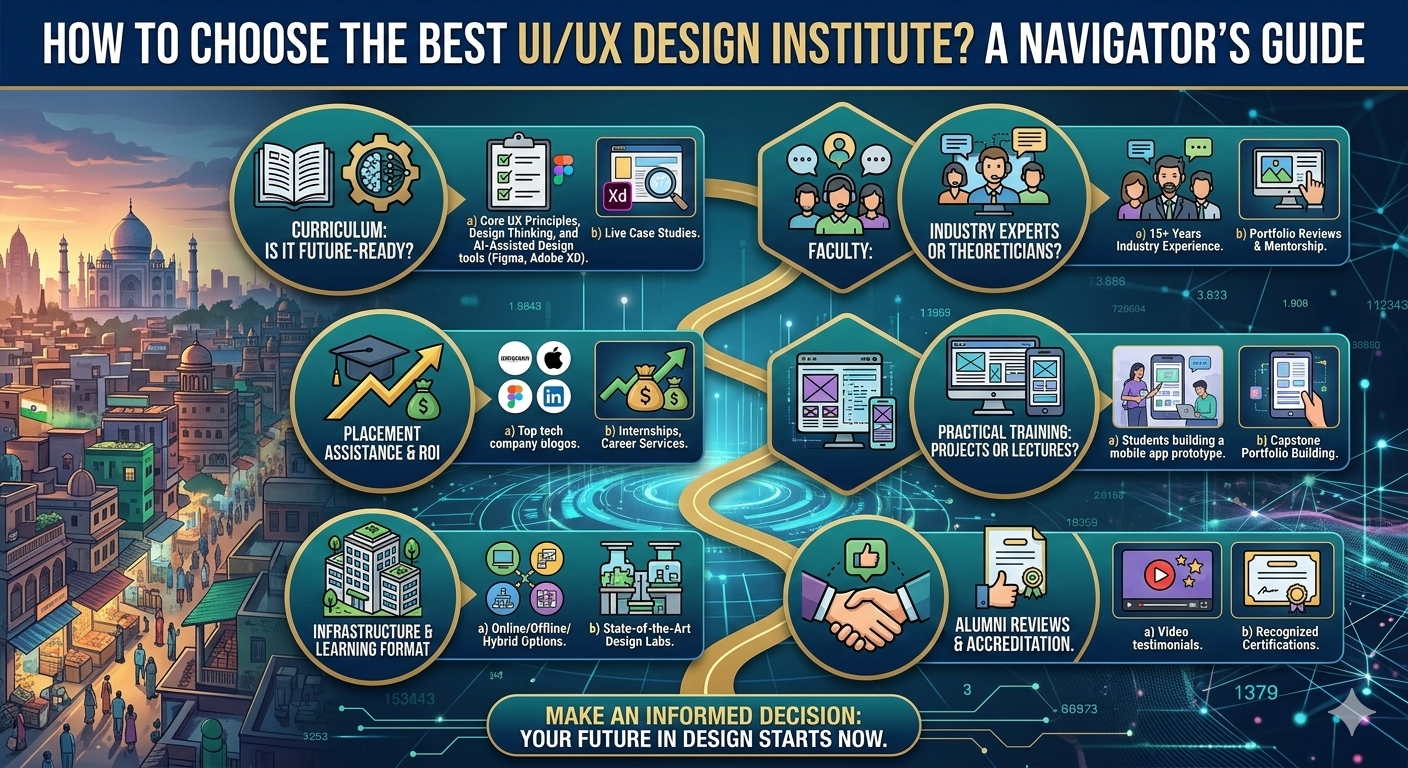
BLOG
Author: Amit Kataria
Posted on: 03 Mar 2026
12 min read**How to Choose the Best UI UX Design Institute in 2026** **Define Your Career Goals and Learning Objectives** **Identify your target role in UI UX design** Before choosing an institute, pinpoint exactly what you want to become. Are you drawn to visual interface design, user research, or product strategy? Maybe you're interested in specialized areas like AR/VR interfaces or accessibility design. Understanding your target role helps you filter institutes that excel in your specific area of interest. **Assess your current skill level and experience** Take an honest look at where you stand today. Complete beginners need foundational courses covering design principles and basic software skills. Career changers might benefit from intensive bootcamps, while professionals looking to upskill could focus on advanced programs. Your starting point determines which institutes can best serve your learning needs. **Determine preferred learning format and timeline** Consider how you learn best and what fits your schedule. Full-time programs offer immersive experiences but require significant time commitment. Part-time evening classes work well for working professionals. Online courses provide flexibility but demand strong self-discipline. Some people thrive in collaborative classroom settings, while others prefer self-paced digital learning. **Set realistic budget expectations** Design education costs vary dramatically, from free online resources to expensive university programs. Factor in tuition, software licenses, hardware upgrades, and potential lost income during full-time study. Research average salaries in your target role to understand potential return on investment. Many institutes offer payment plans or job placement guarantees that can influence your decision. **Evaluate Curriculum Quality and Technology Integration** **Analyze course content relevance to current market demands** The best UI/UX institutes regularly update their curriculum to match what employers actually want. Look for programs that teach design systems, accessibility standards, and mobile-first design principles. Check if they cover emerging trends like voice interfaces, AR/VR design, and AI-powered design tools that companies are actively seeking. **Assess hands-on project opportunities and real-world applications** Quality institutes provide extensive portfolio-building opportunities through client projects and industry partnerships. Students should work on diverse challenges ranging from mobile apps to enterprise software. The best programs connect learners with real companies for internships and capstone projects that mirror actual workplace scenarios. **Review software tools and technology stack coverage** Modern UI/UX education must include industry-standard tools like Figma, Adobe Creative Suite, and prototyping platforms. Strong programs also introduce students to design handoff tools, user research software, and basic front-end coding. The technology stack should reflect what design teams actually use in 2026. **Compare theoretical knowledge versus practical skill development** While design theory matters, the most valuable programs emphasize hands-on learning over lengthy lectures. Look for institutes that dedicate at least 70% of class time to practical exercises, workshops, and project work. The best balance combines foundational principles with immediate application through real design challenges. **Investigate Learning Support and Career Services** **Examine mentorship programs and instructor accessibility** Strong mentorship programs separate exceptional institutes from average ones. Look for schools offering dedicated mentors who provide personalized guidance throughout your learning journey. Check if instructors hold regular office hours, respond promptly to questions, and offer one-on-one feedback sessions. The best programs assign industry professionals as mentors who share real-world insights and help navigate career transitions. **Review job placement assistance and career counseling** Comprehensive career services should include resume optimization, interview preparation, and active job placement support. Top institutes maintain partnerships with hiring companies and regularly host recruitment events. They should provide career counselors who understand the UI/UX job market and offer tailored advice based on your background. Look for programs with high placement rates and transparent employment statistics within six months of graduation. **Assess portfolio development guidance and feedback systems** Portfolio quality directly impacts your job prospects, making guided development essential. Seek institutes offering structured portfolio workshops, regular critique sessions, and iterative feedback processes. Instructors should help you select your strongest work, craft compelling case studies, and present projects professionally. The best programs provide multiple review rounds and connect you with industry professionals for external portfolio assessments. **Evaluate networking opportunities and industry connections** Strong industry networks open doors to career opportunities and mentorship relationships. Research which design agencies, tech companies, and startups regularly recruit from your target institute. Look for programs hosting design meetups, guest speaker series, and alumni networking events. Active connections with local design communities and established relationships with hiring managers significantly boost your chances of landing quality positions. **Check ongoing support after course completion** Post-graduation support demonstrates an institute's commitment to your long-term success. Quality programs offer alumni networks, continued access to career services, and opportunities for skill updates. Some institutes provide lifetime access to course materials, advanced workshops, and industry updates. This ongoing relationship helps you stay current with design trends and provides support during career transitions throughout your professional journey. **Test Institute Culture Through Trial and Reviews** **Attend free workshops or trial classes when available** Most reputable UI/UX institutes offer free workshops or trial classes to showcase their teaching methods and course quality. These sessions give you firsthand experience of instructor expertise, class dynamics, and learning environment before committing financially. **Read authentic student reviews and testimonials** Look beyond polished marketing testimonials by checking platforms like Google Reviews, LinkedIn, and education forums. Current students and recent graduates provide honest insights about course content, instructor support, job placement success, and overall satisfaction with their learning experience. **Connect with current students and recent graduates** Reach out directly through LinkedIn or social media to get unfiltered perspectives on the institute's strengths and weaknesses. Ask specific questions about curriculum relevance, career support effectiveness, and whether they'd recommend the program to others. **Evaluate communication style and responsiveness of staff** Pay attention to how quickly and professionally the institute responds to your inquiries. Their communication approach during the enrollment process often reflects the level of support you'll receive as a student throughout your learning journey. Finding the right UI UX design institute comes down to matching your personal goals with what each program actually delivers. Take time to research credentials, dig into their curriculum depth, and see how well they support students beyond just teaching design theory. The best institutes blend current industry practices with hands-on learning, plus they connect you with real career opportunities when you graduate. Don’t rush this decision – your future design career depends on choosing wisely. If you’re searching for the right offline UI UX Design Institute In Delhi, take your time to explore your options carefully. Try out demo or trial classes, read genuine student reviews, and compare the course fees with the skills, certifications, and placement support offered. A trusted name like Madrid Software can provide structured training, practical exposure, and industry-relevant projects to help you build real design skills. Remember, the perfect [UI/UX Design Institute In Delhi](https://www.madridsoftwaretrainings.com/ui-ux-design-course-training-in-delhi) for you may not always be the most expensive or heavily advertised one. What truly matters is quality training, experienced mentors, hands-on projects, and strong career guidance. Trust your research, listen to your instincts, and choose a place like [Madrid Software](https://www.madridsoftwaretrainings.com) where you can clearly see yourself growing into the creative, confident designer you aspire to become.
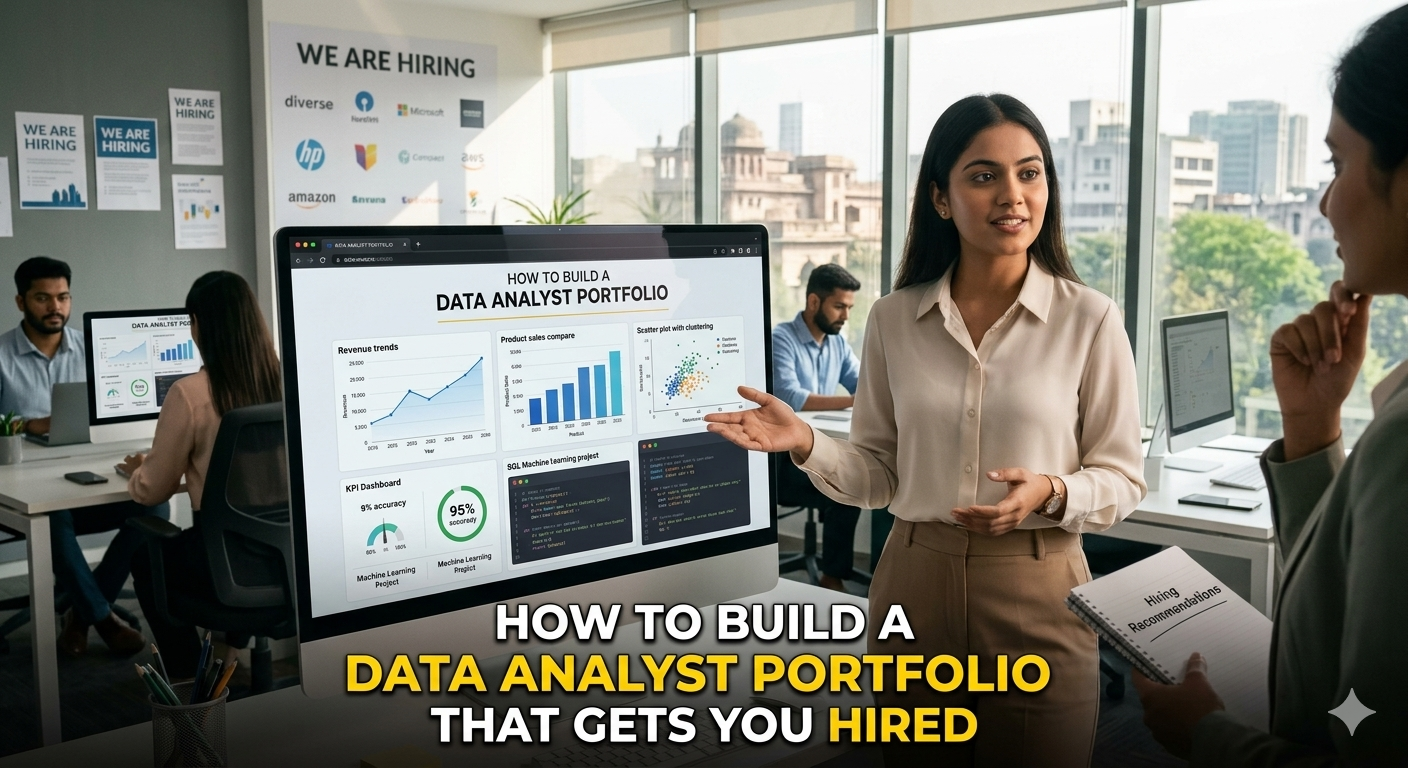
BLOG
Author: Amit Kataria
Posted on: 20 Mar 2026
17 min read**How to Build a Data Analyst Portfolio That Gets You Hired** A strong data analyst portfolio is your ticket to landing interviews at top companies. This guide is for aspiring data analysts, career changers, and recent graduates who want to showcase their skills and stand out from other candidates. Your portfolio needs to tell a compelling story about your analytical abilities while being easy for recruiters to find and navigate. We'll cover how to select high-impact projects that demonstrate your value to potential employers and present your work with professional visual design that makes a great first impression. You'll also learn proven strategies for writing compelling project descriptions that highlight your problem-solving skills and technical expertise. By the end of this post, you'll have a clear roadmap for building a data analyst portfolio that gets you noticed and hired. **Essential Components Every Data Analyst Portfolio Must Include** **Showcase diverse technical skills through varied project types** Your portfolio needs different project types to show recruiters your full range of abilities. Include exploratory data analysis projects that reveal hidden patterns, predictive modeling work that forecasts business outcomes, and data visualization pieces that tell compelling stories. Mix business-focused analyses with technical deep dives to prove you can bridge the gap between data and decision-making. **Demonstrate proficiency in key programming languages and tools** Master the essential toolkit that every data analyst needs: Python or R for statistical analysis, SQL for database querying, and visualization tools like Tableau or Power BI. Don't just list these skills - show them in action through real projects. Include examples of complex SQL queries, statistical modeling in [Python](https://www.python.org), and interactive dashboards that solve actual business problems recruiters recognize. **Include clean, well-documented code repositories** Clean, readable code separates professional analysts from amateur enthusiasts. Your [GitHub](https://github.com) repositories should feature organized file structures, meaningful variable names, and comprehensive comments explaining your thought process. Include detailed README files that walk viewers through your analysis methodology and key findings, making it easy for non-technical recruiters to understand your work's value and impact. **Present clear problem-solving methodologies** Walk recruiters through your analytical thinking process by documenting how you approach complex problems. Start with clearly defined business questions, explain your data collection and cleaning methods, justify your analytical choices, and present actionable insights. This structured approach demonstrates critical thinking skills and shows you can tackle ambiguous business challenges with systematic precision. **Select High-Impact Projects That Demonstrate Your Value** **Choose projects that solve real business problems** Your portfolio should tackle genuine challenges companies face daily. Pick projects that demonstrate how you'd reduce customer churn, optimize marketing spend, or improve operational efficiency. Recruiters want to see you can translate raw data into actionable business solutions that directly impact revenue or costs. **Include end-to-end data analysis workflows** Show every step of your analytical process, from data collection and cleaning through visualization and recommendations. Document your decision-making at each stage, including how you handled missing values, chose statistical methods, and validated results. This transparency proves you understand the complete data lifecycle, not just the final dashboard. **Showcase different industry applications** Diversify your project portfolio across multiple sectors like healthcare, finance, retail, or technology. Each industry has unique data challenges and metrics that matter. A well-rounded portfolio demonstrates adaptability and shows you can quickly understand new business contexts, making you valuable to employers across various fields. **Balance complexity with clear storytelling** Mix sophisticated analyses with projects anyone can understand. Include one technical deep-dive using advanced statistical methods alongside simpler exploratory analyses with compelling narratives. Your grandmother should grasp the business impact of your simpler projects, while data scientists can appreciate your technical skills in complex ones. **Highlight measurable outcomes and insights** Quantify your impact wherever possible. Instead of saying "improved customer satisfaction," specify "increased NPS scores by 23% through targeted retention strategies." Include before-and-after comparisons, percentage improvements, and dollar amounts when available. Numbers make your contributions concrete and memorable to hiring managers reviewing dozens of portfolios. **Present Your Work With Professional Visual Design** **Create compelling data visualizations that tell stories** Your visualizations should guide viewers through a clear narrative, revealing insights step by step. Start with overview charts that show the big picture, then drill down into specific patterns or trends. Interactive elements like hover tooltips and filters help recruiters explore your findings independently. Choose chart types that match your message—use line charts for trends over time, scatter plots for correlations, and bar charts for comparisons. **Design clean, intuitive dashboard layouts** **Use consistent branding and color schemes throughout** White space is your friend—resist cramming too many elements onto one screen. Group related metrics together and establish a clear hierarchy using size, color, and positioning. Your color palette should reflect your personal brand while remaining professional. Stick to 2-3 primary colors and use them consistently across all projects. This cohesive approach demonstrates attention to detail and creates a memorable impression that sets you apart from other candidates. **Write Compelling Project Descriptions That Sell Your Skills** **Craft executive summaries that highlight business impact** Your project descriptions need to hook recruiters within the first few sentences. Start each project with a punchy executive summary that answers the critical question: "What business problem did you solve?" Skip technical jargon and focus on outcomes that matter to employers. For example, instead of writing "Performed exploratory data analysis on customer data," try "Identified customer segments driving 40% of revenue, leading to targeted marketing campaigns that increased sales by $2.3M annually." **Explain your analytical approach and methodology** Walk readers through your problem-solving process without drowning them in technical details. Describe how you framed the business question, what hypotheses you tested, and why you chose specific analytical approaches. This demonstrates your strategic thinking and helps recruiters understand how you tackle complex challenges systematically. **Detail the tools and techniques you employed** Showcase your technical toolkit by mentioning specific software, programming languages, and statistical methods you used. Be strategic about highlighting tools mentioned in job postings you're targeting. However, don't just list technologies—explain why you chose them and how they contributed to solving the business problem at hand. **Quantify results and demonstrate value creation** Numbers tell your story better than adjectives ever could. Include specific metrics like percentage improvements, cost savings, revenue increases, or efficiency gains. When hard numbers aren't available, use relative improvements or explain the scale of your impact. Hiring managers want to see concrete evidence that you can drive measurable business results through data analysis. **Optimize Your Portfolio for Recruiter Discovery** **Choose the right platform for maximum visibility** GitHub remains the gold standard for data analysts, offering version control and direct code access that technical recruiters value. Portfolio websites using platforms like WordPress or Squarespace provide more design flexibility and better storytelling capabilities. Consider hosting on both - GitHub for technical depth and a personal website for polished presentation. **Implement SEO best practices for searchability** Target keywords like "data analyst," your location, and specific skills throughout your portfolio content. Write descriptive project titles and include relevant technical terms in your descriptions. Create unique meta descriptions for each page and use alt text for visualizations to help search engines understand your work and connect you with relevant opportunities. **Create mobile-responsive designs for all devices** Over 60% of recruiters browse portfolios on mobile devices during their commute or between meetings. Test your portfolio on smartphones and tablets to ensure charts remain readable and navigation stays intuitive. Use responsive design frameworks or choose templates that automatically adjust to different screen sizes without breaking your carefully crafted data visualizations. **Include clear contact information and call-to-actions** Place your email, LinkedIn profile, and phone number prominently at the top of every page. Add a dedicated "Contact" or "Hire Me" button that stands out visually from other elements. Include downloadable resume links and make it effortless for recruiters to reach you when they're impressed by your work and ready to move forward. **Avoid Common Portfolio Mistakes That Hurt Your Chances** **Eliminate projects with poor data quality or methodology** Portfolio projects built on incomplete datasets or flawed analytical approaches will raise red flags with hiring managers. Recruiters can spot methodological issues like cherry-picked data, inappropriate statistical tests, or missing validation steps from a mile away. Clean up projects that use unreliable data sources or demonstrate questionable analytical rigor before they damage your credibility. **Remove outdated or irrelevant work samples** Keep your portfolio current by removing projects that showcase outdated tools or techniques no longer used in the industry. Projects featuring deprecated software versions, obsolete programming languages, or business cases from five years ago signal you're out of touch with modern data analysis practices. **Fix broken links and ensure all code runs properly** Nothing kills a first impression faster than broken GitHub links, non-functional dashboards, or code that throws errors when executed. Test every link, verify all visualizations load correctly, and run your code from scratch to catch any dependency issues before submitting your portfolio for review. Building a standout data analyst portfolio comes down to showcasing the right projects with clear, compelling storytelling. Your portfolio needs those essential components - clean datasets, meaningful analysis, and polished visualizations that prove you can solve real business problems. The projects you choose should demonstrate impact and value, while your descriptions need to walk recruiters through your thought process and highlight the skills they're actually looking for. Don’t let common mistakes slow down your career growth in the data field. If you want to become a successful analyst, it’s important to build strong practical skills, understand real business problems, and learn how to present insights clearly. Enrolling in a [data analytics offline course in Delhi](https://www.madridsoftwaretrainings.com/data-analytics-course-training-in-delhi) can help you develop the right foundation and gain the confidence needed to work with real-world data. At **Madrid Software**, the data analytics course in Delhi is designed to give learners hands-on experience with essential tools like Excel, SQL, Python, and Power BI while working on practical projects and case studies. With guidance from experienced trainers and industry-focused training, students learn how to analyze data, create meaningful reports, and communicate insights effectively. [Madrid Software](https://www.madridsoftwaretrainings.com) focuses on practical learning and career-oriented training, helping students build the skills required to succeed in today’s data-driven job market.

BLOG
Author: Amit Kataria
Posted on: 21 Mar 2026
17 min read**Top 10 Data Analytics Tools You Must Learn in 2026 (Beginner to Advanced)** Data analytics has become the backbone of smart business decisions across every industry. If you're a beginner looking to break into data analytics, a professional wanting to level up your skills, or a career changer seeking high-demand expertise, mastering the right tools can transform your career prospects and earning potential. This guide breaks down the top 10 data analytics tools you must learn in 2026, from beginner-friendly options to advanced professional platforms. You'll discover which essential beginner tools can launch your analytics journey without overwhelming you, and how intermediate and advanced tools can elevate your capabilities to data science excellence. We'll also cover practical strategies for choosing the right tool based on your career goals and proven learning methods that help you master these skills faster while avoiding the common mistakes that trip up most beginners. **Why Data Analytics Skills Are Your Career Game-Changer** **Explosive job market growth and salary potential** Data analytics roles are expanding at breakneck speed, with the Bureau of Labor Statistics projecting 25% growth through 2032 – much faster than average occupations. Entry-level analysts start around $65,000, while senior data scientists command $150,000+ annually. **Industry demand across all sectors** Every industry now relies on data-driven decisions. Healthcare uses analytics for patient outcomes, retail optimizes inventory, finance detects fraud, and marketing targets customers precisely. Companies desperately need professionals who can transform raw data into actionable insights. **Future-proof your professional journey** Automation may replace many jobs, but data analytics skills become more valuable as machines generate massive datasets requiring human interpretation. These capabilities transfer across industries and adapt to emerging technologies, making your career resilient against economic shifts. **Essential Beginner-Friendly Tools to Start Your Analytics Journey** **Microsoft Excel for foundational data manipulation** Excel remains the cornerstone of data analytics, offering powerful features like pivot tables, VLOOKUP functions, and conditional formatting. Its familiar interface makes it perfect for beginners to learn data cleaning, basic statistical analysis, and creating simple visualizations without overwhelming complexity. **Google Analytics for web traffic insights** Google Analytics provides free access to comprehensive website performance data, making it essential for digital marketers and business analysts. You can track user behavior, conversion rates, and traffic sources while learning key analytics concepts like segmentation and goal tracking in a real-world environment. **Tableau Public for visual storytelling** Tableau Public transforms raw data into compelling interactive dashboards and charts with drag-and-drop simplicity. This free version allows beginners to master data visualization principles, create professional-looking reports, and build an online portfolio showcasing their analytical skills to potential employers. **Power BI for business intelligence basics** Microsoft's Power BI offers robust business intelligence capabilities with seamless integration across Microsoft's ecosystem. Its user-friendly interface enables beginners to connect multiple data sources, create automated reports, and develop interactive dashboards while learning enterprise-level BI concepts and collaborative analytics workflows. **Intermediate Tools That Elevate Your Data Analysis Capabilities** **Python programming for advanced data processing** Python transforms how analysts tackle complex datasets with its extensive libraries like pandas, NumPy, and matplotlib. Unlike Excel's limitations, Python handles millions of rows seamlessly while offering sophisticated data cleaning, transformation, and visualization capabilities. The learning curve pays off quickly as you automate repetitive tasks and create reproducible analysis workflows that save countless hours. **R programming for statistical analysis mastery** R dominates statistical computing with unmatched depth in advanced analytics, from regression modeling to machine learning algorithms. Data scientists rely on R's comprehensive package ecosystem, including ggplot2 for stunning visualizations and dplyr for elegant data manipulation. While Python excels in general programming, R's statistical heritage makes it indispensable for hypothesis testing, predictive modeling, and academic research where statistical rigor matters most. **SQL databases for data querying expertise** SQL skills unlock access to enterprise databases where real business data lives. Mastering joins, subqueries, and window functions lets you extract insights directly from source systems without waiting for IT departments. Modern SQL dialects support advanced analytics functions, making database querying a powerful complement to Python and R workflows when working with large-scale production data. **Advanced Professional Tools for Data Science Excellence** **Apache Spark for big data processing** Apache Spark revolutionizes how data scientists handle massive datasets that traditional tools simply can't process. This distributed computing framework processes terabytes of data across multiple machines simultaneously, making it perfect for real-time analytics and machine learning at scale. Companies like Netflix and Uber rely on Spark to analyze billions of user interactions daily, turning raw data into actionable insights. **SAS for enterprise-level analytics** SAS dominates enterprise environments where reliability and regulatory compliance matter most. Financial institutions and pharmaceutical companies trust SAS for its robust statistical procedures and audit-ready documentation capabilities. While the learning curve is steep, mastering SAS opens doors to high-paying positions in banking, healthcare, and government sectors where data accuracy can make or break million-dollar decisions. **SPSS for complex statistical modeling** SPSS excels at advanced statistical analysis without requiring extensive programming knowledge. Researchers and analysts use its point-and-click interface to perform sophisticated tests like multivariate regression, factor analysis, and predictive modeling. Academic institutions and market research firms particularly value SPSS for its comprehensive statistical libraries and publication-ready output formats that streamline the research process. How to Choose the Right Tool for Your Career Path **Assess your industry requirements** Different industries demand specific analytics tools based on their data types and business needs. Healthcare organizations often rely on specialized statistical software like SAS for regulatory compliance, while e-commerce companies favor tools like Google Analytics and Tableau for customer behavior analysis. Financial services typically require robust platforms like R or Python for risk modeling, whereas marketing teams gravitate toward user-friendly options like Power BI for campaign performance tracking. **Evaluate learning curve and time investment** The complexity of analytics tools varies dramatically, affecting your learning timeline and career progression speed. Beginner-friendly platforms like Excel and Tableau offer intuitive interfaces that you can master within weeks, making them perfect for quick wins. Advanced tools like Python and R demand months of dedicated practice but provide unlimited analytical flexibility. Consider your current skill level and available study time when selecting tools - starting with simpler options builds confidence before tackling more complex platforms. **Consider budget and licensing costs** Analytics tools range from free open-source options to expensive enterprise licenses that can cost thousands annually. Python and R offer powerful capabilities at zero cost, making them ideal for students and budget-conscious professionals. Commercial tools like SAS, SPSS, and Tableau require significant financial investment but provide dedicated support and polished interfaces. Many companies offer educational discounts or free trials, so explore these options before committing to expensive licenses. **Match tools to your career goals** Your target role should drive your tool selection strategy. Data analysts typically need Excel, SQL, and visualization tools like Tableau or Power BI for reporting and dashboard creation. Data scientists require programming languages like Python or R plus machine learning libraries for predictive modeling. Business intelligence professionals focus on tools like Power BI, Qlik, or Looker for strategic decision-making. Research your dream job postings to identify the most frequently mentioned tools in your field. **Proven Learning Strategies to Master These Analytics Tools** **Create hands-on projects with real datasets** Practice beats theory every time. Download datasets from Kaggle, government websites, or your workplace and tackle real problems. Start simple - analyze sales trends or customer patterns - then gradually take on complex challenges like predictive modeling or sentiment analysis. Working with messy, imperfect data teaches you problem-solving skills no tutorial can match. **Build a portfolio that showcases your skills** Your GitHub profile is your professional storefront. Upload complete projects with clean code, detailed documentation, and compelling visualizations. Include diverse work spanning different tools and industries - a Python dashboard, R statistical analysis, and Tableau story. Employers want to see how you think through problems and communicate insights, not just technical proficiency. **Join online communities and practice regularly** Data analytics communities on Reddit, Stack Overflow, and Discord offer invaluable peer support and learning opportunities. Share your projects, ask questions, and help others solve problems. Set aside 30 minutes daily for skill-building - whether following tutorials, experimenting with new features, or participating in data challenges. Consistency trumps intensity when mastering complex analytics tools. **Common Mistakes That Slow Down Your Analytics Learning** **Jumping to advanced tools too quickly** Many aspiring data analysts make the critical mistake of diving straight into complex tools like TensorFlow or Apache Spark without mastering the fundamentals. This approach creates knowledge gaps that become roadblocks later. Start with Excel or Google Sheets before moving to Python or R. Building a solid foundation with simpler tools gives you the confidence and understanding needed to tackle more sophisticated platforms effectively. **Focusing on features instead of problem-solving** **Neglecting data cleaning and preparation skills** The most overlooked skill in analytics is data cleaning, yet it consumes 80% of a data professional's time. Beginners often skip learning proper data preparation techniques, rushing to create visualizations with messy datasets. This creates unreliable results and bad habits. Master data validation, handling missing values, and identifying outliers early in your learning journey. Clean data is the backbone of every successful analysis project. The data analytics landscape is moving fast, and staying ahead means picking up the right tools for where you are in your career journey. From beginner-friendly platforms that get you comfortable with data basics to advanced tools that unlock machine learning capabilities, each one serves a purpose in building your analytics skillset. The key isn't learning every tool out there – it's choosing the ones that match your current level and career goals, then mastering them with consistent practice and real-world projects. Your career choice should align with your interests, strengths, and long-term goals. If you enjoy working with data, identifying patterns, and helping businesses make smarter decisions, a data analytics course in Delhi can be the perfect starting point for a rewarding career. At Madrid Software, students learn how to transform raw data into meaningful insights using industry-relevant tools like Excel, SQL, Python, Power BI, and real-world analytics techniques. The [data analytics course in Delhi](https://www.madridsoftwaretrainings.com/data-analytics-course-training-in-delhi) at Madrid Software is designed to help beginners and professionals build practical skills through hands-on projects, expert mentorship, and real business case studies. With structured learning, practical exposure, and career-focused training, Madrid Software prepares learners to confidently step into roles such as Data Analyst, Business Analyst, and Reporting Analyst. If you want to build a future in data and work with technologies used by modern companies, [Madrid Software](https://www.madridsoftwaretrainings.com) offers the right platform to start your journey in data analytics.

BLOG
Author: Amit Kataria
Posted on: 26 Mar 2026
26 min read**Top 10 Full Stack Developer Interview Questions** Landing your dream full stack developer role starts with nailing the interview. This guide targets both junior developers preparing for their first big opportunity and experienced programmers switching companies or advancing their careers. You'll discover the most common full stack developer interview questions that hiring managers actually ask, complete with detailed answers that demonstrate real technical knowledge. We'll break down essential frontend questions that test your ability to create engaging user interfaces and critical backend questions that reveal how well you handle server-side logic and architecture. The questions cover everything from database management and version control to system design challenges and coding problems you might solve on a whiteboard. You'll also find behavioral questions that help interviewers understand how you work with teams and approach complex technical problems. **Essential Frontend Development Questions That Test Your UI Skills** **Modern JavaScript ES6+ Features and Their Practical Applications** Arrow functions, destructuring, and template literals transform how developers write cleaner, more readable code. Interviewers often ask candidates to refactor ES5 code using modern syntax, testing their understanding of lexical scoping and parameter handling. Async/await patterns have replaced callback hell, making asynchronous operations more intuitive. **React Component Lifecycle and State Management Best Practices** Understanding useEffect hooks and their dependency arrays separates junior developers from experienced ones. Candidates should explain when to use useState versus useReducer, and demonstrate proper cleanup patterns to prevent memory leaks. State management architecture decisions, like choosing between Context API and external libraries, reveal architectural thinking skills. **CSS Flexbox and Grid Layout Problem-Solving Scenarios** Interviewers present real-world layout challenges where candidates must choose between flexbox for one-dimensional layouts and CSS Grid for complex two-dimensional designs. Common scenarios include creating responsive card layouts, centering content both vertically and horizontally, and building sidebar navigation systems that adapt across device sizes. **Responsive Design Implementation Strategies** Mobile-first approaches using CSS media queries demonstrate understanding of progressive enhancement principles. Candidates should discuss viewport meta tags, flexible images, and fluid typography systems. Modern techniques like container queries and CSS custom properties show awareness of cutting-edge responsive design patterns that go beyond traditional breakpoint-based approaches. **Critical Backend Development Questions That Reveal Server-Side Expertise** **RESTful API Design Principles and Authentication Methods** RESTful APIs should follow clear resource naming conventions with proper HTTP methods - GET for retrieval, POST for creation, PUT for updates, and DELETE for removal. Authentication typically involves JWT tokens or OAuth 2.0, with proper error handling returning meaningful status codes like 401 for unauthorized access and 404 for missing resources. **Database Query Optimization and Performance Tuning** Database performance relies heavily on proper indexing strategies and query optimization. Developers need to understand how to analyze execution plans, identify bottlenecks using tools like EXPLAIN, and implement caching mechanisms. Connection pooling and avoiding N+1 queries are essential for scalable applications handling high traffic loads. **Microservices Architecture vs Monolithic Application Trade-offs** Microservices offer independent deployment and scaling but introduce complexity with distributed systems, network latency, and data consistency challenges. Monolithic architectures provide simpler development and testing workflows but can become difficult to maintain as teams grow. The choice depends on team size, deployment requirements, and business needs. **Database Management Questions That Assess Your Data Handling Skills** **SQL Join Operations and Complex Query Construction** Database queries form the backbone of full-stack development, and mastering JOIN operations separates junior developers from experienced professionals. Expect questions about INNER, LEFT, RIGHT, and FULL OUTER joins, along with scenarios requiring subqueries, window functions, and CTEs. Candidates should demonstrate understanding of query optimization principles, explain execution plans, and write efficient queries that handle large datasets without performance degradation. **NoSQL vs SQL Database Selection Criteria** Choosing between SQL and NoSQL databases requires understanding specific project requirements and data characteristics. SQL databases excel in structured data scenarios requiring ACID compliance, complex relationships, and consistent schema enforcement. NoSQL solutions shine when dealing with unstructured data, rapid scaling needs, or flexible schema requirements. Strong candidates articulate trade-offs between consistency and availability, explain CAP theorem implications, and justify database choices based on real-world constraints. **Database Indexing Strategies for Performance Enhancement** Effective indexing strategies can dramatically improve query performance, making this a crucial topic for full-stack interviews. Candidates should understand different index types including B-tree, hash, and composite indexes, knowing when each provides optimal performance benefits. They must explain index maintenance overhead, identify over-indexing pitfalls, and demonstrate ability to analyze query execution plans for optimization opportunities. **Data Migration and Backup Recovery Procedures** Data migration and backup strategies reveal a developer's understanding of production-level database management responsibilities. Experienced candidates discuss zero-downtime migration techniques, incremental backup strategies, and point-in-time recovery procedures. They should articulate disaster recovery planning, explain database replication methods, and demonstrate familiarity with tools like database dumps, log shipping, and automated backup verification processes that ensure data integrity and business continuity. **Version Control and Collaboration Questions That Show Team Readiness** **Advanced Git Workflow Management and Conflict Resolution** Interviewers often ask about complex merge conflicts and how you'd handle them in a collaborative environment. You should explain the difference between merge, rebase, and squash strategies, and when to use each. Demonstrate knowledge of Git commands like git cherry-pick, git bisect, and git reflog for advanced troubleshooting scenarios. **Code Review Best Practices and Quality Standards** Expect questions about establishing effective code review processes and maintaining code quality across teams. Discuss automated testing integration, pull request templates, and how you provide constructive feedback. Show understanding of tools like GitHub Actions, GitLab CI, or Bitbucket Pipelines for automated quality checks. **Branch Management Strategies for Multiple Environments** Companies want to know how you'd structure branches for development, staging, and production environments. Explain Git Flow, GitHub Flow, or feature-branch workflows, including hotfix procedures and release management. Discuss naming conventions, protection rules, and deployment strategies that prevent conflicts between team members working on different features simultaneously. **System Design Questions That Test Your Architecture Thinking** **Scalability Planning for High-Traffic Applications** When interviewing for full stack positions, expect questions about handling sudden traffic spikes and designing systems that grow with user demand. Interviewers want to see if you understand horizontal versus vertical scaling, microservices architecture, and database sharding strategies. They'll ask how you'd handle a million concurrent users or design a system that can process thousands of requests per second without breaking. **Load Balancing and Caching Implementation Strategies** Smart candidates discuss multiple caching layers - from CDNs for static content to Redis for session management and database query caching. You should know when to use round-robin versus weighted load balancing algorithms and explain how reverse proxies like Nginx distribute traffic. Interviewers love hearing about real-world scenarios where you've implemented these solutions to reduce server load and improve response times. **Security Vulnerability Assessment and Prevention Methods** Security questions test your ability to think like both developer and attacker. You'll need to explain common vulnerabilities like SQL injection, XSS attacks, and CSRF protection methods. Interviewers want practical answers about implementing authentication systems, securing APIs with proper tokens, and validating user inputs. They're looking for candidates who build security into the development process rather than treating it as an afterthought. **Cloud Infrastructure Design and Deployment Considerations** Modern full stack roles require cloud proficiency, so expect questions about AWS, Azure, or Google Cloud services. You should articulate how to design fault-tolerant systems using multiple availability zones, implement auto-scaling groups, and choose appropriate database solutions for different use cases. Interviewers value candidates who understand cost optimization strategies and can explain trade-offs between managed services versus self-hosted solutions. **Problem-Solving Coding Challenges That Demonstrate Technical Proficiency** **Algorithm Optimization and Time Complexity Analysis** Interviewers love testing your ability to analyze and optimize algorithms under pressure. You'll likely face classic problems like finding duplicates in arrays, implementing efficient sorting algorithms, or solving tree traversal challenges. The key isn't just getting the right answer—it's explaining your thought process and identifying bottlenecks. Smart candidates walk through multiple approaches, comparing time and space complexity trade-offs. They might start with a brute force O(n²) solution, then optimize to O(n log n) or even O(n) when possible. **Real-World Bug Fixing and Debugging Techniques** Debugging skills separate good developers from great ones. Expect scenarios where you'll trace through broken code, identify race conditions, or fix memory leaks. Top candidates demonstrate systematic debugging approaches: reproducing the issue, isolating variables, and using proper logging strategies. They show familiarity with debugging tools like browser DevTools, server logs, and profiling instruments. The best responses include prevention strategies—how unit tests, code reviews, and error monitoring could have caught the bug earlier. **Code Refactoring for Maintainability and Performance** Refactoring questions test your ability to improve existing codebases without breaking functionality. You might encounter messy functions with multiple responsibilities, poorly named variables, or inefficient database queries. Strong answers demonstrate SOLID principles, proper separation of concerns, and performance improvements through caching or query optimization. Candidates should explain their refactoring steps clearly, highlighting how changes improve readability, reduce technical debt, and enhance team productivity while maintaining backward compatibility. **DevOps Integration Questions That Prove Deployment Readiness** CI/CD Pipeline Setup and Automation Processes Modern full stack developers must demonstrate hands-on experience with continuous integration and deployment workflows. Interviewers often ask candidates to explain how they'd set up automated pipelines using tools like Jenkins, GitHub Actions, or GitLab CI. You should be ready to discuss branching strategies, automated testing integration, and deployment triggers. Understanding how to configure build stages, manage environment variables, and handle rollback scenarios shows you can maintain reliable software delivery cycles. **Container Orchestration with Docker and Kubernetes** Docker containerization has become essential for consistent deployments across different environments. Expect questions about writing Dockerfiles, managing multi-container applications with Docker Compose, and orchestrating containers at scale using Kubernetes. You'll need to explain concepts like pods, services, deployments, and ingress controllers. Demonstrating knowledge of container registry management, resource allocation, and scaling strategies proves you can handle production-level container orchestration challenges. **Monitoring and Logging Implementation for Production Systems** Production readiness requires robust monitoring and logging systems. Interviewers want to know how you'd implement application performance monitoring using tools like New Relic, DataDog, or Prometheus. You should understand log aggregation with ELK stack or similar solutions, setting up alerts for critical metrics, and creating dashboards for system health visualization. Experience with distributed tracing and error tracking shows you can maintain system reliability and quickly troubleshoot issues in live environments. **Environment Configuration Management** Managing configurations across development, staging, and production environments is crucial for deployment success. Expect questions about environment variable management, secrets handling with tools like HashiCorp Vault, and configuration templating using Ansible or Terraform. You should demonstrate understanding of infrastructure as code principles, automated environment provisioning, and secure credential management. Knowledge of blue-green deployments and feature flags shows advanced deployment strategy awareness. **Performance Optimization Questions That Highlight Efficiency Expertise** **Frontend Performance Metrics and Improvement Techniques** Interviewers often ask candidates to explain Core Web Vitals metrics like Largest Contentful Paint, First Input Delay, and Cumulative Layout Shift. You should demonstrate knowledge of lazy loading images, code splitting with webpack or Vite, and implementing service workers for caching. Bundle size optimization through tree shaking and minification shows your understanding of user experience impact. **Backend Response Time Optimization Strategies** Database query optimization remains a critical topic, including indexing strategies, connection pooling, and N+1 problem solutions. Candidates should discuss caching mechanisms like Redis or Memcached, along with API response compression using gzip. Understanding horizontal scaling, load balancing, and CDN implementation demonstrates comprehensive backend performance knowledge. **Memory Management and Resource Allocation Best Practices** JavaScript memory leaks prevention requires understanding closure pitfalls, event listener cleanup, and proper DOM manipulation. Backend memory management involves garbage collection tuning, connection pooling limits, and monitoring tools like New Relic or DataDog. Discussing profiling techniques and identifying memory bottlenecks shows practical debugging experience that employers value. **Communication and Behavioral Questions That Assess Soft Skills** **Technical Concept Explanation to Non-Technical Stakeholders** Breaking down complex technical concepts for business stakeholders requires removing jargon and using relatable analogies. Instead of explaining "database normalization," describe it as organizing a messy filing cabinet where each piece of information has its proper place. When discussing API integration, compare it to electrical outlets - different devices plug in using standard connections. Practice explaining your current project's architecture using everyday comparisons that highlight benefits like faster loading times or better user experience. **Project Management and Timeline Estimation Approaches** Accurate project estimation combines breaking tasks into smaller components with buffer time for unexpected challenges. Start by identifying dependencies between features and accounting for testing phases, code reviews, and deployment steps. Buffer estimates by 20-30% for unknown complexities that always emerge during development. Communicate timeline changes proactively by explaining technical roadblocks in business terms, focusing on how adjustments maintain quality and prevent bigger delays later. **Handling Conflicting Requirements and Priority Management** When stakeholders present conflicting requirements, document all requests and facilitate discussions about business impact versus technical feasibility. Create a decision matrix showing development time, maintenance costs, and user value for each option. Present trade-offs clearly - choosing faster delivery might mean reduced features initially. Build consensus by focusing on shared business goals and proposing phased approaches that address the most critical needs first while keeping future requirements achievable. **Advanced Technology Questions That Showcase Industry Awareness** **Emerging Framework Adoption Decision-Making Process** When evaluating new frameworks, smart developers weigh performance benchmarks, community support, documentation quality, and learning curve against project requirements. You should demonstrate understanding of risk assessment - considering factors like framework maturity, backing organization stability, migration paths, and team expertise. Discuss how you balance innovation with stability, perhaps sharing examples of successful adoptions or cautionary tales from premature technology choices. **Legacy System Modernization Strategies** Modernization requires strategic thinking beyond simple rewrites. Explain approaches like strangler fig pattern, API-first architecture, or microservices decomposition. Address challenges such as data migration, maintaining business continuity, team training, and budget constraints. Your answer should reflect understanding that modernization is often a gradual process requiring careful planning, stakeholder buy-in, and risk mitigation strategies rather than big-bang replacements. **Cross-Platform Development Considerations** Cross-platform development involves choosing between native performance and development efficiency. Compare approaches like React Native, Flutter, Progressive Web Apps, or hybrid solutions, discussing trade-offs in performance, user experience, maintenance overhead, and team skillsets. Address platform-specific considerations such as iOS App Store guidelines, Android fragmentation, desktop deployment complexities, and how these impact architectural decisions and development workflows. Landing a full stack developer role requires more than just knowing how to code. You need to prove you can handle everything from crafting smooth user interfaces to designing robust backend systems, managing databases, and working effectively with teams. The questions we've covered span the entire development lifecycle - from frontend frameworks and server-side logic to database optimization, version control, system architecture, and deployment strategies. Don't forget that your soft skills matter just as much as your technical abilities when it comes to collaborating with colleagues and communicating complex ideas. Start preparing now by practicing coding challenges, reviewing system design concepts, and getting hands-on experience with the latest tools and frameworks. Set up your own projects that showcase different aspects of full stack development, and be ready to walk through your thought process during technical discussions. Remember, interviewers want to see how you think through problems, not just whether you can memorize the right answers. The more you practice explaining your approach out loud, the more confident you'll feel when it's time for the real thing. Start your tech career with a [Full stack web development course in Delhi](https://www.madridsoftwaretrainings.com/full-stack-developer-course-training-in-delhi) at Madrid Software. Build strong coding skills by practicing real-world challenges and hands-on projects. At [Madrid Software](https://www.madridsoftwaretrainings.com), learn both front-end and back-end development with the latest tools and frameworks. Work on live projects that showcase your full stack development skills. Understand system design concepts and how to solve real industry problems step by step. This Full stack web development course Delhi helps you prepare for technical interviews with confidence. Practice explaining your thought process clearly to stand out in interviews.Get expert guidance and career support from Madrid Software.Start building your portfolio and become job-ready with practical experience.
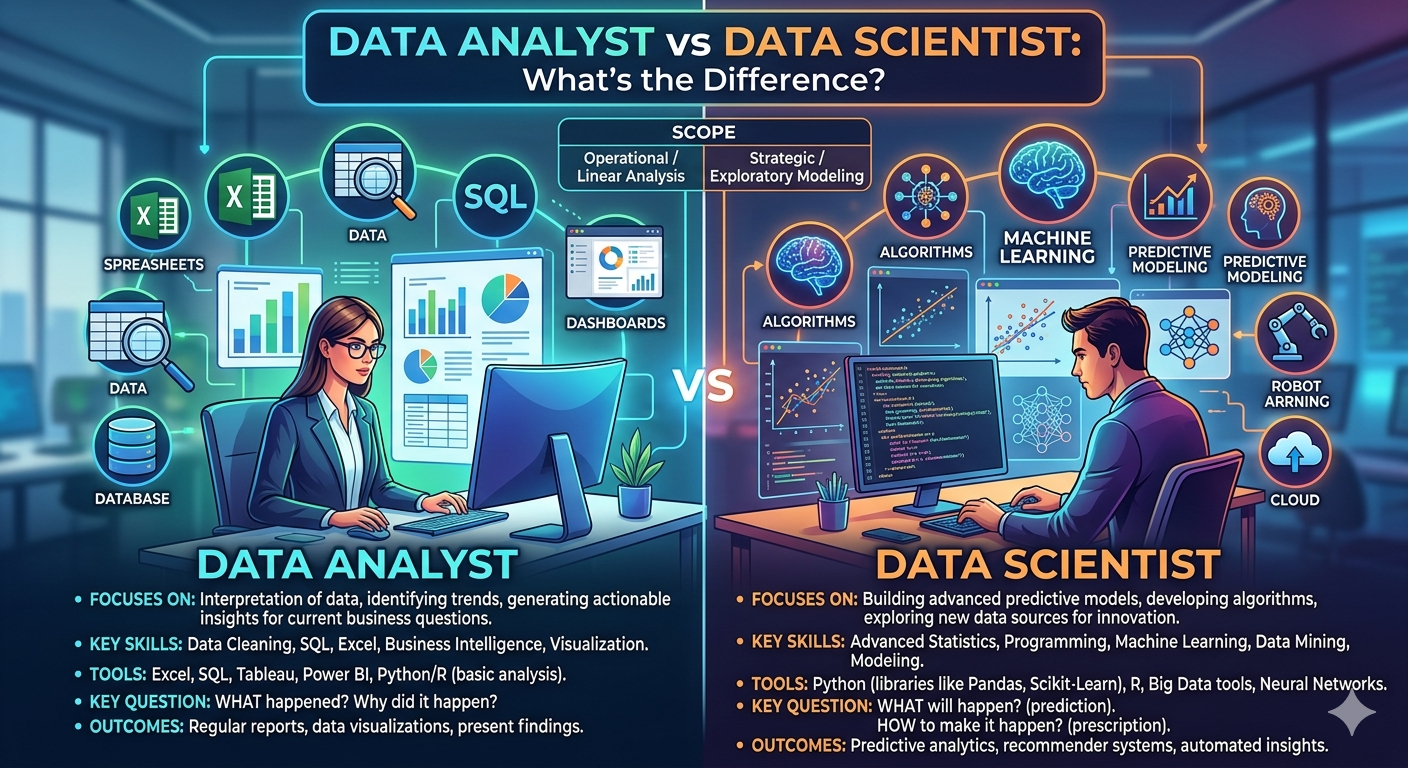
BLOG
Author: Amit Kataria
Posted on: 21 May 2026
12 min read**Data Analyst vs Data Scientist: What's the Difference?** Thinking about a career in data but can't figure out if you should become a data analyst or data scientist? You're not alone. These two roles get mixed up all the time, even though they're quite different in what they actually do day-to-day. This guide is perfect for career changers, recent graduates, and anyone curious about data careers. We'll break down the real differences between data analysts and data scientists, covering the core skills each role needs and the typical daily responsibilities you can expect. You'll also get a clear picture of the educational paths that can get you there and what kind of career growth to expect in each field. By the end, you'll know exactly which role fits your interests, skills, and career goals better. **Understanding Core Definitions and Purposes** **What Data Analysts Do in Organizations?** Data analysts dig into numbers to find patterns and trends that help companies make smart decisions. They clean messy data, create reports, and build dashboards that show what's happening in the business right now. Think of them as translators who turn raw numbers into easy-to-understand stories that managers can actually use. **What Data Scientists Accomplish for Businesses?** Data scientists take a bigger-picture approach, using advanced math and machine learning to predict what might happen next. They build models that can forecast sales, recommend products to customers, or detect fraud before it happens. While analysts focus on describing the past and present, data scientists engineer solutions for future challenges. **How Each Role Serves Different Business Needs?** Analysts support day-to-day operations by answering specific questions like "Why did sales drop last month?" or "Which marketing campaigns work best?" Data scientists tackle complex problems that require building new systems, like creating recommendation engines or automated decision-making tools. Companies often need both roles working together - analysts keep the lights on while data scientists build the future infrastructure. **Essential Skills and Technical Requirements** **Programming Languages Each Role Demands** Data analysts typically master SQL for database queries and Excel for basic analysis, with Python or R as valuable additions. Data scientists need stronger programming foundations, requiring Python or R proficiency plus knowledge of libraries like pandas, scikit-learn, and TensorFlow. Scientists often work with multiple languages including Java or Scala for big data processing. **Statistical Knowledge Differences** Analysts focus on descriptive statistics, hypothesis testing, and basic inferential methods to interpret existing data patterns. Scientists dive deeper into advanced statistical modeling, probability distributions, and experimental design. They need expertise in multivariate analysis, Bayesian methods, and statistical learning theory to build predictive models and validate complex algorithms. **Machine Learning Expertise Expectations** Data analysts rarely build machine learning models, instead focusing on applying pre-built tools for basic predictive tasks. Data scientists design, implement, and optimize machine learning algorithms from scratch. They understand model selection, feature engineering, cross-validation, and deployment strategies. Scientists work with supervised, unsupervised, and reinforcement learning across various domains and problem types. **Data Visualization Tool Proficiencies** Analysts excel in business intelligence tools like Tableau, Power BI, and Excel dashboards for stakeholder reporting. Data scientists use programming-based visualization libraries such as matplotlib, seaborn, and plotly for exploratory analysis. Scientists create interactive visualizations and custom graphics to communicate complex model results. Both roles need strong storytelling abilities to translate data insights into actionable business recommendations. **Career Growth and Salary Expectations** **Entry-Level Compensation Comparisons** Data analysts typically start with salaries ranging from $50,000-$70,000, while entry-level data scientists command higher starting wages between $80,000-$110,000. The premium reflects the advanced technical skills and business strategy focus that data scientists bring from day one. **Senior-Level Earning Potential** Senior data scientists can reach $150,000-$250,000+ at major tech companies, often including substantial stock options and bonuses. Senior data analysts peak around $90,000-$130,000, though specialized roles in finance or healthcare can push higher. The gap widens significantly as professionals advance through their careers. **Career Advancement Opportunities Available** Data scientists have clearer paths to leadership roles like Chief Data Officer or VP of Analytics, given their strategic business exposure. Data analysts often pivot into specialized domains, product management, or business intelligence leadership. Both roles offer excellent growth potential, with data scientists having slightly more diverse exit opportunities into executive positions. **Choosing the Right Path for Your Goals** **Assessing Your Current Skill Set** Start by honestly evaluating your existing technical abilities and experience with data tools. Data analysts typically need strong Excel skills, basic SQL knowledge, and proficiency with visualization tools like Tableau or Power BI. Data scientists require deeper programming skills in Python or R, statistical modeling expertise, and machine learning knowledge. Consider which skills you already possess and which ones excite you to learn. **Identifying Your Interest in Technical Depth** Think about how deep you want to dive into the technical side of data work. Data analysts focus more on interpreting existing data and creating reports that drive business decisions. Data scientists spend time building predictive models, developing algorithms, and conducting complex statistical analyses. Ask yourself whether you prefer working with established datasets or creating new analytical frameworks from scratch. **Evaluating Long-Term Career Aspirations** Consider where you see yourself in five to ten years. Data analyst roles often lead to business intelligence management, operations analysis, or consulting positions. Data scientist paths typically evolve toward machine learning engineering, research roles, or chief data officer positions. Think about whether you want to stay close to business operations or move toward more research-oriented work. **Market Demand Considerations** Research job opportunities in your geographic area and preferred industries. Data analyst positions are widely available across most sectors, from healthcare to retail. Data scientist roles are often concentrated in tech companies, startups, and large corporations with significant data infrastructure. Check salary ranges and growth projections for both paths in your target market to make an informed decision. Data analysts and data scientists both work with data, but they serve different purposes in organizations. Analysts focus on interpreting existing data to answer specific business questions, while scientists build predictive models and create new ways to extract insights from complex datasets. The skill requirements reflect these differences too - analysts need strong SQL, Excel, and visualization tools, whereas scientists require programming languages like Python or R, machine learning knowledge, and statistical modeling expertise. Your career choice should align with your interests, strengths, and long-term goals. If you enjoy working with data, identifying patterns, and helping businesses make smarter decisions, a data analytics course in Delhi can be the perfect starting point for a rewarding career. At Madrid Software, students learn how to transform raw data into meaningful insights using industry-relevant tools like Excel, SQL, Python, Power BI, and real-world analytics techniques. The [data analytics course in Delhi](https://www.madridsoftwaretrainings.com/data-analytics-course-training-in-delhi) at **Madrid Software** is designed to help beginners and professionals build practical skills through hands-on projects, expert mentorship, and real business case studies. With structured learning, practical exposure, and career-focused training, Madrid Software prepares learners to confidently step into roles such as Data Analyst, Business Analyst, and Reporting Analyst. If you want to build a future in data and work with technologies used by modern companies, [Madrid Software](https://www.madridsoftwaretrainings.com) offers the right platform to start your journey in data analytics.
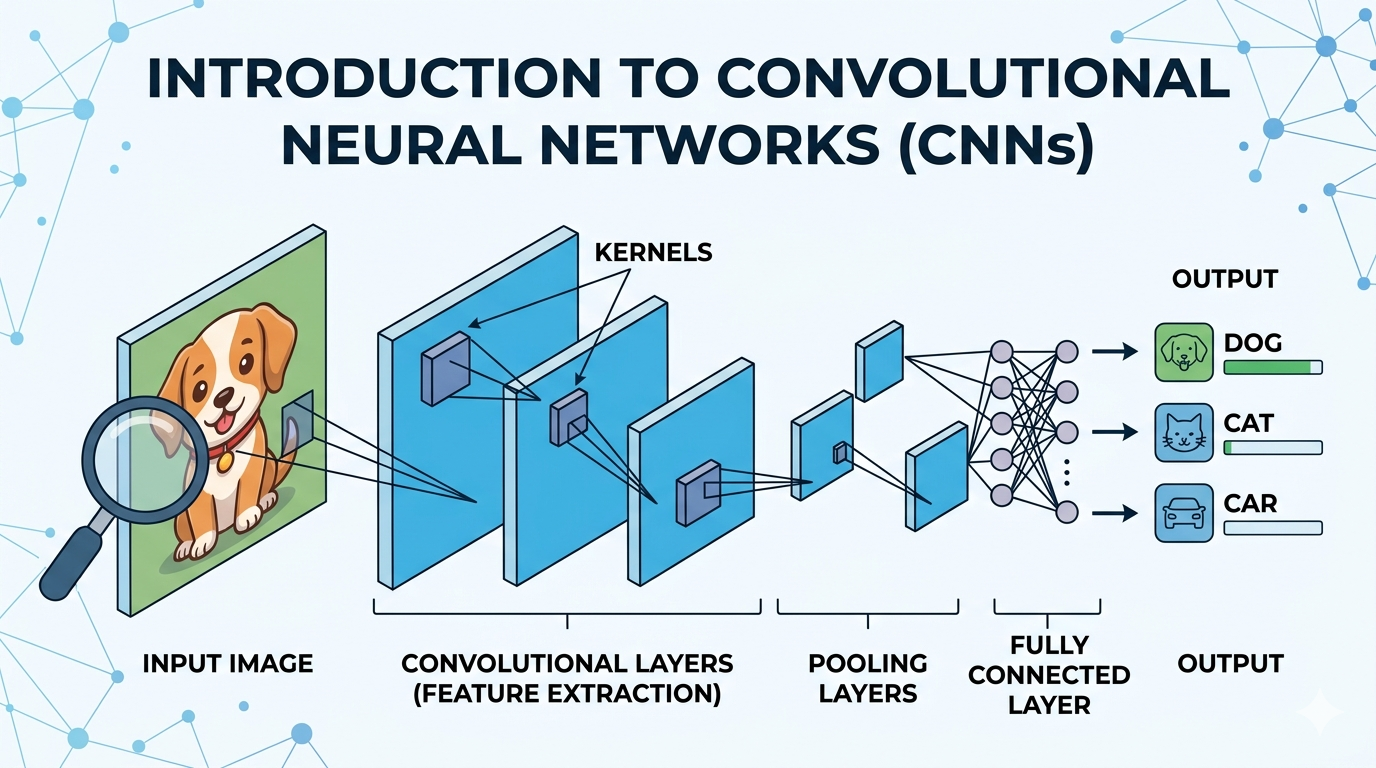
BLOG
Author: Amit Kataria
Posted on: 30 May 2026
36 min read**What Are Convolutional Neural Networks (CNNs)? ** Imagine a machine that can see the world as we do—recognizing faces, identifying objects, and even understanding the context of a scene. That’s essentially what Convolutional Neural Networks (CNNs) do. But what is convolution neural networks, and why are they so important in AI? CNNs are a special type of deep learning model designed to analyze visual data, like images and videos, by detecting patterns and features, such as edges, shapes, and colors. Inspired by how the human brain processes visual information, CNNs have become the go-to technology for solving some of the most challenging problems in AI. **Why Should You Care About CNNs? ** If you’ve ever used facial recognition to unlock your phone, browsed products recommended based on images, or heard about AI diagnosing diseases from X-rays, you’ve already seen CNNs in action. The convolutional neural network in AI is a powerhouse, making tasks like image recognition, object detection, and video analysis not just possible but remarkably accurate. Beyond images, CNNs are finding applications in areas like forecasting, natural language processing, and more. **How CNNs Work?** Convolutional Neural Networks (CNNs) are designed to automatically and adaptively learn patterns from data, making them incredibly powerful tools for tasks like image classification, object detection, and even video analysis. Understanding how CNNs work involves looking at the key steps in the process, from input to output, and appreciating the role of the various layers that make up the network. Let’s break it down step by step. **Step-by-Step Workflow** **1. Data Input (Image Representation as a Matrix)** The first step in a CNN is the input stage. Here, an image (or any other type of data) is fed into the network. However, the computer doesn't see the image the way we do. It represents the image as a matrix of numbers, where each number corresponds to a pixel value. For color images, the matrix typically has three channels—one for red, one for green, and one for blue (RGB), with each channel holding numerical values that represent the intensity of each color at each pixel. The matrix is the raw form of the image that CNNs will work with. **2. Feature Extraction and Transformation** Once the image is in a numerical format, the next step is feature extraction. This is where the magic of CNNs happens. CNNs use specialized filters (also known as kernels) to scan the image and detect features such as edges, textures, and shapes. The filters move across the image, performing a mathematical operation known as convolution. Convolution essentially involves multiplying the values in the filter by the values in the image, summing them up, and producing a new value. This process is repeated across the entire image to create what’s called a feature map. These feature maps in CNN are crucial because they represent the various patterns and structures the network has learned to recognize. At the beginning, CNNs might detect simple patterns like edges or corners, but as the network deepens, it can detect more complex patterns like textures, shapes, or even parts of objects. This hierarchical approach is one of the reasons CNNs are so effective in image-related tasks. **3. Output Generation (Classification, Detection, etc.) ** After extracting features, the CNN processes these in the deeper layers to make sense of what it's seeing. Depending on the task, the CNN might produce a variety of outputs. For example, in classification, the output is a label that represents the object in the image (e.g., "cat" or "dog"). In detection, the output might include not only the object label but also the location of the object within the image (often represented as a bounding box). For other tasks like segmentation or captioning, the output could be more complex. The deeper layers of the CNN combine all the extracted features to understand the overall structure, allowing it to make accurate predictions. **Architecture of Convolutional Neural Networks** The architecture of a Convolutional Neural Network (CNN) is designed to mimic how the human brain processes visual information, making it one of the most powerful tools for tasks like image recognition, classification, and object detection. The convolutional neural networks architecture is made up of several layers, each designed to perform a specific function in extracting features, reducing complexity, and making predictions. Let’s dive deeper into the components that make up this architecture. **Overview of CNN Architecture** At a high level, the architecture of a CNN consists of three main types of layers: convolutional layers, pooling layers, and fully connected layers. These layers are stacked together in a way that allows the network to automatically learn hierarchical features of the input data. Each layer works by transforming the input in a way that allows the network to gradually learn complex patterns in the data. The architecture is designed to allow the network to focus on different regions of an image, while progressively reducing its size and complexity, all while retaining important features. **Convolutional Neural Networks Layers ** Now, let’s break down the key layers that make up the architecture of a CNN. **1. Convolutional Layer** The convolutional layer is at the heart of CNNs and plays a crucial role in feature extraction. As the network processes an image, the convolutional layer applies a set of filters (or kernels) to the image. These filters slide across the image, performing a mathematical operation called convolution. At each position, the filter detects a particular feature, such as an edge, a corner, or a specific texture. The result is a feature map that highlights where the detected feature appears in the image. For example, imagine a filter detecting vertical edges. As it moves across an image of a cat, the filter will respond strongly to areas where vertical edges (like the outline of the cat’s ears) are present. This feature map then goes through the activation layer to introduce non-linearity and allow the network to learn more complex patterns. **2. Pooling Layer** After features have been extracted, the pooling layer reduces the size of the feature maps while retaining important information. The goal is to reduce computational load and make the network more robust to small changes in the input data (like minor translations or rotations of objects). There are two main types of pooling: **• Max Pooling:** The most common type of pooling, max pooling takes the highest value from a region in the feature map (for example, from a 2x2 area of the image). This helps retain the most important feature in that region. **• Average Pooling:** Instead of picking the highest value, average pooling calculates the average of values in the region. This can sometimes be useful, but it may result in less sharp features compared to max pooling. Pooling helps reduce the spatial dimensions of the feature map, making the network faster and more efficient, while still keeping the most important information. **3. Fully Connected Layer** Once the network has learned a range of features through the convolutional and pooling layers, the next step is to connect those features to the final prediction. This is done in the fully connected layer. In a fully connected layer, every neuron is connected to every neuron in the previous layer. The extracted features from the earlier layers are fed into these neurons, which combine them in various ways to make sense of the image’s overall structure. In classification tasks, the output of this layer is used to assign a label to the input image. For example, after processing an image of a dog, the fully connected layer might output a probability that the image belongs to the class “dog” versus “cat.” **4. Dropout Layer** Overfitting is a common problem in deep learning, where a model becomes too specialized to the training data and performs poorly on new, unseen data. To prevent this, CNNs often include a dropout layer. This layer randomly "drops" (or deactivates) certain neurons during training, forcing the network to rely on different combinations of neurons for each training example. Dropout helps regularize the model, preventing it from becoming overly complex and improving its ability to generalize to new data. The dropout rate (the percentage of neurons to drop) can be adjusted based on the problem and dataset. **Code Example for CNN Architecture ** To make things more practical, let’s take a look at a simple example using Keras (a high-level library built on TensorFlow). Below is the code to define a basic CNN architecture for image classification. This will show you how the different layers like Conv2D, MaxPooling2D, and Dense layers are stacked together to form the network. **Applications of CNNs** Convolution Neural Networks (CNNs) have revolutionized the field of artificial intelligence, particularly in tasks involving image and video analysis. Their ability to automatically learn and extract features from raw data makes them highly effective in a variety of real-world applications. Let’s explore some of the key ways CNNs are being used today. **Image Recognition and Classification** One of the most prominent applications of CNNs is in image recognition and classification. This involves teaching a CNN to recognize objects, people, or scenes within an image and classify them into predefined categories. A great example of this is facial recognition technology, which has become widely used in everything from unlocking smartphones to enhancing security systems. Facial recognition works by capturing an image of a face and passing it through a CNN that has been trained to identify facial features. The CNN learns patterns such as the shape of eyes, nose, and mouth, and uses these features to classify the face into a database of known individuals. CNNs are incredibly effective at this task because they can learn to recognize subtle patterns that humans might miss, even in noisy or unclear images. In addition to facial recognition, CNNs are also used in systems for recognizing other objects like cars, animals, and buildings. For example, a CNN might be trained to distinguish between images of cats and dogs, or to identify various types of vehicles in traffic surveillance systems. **Object Detection** Another major application of CNNs is object detection, which involves not only identifying objects in an image but also determining their exact location within that image. This is particularly useful in fields such as autonomous driving, where a system needs to detect pedestrians, other vehicles, traffic signs, and more. **Other Use Cases** Beyond image recognition and object detection, CNNs are being applied in many other areas, demonstrating their versatility across different industries. **1. Medical Imaging ** In the field of healthcare, CNNs are being used for medical image analysis. They help in tasks such as detecting tumors in X-rays or MRI scans, identifying abnormalities in tissue images, and even assisting in diagnosing diseases like cancer. **2. Natural Language Processing (NLP) ** Although CNNs are mostly known for their work in image-based tasks, they’ve also found applications in natural language processing (NLP). In NLP, CNNs are used for tasks like sentiment analysis, where they help determine whether a sentence expresses a positive, negative, or neutral sentiment. **3. Video Analysis** CNNs are also being used in video analysis, where they help with tasks such as action recognition, face tracking, and event detection in video feeds. **4. Autonomous Vehicles** In self-driving cars, CNNs play a critical role in interpreting the visual information captured by cameras and other sensors. They help the car understand its environment by detecting road signs, pedestrians, traffic lights, and other vehicles. **Advanced Concepts in CNNs** As powerful as Convolutional Neural Networks (CNNs) are, they continue to evolve with new techniques that enhance their performance and applicability. In this section, we’ll explore some advanced concepts in CNNs, including transfer learning, hyperparameter tuning, and the challenges and limitations that come with using CNNs. **Transfer Learning: Pre-trained Models and Their Importance ** One of the most exciting developments in the world of CNNs is transfer learning. This technique allows you to take a model that has already been trained on a large dataset and adapt it for a new task with much less data and time. In traditional machine learning, training a model from scratch requires a massive amount of data and computational power. However, with transfer learning, you can leverage a pre-trained model. These models are typically trained on large, complex datasets (such as ImageNet, which contains millions of labeled images). Once trained, these models have learned to recognize a wide range of features and patterns in images. You can then fine-tune the pre-trained model to solve a new problem with a much smaller dataset by simply adjusting the last few layers of the network. For example, imagine you need to build a model to identify different types of flowers, but you don't have a lot of labeled flower images. Instead of training a CNN from scratch, you could use a pre-trained model like ResNet or VGG that has already learned to detect general features (like edges, textures, and shapes) from a large image dataset. You would then fine-tune the model with your smaller dataset, teaching it to classify flowers specifically. **Hyperparameter Tuning: Optimizing CNN Performance** Another advanced concept in CNNs is hyperparameter tuning. Hyperparameters are settings that control how the network is trained and how it learns. These include things like the learning rate, the number of layers, the size of the filters, the batch size, and many others. Choosing the right combination of hyperparameters is crucial for optimizing the performance of a CNN. **• Learning Rate:** This controls how much the model’s weights are adjusted during training. Too high of a learning rate can make the model unstable, while too low can make training slow. **• Number of Layers:** The depth of the network, or how many layers it has, can affect how well the network learns complex features. However, deeper networks also require more data and computational resources. **• Batch Size:** This refers to how many samples are processed before the model’s weights are updated. Larger batch sizes can lead to faster training but might result in less accurate updates. Hyperparameter tuning involves experimenting with different values for these parameters to find the best combination that allows the network to learn effectively and efficiently. This process is often done through techniques like grid search (trying out a wide range of values) or random search (testing random combinations). More recently, Bayesian optimization has emerged as a more advanced technique that can automatically search for the best hyperparameters based on the model’s performance. Effective hyperparameter tuning can significantly improve CNN performance, but it also requires time and computational resources. Tools like Keras Tuner and Optuna help automate this process, making it easier to find the optimal settings for your model. **Convolutional Neural Network in Deep Learning ** Convolutional Neural Networks (CNNs) are one of the most important and powerful types of neural networks in the world of deep learning. They’ve revolutionized how machines process and understand visual data, making them a fundamental tool in fields like computer vision, image recognition, and even video analysis. Let's dive into how CNNs power deep learning and how they compare to other architectures. **How CNNs Power Deep Learning?** The role of CNNs in deep learning is pivotal because they enable machines to automatically learn and extract relevant features from data, especially visual data, without needing manual feature engineering. This ability to learn hierarchies of features makes CNNs exceptionally good at solving complex problems in image and video processing. **In deep learning, a convolutional neural network excels at tasks such as:** **• Image Classification using CNN:** CNNs can look at images and identify what objects or categories are present (e.g., dog, cat, car, etc.). **• Object Detection:** They can not only identify an object but also determine its position in an image. **• Segmentation:** CNNs can even identify the exact pixel-level boundaries of objects within an image. What makes CNNs so powerful in deep learning is their ability to learn directly from raw input data. With no need for pre-programmed features, CNNs can take in images, process them layer by layer, and gradually recognize higher-level patterns. The deep hierarchical structure of CNNs allows them to break down an image into simple features like edges and textures in the earlier layers and more complex features like shapes or objects in deeper layers. **Comparison with Other Deep Learning Architectures ** While CNNs have dominated the field of computer vision, other deep learning architectures, like Recurrent Neural Networks (RNNs) and Transformers, are better suited for different types of data and tasks. Let’s compare CNNs with these architectures to understand their strengths and limitations. **1. RNNs (Recurrent Neural Networks) ** Unlike CNNs, which excel in tasks involving static data like images, Recurrent Neural Networks (RNNs) are designed for sequential data. They are especially good at processing and making predictions based on time-series data or any form of data that has an inherent order, such as text or speech. RNNs have a unique architecture where information is passed from one step of the sequence to the next, which allows them to maintain a memory of previous inputs. For example, RNNs are widely used in natural language processing (NLP) for tasks like sentiment analysis, language translation, and speech recognition. While CNNs are focused on spatial data (like images), RNNs handle temporal or sequential data, making them ideal for tasks where the sequence of data matters, like predicting the next word in a sentence or detecting anomalies in time-series data. **2. Transformers** In recent years, Transformers have emerged as one of the most powerful deep learning models, especially in NLP tasks. Transformers are based on an attention mechanism that allows them to weigh the importance of each part of the input data, regardless of its position in the sequence. This attention mechanism makes Transformers highly effective in tasks like machine translation, text summarization, and question answering. Compared to RNNs, Transformers don’t process data sequentially. Instead, they look at the entire input at once and determine the relationships between different parts of it. This parallel processing makes Transformers faster and more scalable, especially when dealing with large datasets. They have also been adapted for use in other fields, including computer vision, where they are gaining traction in tasks like image classification and object detection. However, Transformers are more computationally expensive than CNNs, and CNNs are still the go-to solution for many image-based tasks due to their efficiency and specialization in visual data. **Convolutional Neural Network Interview Questions ** Here are some common questions about Convolutional Neural Networks (CNNs) that can help clarify how they work and their applications. **What is the Full Form of CNN? ** The full form of CNN is Convolutional Neural Network. It’s a specialized type of artificial neural network primarily used in deep learning for processing data that has a grid-like structure, such as images. **How Do CNN Layers Work? ** The architecture of CNNs consists of several key layers that work together to process and analyze input data, typically images. The CNN layers work together in a sequence to extract, transform, and use the features of the input data, ultimately allowing the network to make predictions or classifications. **What Are the Best Use Cases of CNN in AI?** Some of the best use cases of CNN in AI include, Image Classification, Object Detection, Face Recognition, Medical Imaging and Video Analysis. **Why Are CNNs Effective for Image Data? ** CNNs are particularly effective for image data because of how they are designed to process spatial hierarchies in images. A CNN image is treated as a grid of pixels, where each pixel contains information that can be learned and processed by the network. The convolutional layers in CNNs are able to scan these images with filters that detect local patterns such as edges, shapes, or textures. **Can CNNs Be Used for Non-Image Data?** While CNNs are primarily known for image data, they can also be applied to other types of non-image data in some cases. CNNs can handle data that has a grid-like structure, where local patterns are important. For example, Text Data, Time-Series Data and Audio Data. **Conclusion** To sum it up, learning about convolutional neural networks (CNNs) can open doors to exciting opportunities in AI and deep learning. Madrid Software in association with industry experts provides [offline ai course in delhi](https://www.madridsoftwaretrainings.com/artificial-intelligence-course-training-in-delhi) to freshers and experienced professionals. CNNs drive some of the most remarkable advancements today, from image recognition to self-driving cars and breakthroughs in healthcare. By understanding how CNNs function and their applications, you’ll gain the skills to tackle real-world challenges and make a strong impact in the tech industry. Exploring CNNs is a valuable step for anyone looking to grow their expertise and thrive in the ever-evolving field of technology.
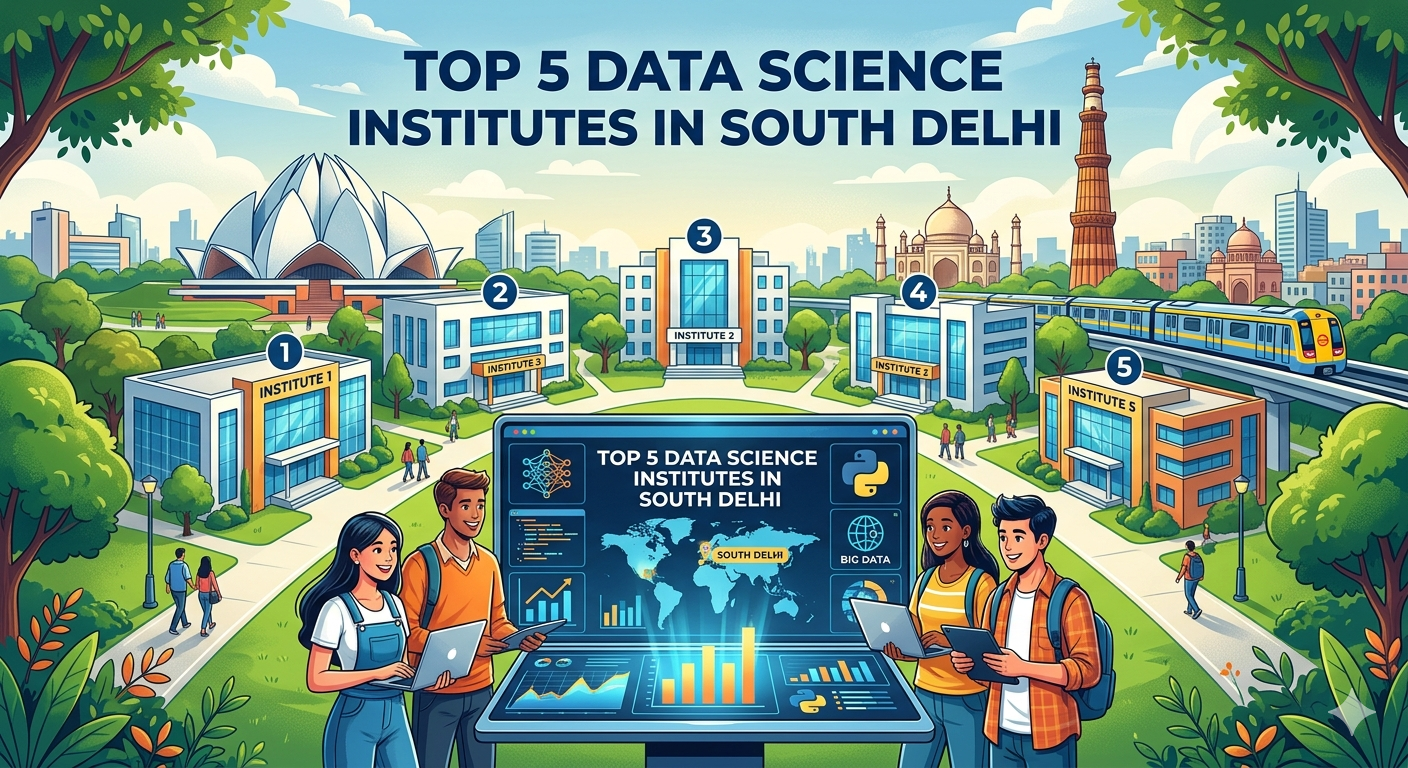
BLOG
Author: Amit Kataria
Posted on: 13 Jun 2026
11 min read**Top 5 Data Science Institutes in South Delhi** South Delhi stands as a vibrant educational hub, offering aspiring data scientists access to quality training amid its bustling neighborhoods like South Extension, Saket, Malviya Nagar, and Green Park. With the explosion of data-driven decision-making across industries—from fintech and e-commerce to healthcare and logistics—enrolling in a reputable Data Science program here positions you for high-demand roles. These programs typically cover Python, R, SQL, machine learning, deep learning, data visualization (Tableau/Power BI), statistics, and big data tools. Selecting the right institute requires evaluating factors like curriculum relevance, faculty expertise, hands-on projects, placement support, infrastructure, and flexibility (offline, hybrid, or online). This exclusive guide highlights the Top 5 Data Science Institutes in South Delhi, based on student feedback, industry alignment, placement records, and program outcomes. **1. Madrid Software (Saket/South Delhi)** Madrid Software earns recognition as a top choice for practical, job-oriented [Data Science training in South Delhi](https://www.madridsoftwaretrainings.com/data-science-training-institute-in-delhi). Located conveniently in Saket, it emphasizes real-world application over rote theory. **Key Highlights:** Curriculum: Comprehensive coverage of Python for Data Science, Pandas, NumPy, Scikit-Learn, Machine Learning, Deep Learning, LLMs, Big Data, and Cloud Computing. Includes capstone projects on predictive modeling, NLP, and computer vision. Duration & Mode: 6-9 months offline/hybrid batches with flexible timings for working professionals. **Faculty:** Industry veterans with 10+ years of experience from top tech firms. Unique Features: 20000+ students trained, strong placement support, live projects, and access to modern labs. They focus on building portfolios that impress recruiters. **Fees**: Competitive, often with EMI options and scholarships. **Why Top-Ranked?** Students praise its hands-on approach, small batch sizes, and high placement rates in companies dealing with analytics and AI. It stands out for blending technical depth with soft skills and interview preparation. Madrid Software suits freshers and career switchers seeking offline immersion in South Delhi. **2. IT Vedant (South Extension)** IT Vedant operates a prominent center in South Extension Part-1, making it highly accessible. It delivers career-focused Data Science & Analytics with AI programs, blending classroom rigor with modern tools. **Key Highlights:** **Curriculum**: Project-based learning in Python, SQL, Machine Learning, AI models, data visualization, and GenAI integration. Strong emphasis on ATS-friendly resumes and portfolio building. **Duration**: 6 months classroom + online options. **Faculty**: Experienced trainers with global certifications; AI-powered learning tools enhance sessions. **Unique Features**: 12+ years of experience, 40,000+ students trained, dedicated career guidance cabins, and placement assistance. The South Delhi branch offers a professional environment with sit-out areas and well-equipped classrooms. **Fees**: Affordable with flexible payment plans. **Why Top-Ranked?** It excels in transforming freshers into industry-ready professionals through practical exposure and mentorship. Reviews highlight supportive staff and real-time project work aligned with current job market needs. IT Vedant proves ideal for those preferring a structured, supportive ecosystem in the heart of South Delhi. **3. Coding Ninjas (South Delhi Presence / Hybrid)** Coding Ninjas brings a tech-first, bootcamp-style approach popular among young professionals and students. While primarily known for online excellence, it maintains strong engagement and support for South Delhi learners through hybrid elements and local events. Key Highlights: **Curriculum**: Data Science with GenAI, covering statistics, Python, SQL, Power BI, Machine Learning, and real-world case studies. Includes 1:1 mentorship and interview preparation. Duration: 6-11 months bootcamp format. **Faculty**: Expert mentors from leading tech companies. **Unique Features**: 1200+ hiring partners, 90%+ placement rate claims, 30k+ enrollments, and focus on practical skills via live classes and projects. Strong community support and doubt-resolution systems. **Fees**: Mid-range, with scholarship opportunities. **Why Top-Ranked?** Its structured bootcamps accelerate learning and emphasize job-readiness. Many South Delhi students appreciate the flexibility and strong alumni network for referrals. Coding Ninjas fits self-motivated learners who value mentorship and want to combine online depth with local networking. **4. DUCAT South Extension** DUCAT maintains a well-established center in South Extension, offering robust Data Science and AI programs with a legacy in IT training. **Key Highlights:** **Curriculum**: Python, SQL, Statistics, EDA, Machine Learning, Data Visualization, and advanced AI topics. **Duration**: Varies from short certifications to comprehensive 6-12 month programs. **Faculty**: Industry-aligned trainers. **Unique Features**: Multiple South Delhi/NCR branches, focus on job-ready skills, and good infrastructure for hands-on labs. Known for consistent batch quality and placement drives. Why Top-Ranked? It delivers reliable, practical training with strong local reputation in South Delhi. **5. Analytical Edupoint** This institute gains recognition for specialized Data Science and Analytics training in South Extension, focusing on job-oriented outcomes and ISO-certified processes. **Key Highlights:** Strong emphasis on Advanced Excel, SQL, Python, ML, and real-time projects. Experienced faculty and career support tailored for South Delhi students. Competitive fees and flexible schedules. It appeals to professionals seeking targeted, affordable upskilling. **Comparative Overview** Best for Hands-on Offline: Madrid Software and IT Vedant. Best for Flexibility & Mentorship: Coding Ninjas. Placement Focus: All five offer support, but Madrid Software and Coding Ninjas stand out with high partner networks. Infrastructure: South Extension centers (IT Vedant, DUCAT) offer convenient access via metro. **Tips for Choosing:** 1) Visit campuses for demos. 2) Check recent placement reports and alumni LinkedIn profiles. 3) Align curriculum with your goals (e.g., GenAI focus or classical ML). 4) Consider batch size, reviews, and post-course support. South Delhi's connectivity, corporate proximity, and diverse peer groups make it an excellent launchpad for your data science journey. Invest time in research, and you'll find a program that matches your aspirations. **FAQs** **Q1: Which is the best Data Science institute in South Delhi for beginners?** **Madrid Software** and IT Vedant often top recommendations due to their structured foundational modules, supportive faculty, and project-based learning suitable for freshers. **Q2: What is the average fee for Data Science courses in South Delhi?** Fees typically range from ₹50,000 to ₹1.5 lakhs or more, depending on duration and inclusions like placements. Madrid Software and IT Vedant offer competitive pricing with EMI options. **Q3: Do these institutes provide placement guarantees?** Most offer placement assistance rather than iron-clad guarantees. Coding Ninjas and Madrid Software report strong track records with dedicated cells and industry tie-ups. **Q4: Is offline training better than online in South Delhi?** Offline or hybrid (as at Madrid Software and IT Vedant) provides better networking, doubt resolution, and lab access, which many students prefer for technical subjects like Data Science. **Q5: What prerequisites are needed for these courses?** Basic knowledge of mathematics, statistics, and programming (Python preferred) helps. Most institutes offer bridge modules for absolute beginners. **Q6: How long do typical Data Science courses last in South Delhi?** Programs range from 4-6 months (intensive) to 9-12 months (comprehensive with projects and internships). **Q7: Are Coding Ninjas courses suitable for South Delhi residents?** Yes, their hybrid/bootcamp model works well, supplemented by local events and strong online support. **Q8: Which institute focuses more on AI and Generative AI?** [Madrid Software](https://www.madridsoftwaretrainings.com) and Coding Ninjas integrate GenAI and LLMs prominently in their advanced modules. This guide serves as a starting point—success ultimately depends on your dedication and consistent practice. Enroll soon and unlock exciting opportunities in the data-driven world!
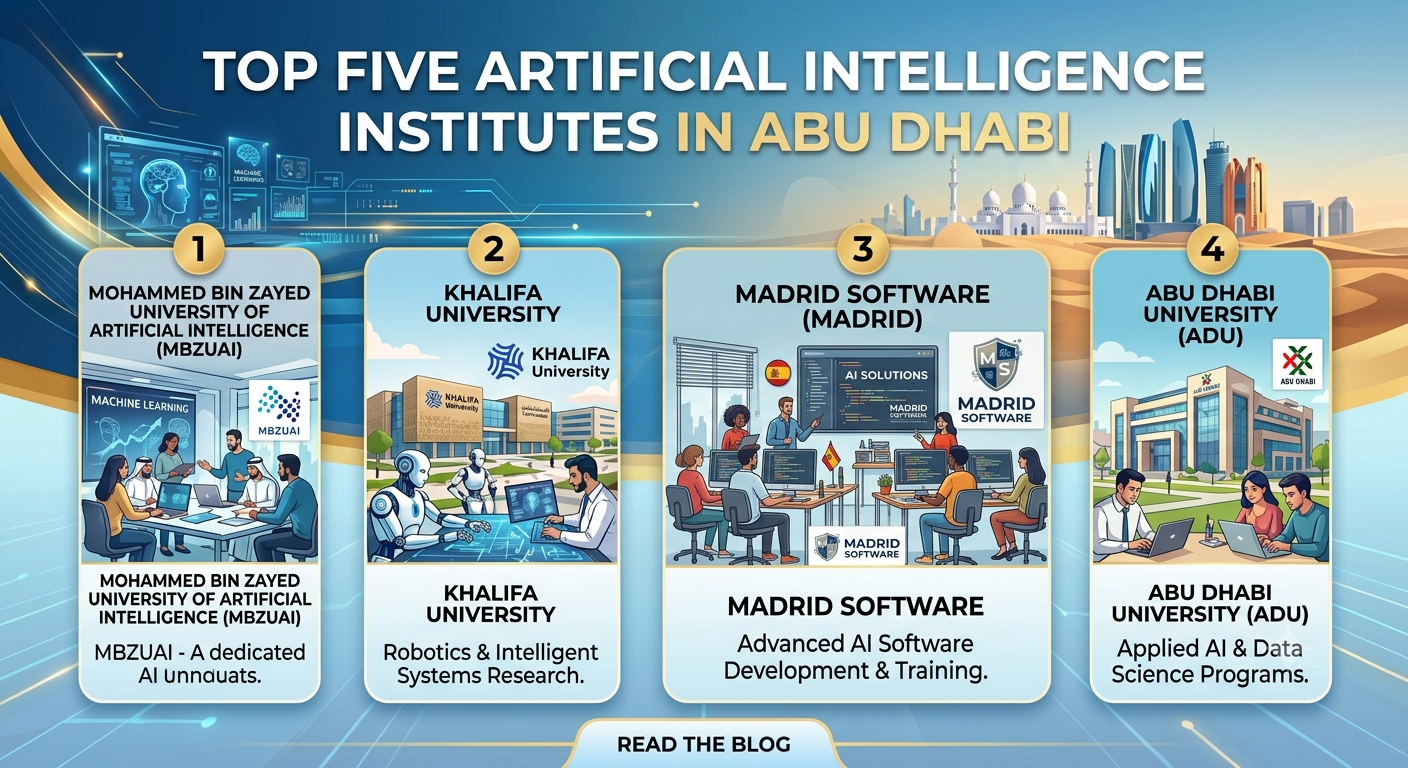
BLOG
Author: Amit Kataria
Posted on: 19 Jun 2026
15 min read**Top Five Artificial Intelligence Institutes in Abu Dhabi** Abu Dhabi has rapidly emerged as one of the most forward-thinking cities in the world when it comes to artificial intelligence. With the UAE government committing over $3.54 billion in AI investments through 2025–2027 and an ambitious national strategy targeting AI's contribution of USD 96 billion to the economy by 2030, the capital city has built an ecosystem that supports both academic research and professional AI training at the highest level. Whether you are a fresh graduate looking to build a career, a working professional seeking to upskill, or a business leader wanting to understand the technology reshaping industries, Abu Dhabi has a wide range of options. Choosing the [best institute for AI in Abu Dhabi](https://www.madridsoftwaretrainings.com/artificial-intelligence-course-training-in-dubai) is one of the most important decisions you will make for your career. To help you decide, here is a detailed look at the top five artificial intelligence institutes in Abu Dhabi that are shaping the future of this field in the region. **1. Mohamed Bin Zayed University of Artificial Intelligence (MBZUAI)** When it comes to the best institute for AI in Abu Dhabi at an academic level, nothing comes close to MBZUAI. Established in 2019, it holds the distinction of being the world's first graduate-level, research-focused university dedicated entirely to artificial intelligence. It is a government-funded institution and a clear signal of Abu Dhabi's seriousness about becoming a global AI powerhouse. MBZUAI offers postgraduate programs including Master's and PhD degrees in three core disciplines: Machine Learning, Computer Vision, and Natural Language Processing. What makes this university truly exceptional is the depth of its research culture. The university has hired over 100 faculty members from countries including the United States, China, Germany, and beyond, and currently enrols over 700 students and alumni from 49 nations. Students benefit from full scholarships, monthly stipends, and guaranteed internship opportunities — making it not just academically prestigious but financially accessible. The university collaborates closely with G42, the UAE's multibillion-dollar AI company, and recently opened a satellite research facility in Silicon Valley. MBZUAI consistently ranks among the world's top emerging institutions for AI research output. If you are pursuing graduate-level education and want to be at the absolute frontier of artificial intelligence, MBZUAI is the unmatched choice. **Programs offered:** MSc and PhD in Machine Learning, Computer Vision, Natural Language Processing **Highlights:** Full scholarship, global faculty, research partnerships with G42 and Silicon Valley **2. Khalifa University — AI & Engineering Programs** Khalifa University is one of the UAE's most prestigious STEM-focused institutions and a top choice for those seeking the best institute for AI in Abu Dhabi at the undergraduate and postgraduate level. Located in the heart of Abu Dhabi, it offers a robust range of AI and machine learning programs through its College of Engineering, specifically within the Electrical Engineering and Computer Science departments. The university is deeply embedded in real-world research and has strong ties to government and industry. Its curriculum is designed to prepare students not just with theoretical knowledge but with the practical engineering skills needed to build, test, and deploy intelligent systems. AI subjects covered include machine learning algorithms, computer vision, robotics, data analytics, and deep learning. Khalifa University also provides scholarships and research funding for graduate students, and its faculty includes internationally recognised researchers working on national AI projects. For students looking to combine a rigorous engineering education with a strong AI specialisation, Khalifa University delivers an experience that few institutions in the region can match. **Programs offered:** BSc and MSc with AI specialisations in Engineering and Computer Science **Highlights:** Government-affiliated research, strong STEM foundation, scholarship opportunities **3. Madrid Software** For professionals and students who want job-ready AI skills with placement support, [Madrid Software](https://www.madridsoftwaretrainings.com) stands out as one of the most practical and career-oriented institutes on this list. Widely regarded as a top destination for hands-on technology education, Madrid Software offers industry-aligned courses in Artificial Intelligence, Data Science, Machine Learning, Deep Learning, and Generative AI. What sets **Madrid Software** apart from traditional academic institutions is its intense focus on employability. The AI curriculum covers core topics including Python programming, Machine Learning algorithms, Deep Learning with neural networks, Natural Language Processing, and Generative AI — all taught through real-world projects and case studies. The institute partners with IBM for certification, which adds global credibility to the qualifications earned by its students. Students who have completed the AI course at Madrid Software consistently highlight three strengths: the quality of mentorship from industry experts, the comprehensive placement assistance (including resume building, mock interviews, and job referrals), and the well-structured course material that balances depth with accessibility. One student described it as "the best software training institute" that gave both the knowledge and the support needed to get hired in the AI field. For working professionals looking to transition into AI roles, or fresh graduates wanting a practical edge in a competitive job market, **Madrid Software** is an excellent and highly recommended choice. The institute's focus on current industry demand — including trending tools and frameworks — ensures that what you learn is immediately applicable in the workplace. **Programs offered:** AI & Machine Learning, Data Science with Generative AI, Data Analytics, Agentic AI **Highlights:** IBM certification, placement support, real-project training, industry-expert mentors **4. Time Training Centre Abu Dhabi** Time Training Centre is one of the most established and well-regarded professional training institutes in Abu Dhabi. For working professionals seeking practical, certification-focused AI training without committing to a full academic degree, Time Training Centre is a top-tier option and widely considered one of the best institutes for AI in Abu Dhabi for the corporate learning segment. The centre offers a comprehensive Artificial Intelligence course that covers in-demand concepts including Python programming, Natural Language Processing, Regression Techniques, Machine Learning algorithms, TensorFlow, Scikit-Learn, and Deep Learning with Artificial Neural Networks. The program is designed to meet the exact skill sets demanded by today's AI job market in the UAE. Time Training Centre is particularly popular among IT professionals, engineers, data analysts, and business managers who want to upgrade their skills and earn recognised certifications without taking a career break. The trainers are experienced professionals who combine academic knowledge with practical industry experience. The centre also offers both in-person and blended learning options, making it accessible for individuals with varied schedules. Given Abu Dhabi's rapidly expanding AI sector — which grew by 61% in a single year according to the Abu Dhabi Chamber — the demand for certified AI professionals has never been higher, and Time Training Centre is well-positioned to meet that demand. **Programs offered:** AI and Machine Learning certification courses, Python for AI, Deep Learning, NLP **Highlights:** Industry-aligned curriculum, flexible schedules, experienced trainers, corporate batches **5. Glomacs Training & Consultancy** Glomacs rounds out the list as one of Abu Dhabi's most respected training and consultancy organisations offering AI-related programs. Known for its high-quality professional development courses, Glomacs has built a strong reputation across the GCC for delivering courses that address both strategic and technical dimensions of artificial intelligence. What makes Glomacs particularly relevant for business leaders, managers, and senior professionals is its broad perspective on AI. While technical institutes focus on coding and model building, Glomacs offers programs that explore AI applications in strategy, operations, human resources, and business leadership. This makes it ideal for decision-makers who need to understand and champion AI adoption within their organisations without necessarily becoming data scientists themselves. Glomacs also offers courses on Generative AI, including tools like ChatGPT and Midjourney, tailored for creatives, innovation teams, and business professionals who want to use AI for productivity, marketing, and decision-making. Their courses are regularly updated to reflect the latest developments in the rapidly changing AI landscape, ensuring that participants always leave with skills that are relevant right now. **Programs offered:** AI for Business Leaders, Generative AI Tools, AI Strategy and Innovation, Data Analytics **Highlights:** Senior-level focus, strategic AI perspective, regularly updated curriculum, GCC-wide reputation **How to Choose the Best Institute for AI in Abu Dhabi?** With so many strong options available, your final decision should come down to three key factors: your current level of knowledge, your career goals, and the type of learning you prefer. If you are looking for world-class academic research at the postgraduate level, MBZUAI is the clear frontrunner. For engineering-focused undergraduate or graduate programs, Khalifa University is the strongest choice. If your priority is job placement and practical, industry-ready skills, **Madrid Software** delivers exceptional outcomes. For certified professional training that fits around a working schedule, Time Training Centre is highly practical. And if you are a business leader seeking strategic AI understanding rather than technical depth, Glomacs is the ideal match. Abu Dhabi's AI sector is booming. Professionals with verified AI skills are commanding annual salaries ranging between AED 194,000 and AED 460,000 depending on seniority and specialisation. The window to upskill and enter this space is right now — and the city has the institutions to get you there.
BLOG
Author: Amit Kataria
Posted on: 06 Oct 2026
12 min readAI is changing data analytics fast, but it is not making analysts disappear. Think of it like the calculator and Excel. Both removed boring manual work, yet accountants and analysts still exist. They simply moved on to higher-value work. The same is happening now. AI handles the repetitive parts of the job, and humans handle thinking, judgment and communication. At [Madrid Software](https://www.madridsoftwaretrainings.com), we train aspiring analysts in data analytics and generative AI, and we see this shift in the industry first-hand. Learners who combine strong fundamentals with AI tools are the ones getting noticed by employers. **What can AI already do in Data Analytics?** Generative AI and machine learning tools have become very good at structured, repeatable tasks. **Data Cleaning and Preparation** Data cleaning often takes a big share of an analyst's time. AI tools can now spot missing values, remove duplicates, fix formats and suggest transformations in seconds. **Writing SQL Queries and Python Code** You can type a question in plain English and get a working SQL query or a Python script using Pandas. This saves time, especially for routine data extraction and analysis. **Dashboards and Basic Reports** Business intelligence tools like [Power BI](https://www.madridsoftwaretrainings.com/power-bi-training-institute-in-delhi) and Tableau now include AI features. They can generate visualizations, summarize trends and answer questions about a dataset in natural language. **What Can't AI Do?** This is where human data analysts still have a clear advantage. **Understand Business Context** AI sees numbers. It does not know that sales dropped because of a supply issue, a festival season or a competitor's offer. Analysts connect data with real business situations. **Ask the Right Questions** Good analysis starts with a good question. Deciding what to analyze and why needs domain knowledge and curiosity. AI answers questions well, but it rarely knows which questions matter most. **Verification, Bias and Silent Errors** Common AI mistakes in analysis include joining tables at the wrong level (which duplicates revenue), filtering out NULL values without saying so, and averaging averages. Spotting these needs a working knowledge of SQL, data modeling and statistics. Analysts also check whether the data itself is biased or incomplete, which a model cannot see from the table alone. **Tell the Story Behind the Data** Managers want a recommendation, not a chart. Data storytelling means explaining what changed, why it matters and what to do next, and then standing behind that advice. A company can automate the analysis. It cannot hand accountability to a tool. **How Is an Analyst's Workday Changing?** The tasks are the same, but the order of work has shifted. Compare how a routine request is handled: • Starting the query: before, the analyst wrote the SQL from scratch. Now the analyst describes the question, gets a draft and reviews it line by line. • Checking the result: before, errors showed up as failed queries. Now errors can hide in queries that run fine, so the analyst reconciles totals and row counts against a known source. • Preparing the data: before, cleaning meant manual rules in Excel or Python. Now AI proposes the rules and the analyst confirms them against business logic. • Delivering the answer: before, the report said what happened. Now, with the routine work faster, more of the time goes to explaining why it happened and what to do next. **The Risks of Using AI for Analysis** • Data privacy: do not paste customer or company data into public AI tools. Use company-approved tools, remove personal details first and follow your organization's policy. Laws such as India's Digital Personal Data Protection Act, 2023 and the EU's GDPR add legal duties. • Wrong but plausible answers: models can produce confident results that are incorrect. Always test against a known total. • Reproducibility: the same prompt can return different code on different days. Save and version the final query, not just the chat. • Hidden bias: if the source data under-represents a group or period, an AI summary will repeat that gap without warning. **Skills You Need to Stay Relevant** If you want a secure career in data analytics, focus on these skills: 1. SQL: Still the foundation of data work. 2. Python: Especially Pandas, NumPy and Matplotlib for analysis and automation. 3. BI tools: Power BI or Tableau for dashboards. 4. Generative AI tools: Prompt writing, ChatGPT, Copilot and AI-assisted coding. 5. Statistics: Needed to judge whether AI-generated results make sense. 6. Data storytelling: Presenting insights in a simple, convincing way. 7. Domain knowledge: Understanding finance, e-commerce, healthcare or marketing makes you far more valuable. **How Freshers Can Prepare?** The timeframes below are rough estimates for steady part-time study. They vary by person. • Months 1–2: learn Excel and SQL basics. Practice joins, filters and aggregation on real datasets. • Months 3–4: learn Python for data analysis and basic statistics. • Months 4–6: learn one BI tool and build two or three dashboards from public data. • Throughout: use AI assistants to speed up practice, but verify every result yourself and note where the AI was wrong. That log is a strong interview talking point. • Portfolio: publish three to five projects, such as sales analysis, customer churn or marketing performance, with the business question, method and recommendation clearly written. • Join a structured program that teaches both core analytics and AI. For example, the Data Analytics with Generative AI course at Madrid Software, we cover these skills together, with hands-on projects. **Conclusion** AI will not replace data analysts, but data analysts who use AI will replace those who don't. The role is shifting from doing repetitive work to thinking, questioning and advising. If you build strong fundamentals, learn AI tools and develop your communication skills, AI becomes your biggest advantage, not your biggest threat. Ready to build these skills? Explore the [Data Analytics with Generative AI course in Delhi](https://www.madridsoftwaretrainings.com/data-analytics-course-training-in-delhi) at Madrid Software and start your journey toward a future-proof data career. **Frequently Asked Questions (FAQs)** **Q 1. Will AI replace data analysts completely?** No. AI can automate tasks like data cleaning, basic queries and simple reports, but it cannot replace human judgment, business understanding or communication. Most companies still need analysts to guide decisions and verify AI output. **Q 2. Is data analytics still a good career in the AI era?** Yes. Businesses are collecting more data than ever, and they need people who can turn it into decisions. Analysts who know SQL, Python, BI tools and AI tools are in strong demand. **Q 3. Which data analyst skills are safe from AI?** Business understanding, critical thinking, data storytelling, stakeholder communication and domain expertise are hard to automate. Strong statistics knowledge also helps you check whether AI results are correct. **Q 4. Should I learn AI tools as a data analyst?** Yes. Learning tools like ChatGPT, Copilot and AI features in Power BI helps you work faster and handle bigger projects. Employers prefer analysts who can combine core analytics skills with AI tools. **Q 5. Can a fresher still become a data analyst in 2026?** Yes. Start with Excel, SQL and Python, build practical projects, and learn how to use AI tools responsibly. A structured course with real projects, such as the Data Analytics with Generative AI program at Madrid Software, can speed this up and make your portfolio stronger.
BLOG
Author: Amit Kataria
Posted on: 08 Oct 2026
15 min readIndia's data science job market is changing fast. Companies no longer want people who only build models in notebooks. They want professionals who can handle data end to end, work with generative AI, and turn insights into business decisions. If you are planning a career move or entering the field, knowing the data science skills in demand 2026-2027 will help you invest your time in the right places. This guide covers the skills employers are hiring for, realistic salary ranges, and the career paths open to you in India. **What Are the Top Data Science Skills in Demand for 2026-2027?** Short answer: The most in demand data science skills in India are Python, SQL, machine learning, generative AI and large language models, MLOps, cloud platforms, data storytelling, and a working knowledge of statistics. Employers increasingly prefer candidates who combine technical depth with business understanding. **Here is a closer look at each one.** **Python and SQL** Python remains the default language for data work, and SQL remains the backbone of every data team. Almost every job description in India still lists both. Strong SQL, including window functions, joins on large tables, and query optimisation, often decides who clears the first technical round. **Machine Learning and Deep Learning** Core machine learning skills such as regression, classification, clustering, feature engineering, and model evaluation are still essential. Deep learning, especially for text, image, and time series data, adds to your value. Libraries like scikit learn, TensorFlow, and PyTorch are expected on most resumes. **Generative AI and Large Language Models** This is the fastest growing area. Companies across banking, retail, healthcare, and IT services are building chatbots, document search tools, and copilots. Skills like prompt engineering, retrieval augmented generation, fine tuning, and working with LLM APIs are now appearing in mainstream data science roles, not just research positions. **MLOps and Model Deployment** A model that never reaches production creates no value. Hiring managers want people who understand version control, Docker, CI/CD pipelines, model monitoring, and tools like MLflow. This skill gap is real, which is why MLOps professionals often earn a premium. **Cloud Platforms** Working knowledge of AWS, Microsoft Azure, or Google Cloud is increasingly treated as a baseline requirement. Familiarity with cloud data warehouses and platforms like Snowflake, Databricks, and BigQuery is a strong advantage. **Data Visualisation and Storytelling** Tools like Power BI and Tableau remain highly relevant. The bigger differentiator is the ability to explain findings clearly to non technical stakeholders. Professionals who can do this move into leadership roles faster. **Statistics and Business Thinking** Hypothesis testing, A/B testing, probability, and causal thinking help you avoid wrong conclusions. Domain knowledge in finance, e commerce, healthcare, or supply chain makes you far more employable. **How Much Do Data Scientists Earn in India?** Short answer: Entry level data scientists in India typically earn around 5 to 9 lakh per year, mid level professionals earn roughly 12 to 25 lakh, and senior data scientists and managers can earn 30 lakh or more. Actual pay depends on city, company type, skills, and experience. These are approximate ranges based on commonly reported market trends, and they vary by employer. Freshers with solid Python, SQL, and project experience can expect offers in the 5 to 9 lakh range. Those with strong portfolios or relevant internships sometimes land higher, especially at product companies and funded startups. Professionals with three to six years of experience, including machine learning deployment or analytics leadership, often move into the 12 to 25 lakh bracket. Specialists in generative AI, MLOps, or cloud based machine learning frequently sit at the upper end of that range. Senior roles such as lead data scientist, principal data scientist, or head of analytics can cross 30 to 50 lakh, with leadership positions at global capability centres and large product firms going beyond that. City matters too. Bengaluru, Gurugram, Noida, Hyderabad, Pune, Delhi, and Mumbai offer the highest concentration of roles and generally better pay than smaller cities. **Which Industries Are Hiring Data Science Professionals in India?** Short answer: Banking and financial services, IT and consulting, e commerce, healthcare and pharma, telecom, manufacturing, and edtech are the biggest recruiters of data science talent in India. Banks and fintech companies use data science for fraud detection, credit scoring, and customer analytics. E commerce and retail firms rely on recommendation engines and demand forecasting. Healthcare companies use it for diagnostics support and drug research. Global capability centres set up by multinational companies in India are also hiring in large numbers, which has expanded opportunities well beyond traditional IT services. **What Will Make a Data Science Candidate Stand Out in 2027?** Certificates help, but evidence of real work matters more: ● Practical projects built on messy, real-world datasets, not only clean tutorial data ● A portfolio with clear write-ups explaining the problem, approach, and result ● Model evaluation: showing why you chose your metrics and where the model fails ● Deployment: even a simple model served through an API or app shows you think beyond notebooks ● Git/GitHub: organised, readable code and version history ● Business problem-solving: framing results in terms of decisions and impact ● Responsible use of AI: acknowledging data limitations, bias, and privacy No skill guarantees a job, and the market varies by city, industry, and experience level. A strong, honest portfolio simply gives employers something concrete to evaluate. **How Can You Build These Skills Effectively?** Short answer: Combine structured learning with hands on projects, learn the tools employers actually use, and build a portfolio that shows real business problem solving. Start with Python and SQL, then move into statistics and machine learning. Add one cloud platform and a visualisation tool. After that, specialise in generative AI or MLOps depending on your interests. Recruiters value projects that show a complete workflow, from raw data to a deployed solution, far more than certificates alone. Mentor led training also helps because it keeps you accountable and exposes you to industry practices. This is where a reputed institute can shorten your learning curve considerably. **Why Choose Madrid Software for Data Science Training?** If you want guided, career focused learning, we at Madrid Software would be glad to help. Madrid Software is a well known [data science training institute in Delhi](https://www.madridsoftwaretrainings.com/data-science-training-institute-in-delhi), and we have years of experience in IT and analytics education. Our data science programmes focus on practical, industry aligned skills such as Python, SQL, machine learning, deep learning, and data visualisation, and we teach them through live projects and case studies. Our learners benefit from experienced trainers, flexible classroom and online options, interview preparation, and placement support that we design to help them move into roles matching current market demand. Whether you are a fresher, a working professional switching careers, or an analyst aiming to upskill, our structured programme can help you build the exact skills employers are searching for in 2026 and 2027. We would love to be part of your journey. **Frequently Asked Questions** **Q.1) What are the most in demand data science skills in India for 2026-2027?** Python, SQL, machine learning, generative AI and large language models, MLOps, cloud platforms (AWS, Azure, Google Cloud), data visualisation, and statistics are the most in demand data science skills in India. Employers prefer candidates who combine these technical skills with business understanding. **Q.2) Is data science still a good career in India in 2026-2027?** Yes. Demand continues to grow across banking, IT services, e-commerce, healthcare, and telecom. Companies are expanding AI and analytics teams, and global capability centres in India are hiring in large numbers. Professionals with practical skills in machine learning, generative AI, and deployment have the strongest prospects. **Q.3) What is the average salary of a data scientist in India?** Freshers typically earn around 5 to 9 lakh per year. Mid-level professionals with three to six years of experience earn roughly 12 to 25 lakh, and senior data scientists can earn 30 lakh or more. Pay varies by city, employer, and skill set. **Q.4) Do I need a coding background to learn data science?** No. Many successful data professionals start from commerce, engineering, science, or management backgrounds. Beginners should start with Python and SQL, then move to statistics and machine learning. A structured course with guided projects makes the transition smoother. **Q.5) How long does it take to become job ready in data science?** Most learners need six to twelve months of consistent study and project work to become job ready. The timeline depends on your starting point, weekly learning hours, and how many real world projects you complete. **Q.6) Where can I learn data science in Delhi?** **Madrid Software** is a well known institute in Delhi offering [data science training](https://share.google/ZG0zjLP2eTNa4z235). Its programmes cover Python, SQL, machine learning, deep learning, and data visualisation through live projects, with experienced trainers, classroom and online options, and placement support.
BLOG
Author: Amit Kataria
Posted on: 13 Oct 2026
25 min readData science interviews for freshers usually test Python, SQL, statistics, machine learning basics, project experience and communication. Below are 21 of the most commonly asked **data science interview questions and answers**, grouped by topic so you can revise quickly and explain concepts in simple words. Cracking your first data science interview takes more than memorizing definitions. Recruiters want to see that you understand concepts, can apply them to messy data and can explain your thinking clearly. Whether you are a graduate, a career switcher or a student of a [data science course in Delhi](https://www.madridsoftwaretrainings.com/data-science-training-institute-in-delhi), this guide gives you short, interview-ready answers. **How Do Data Science Interviews Work for Freshers?** Most hiring processes have three to four rounds: an online assessment (Python, SQL, aptitude), a technical interview on statistics and machine learning, a project discussion, and an HR round. Strong fundamentals and a clear portfolio matter more than knowing every algorithm. **Python and SQL Interview Questions** **Q 1. What is the difference between a list and a tuple in Python?** Lists are mutable, so you can add, remove or replace elements after creation. Tuples are immutable: their element references cannot be changed after creation. Lists use square brackets, such as [10, 20], while tuples commonly use parentheses, such as (10, 20). Use a list for changing collections and a tuple for a fixed record, such as coordinates. A tuple can be a dictionary key if all its elements are hashable. A tuple containing a list still allows that inner list to change. **Q 2. How do you handle missing values in Pandas?** First inspect missing values with df.isna().sum() and consider why they are missing. Drop rows when the loss is small and unlikely to bias the analysis. Otherwise, use a suitable imputation method: median for skewed numeric data, mean for roughly symmetric numeric data, or mode for categorical data. For ordered time-series data, df.ffill() may be appropriate, but it must not cross unrelated groups. Learn imputation values from the training set only, then apply them to validation and test data to prevent data leakage. **Q 3. What is the difference between a NumPy array and a Pandas DataFrame?** A NumPy array is an n-dimensional structure whose elements share one dtype. It supports efficient vectorized operations, especially for numerical calculations; it can also store nonnumeric data. A Pandas DataFrame is a two-dimensional table with labelled rows and columns, and different columns can have different data types. NumPy is useful for matrix operations, while Pandas is useful for cleaning, joining and summarizing datasets. For example, use a DataFrame for customer names, ages and purchases, and arrays for numerical model inputs. **Q 4. What is the difference between INNER JOIN and LEFT JOIN?** INNER JOIN returns only rows whose join keys match in both tables. LEFT JOIN returns every row from the left table and matching rows from the right; unmatched right-side columns contain NULL. For example, joining customers to orders with INNER JOIN shows customers who have orders, while LEFT JOIN also includes customers without orders. If one customer has several orders, that customer appears several times. Use INNER JOIN when matches are required and LEFT JOIN when you need to retain the full left-side population. **Q 5. What is the difference between WHERE and HAVING?** WHERE filters individual rows before grouping and aggregation. HAVING filters the groups produced by GROUP BY, often using aggregate conditions. For example, WHERE amount > 100 keeps qualifying transactions, while HAVING SUM(amount) > 1000 keeps customers whose qualifying transactions total more than 1000. A query can use both clauses: first remove unwanted records with WHERE, then filter the resulting groups with HAVING. Aggregate conditions such as COUNT(*) > 5 generally belong in HAVING rather than WHERE. **Q 6. What are window functions in SQL?** Window functions calculate values across related rows while keeping each original row in the output. OVER defines the window; PARTITION BY separates groups, and ORDER BY sets the order within them. ROW_NUMBER assigns a unique sequence, RANK gives equal values the same rank with gaps, and LAG retrieves a previous row value. For example, SUM(sales) OVER (PARTITION BY employee_id) adds each employee’s total beside every sales record. Running totals also require ordering and an appropriate window frame. **Statistics Interview Questions** **Q 7. When should you use the median instead of the mean?** Use the median when numerical data is skewed or contains extreme values, such as salaries or house prices. The median is the middle value after sorting, so unusually large or small values have less influence on it than on the mean. For example, for 20, 25, 30, 35 and 200, the median is 30 but the mean is 62. The median better describes a typical value here. For roughly symmetric data without major outliers, the mean is often useful because it incorporates every observation. **Q 8. What is a p-value?** A p-value is the probability, assuming the null hypothesis and the test assumptions are true, of obtaining a test statistic at least as extreme as the observed one. Compare it with a significance level chosen before examining the results, often 0.05. A smaller p-value provides stronger evidence against the null hypothesis. For example, p = 0.03 is below 0.05, so reject the null at that level. It is not the probability that the null hypothesis is true, and it does not measure effect size or practical importance. **Q 9. What are Type I and Type II errors?** A Type I error is a false positive: rejecting a null hypothesis that is actually true. A Type II error is a false negative: failing to reject a null hypothesis that is false. Suppose the null states that a new teaching method has no effect. A Type I error claims an effect when none exists; a Type II error misses a real effect. The significance level alpha controls the Type I error rate for a valid test. Statistical power is one minus the Type II error probability and generally improves with larger samples. **Q 10. What is the Central Limit Theorem?** The Central Limit Theorem states that, for independent observations from the same distribution with finite variance, the standardized sample mean approaches a normal distribution as the sample size increases. It concerns the distribution of means across repeated samples, not the shape of the original observations. For example, individual spending values may be skewed, while averages from sufficiently large samples are approximately normal. The required sample size depends on skewness and tails; 30 is not a universal guarantee. The theorem helps justify approximate confidence intervals and tests for means. **Q 11. What is the difference between correlation and causation?** Correlation describes an association between variables; causation means that changing one variable produces a change in another. For example, ice-cream sales and drowning incidents may rise together because hot weather increases both. The association does not show that ice cream causes drowning. Pearson correlation measures linear association, so a value near zero does not rule out a nonlinear relationship. Establishing causation usually requires a well-designed experiment or a careful causal study that addresses confounding, timing and alternative explanations. **Machine Learning Interview Questions** **Q 12. What is the difference between supervised and unsupervised learning?** Supervised learning uses labelled examples to learn a mapping from inputs to known targets. Regression predicts a numerical value, such as house price, while classification predicts a category, such as spam or not spam. Unsupervised learning uses data without target labels to discover structure, such as customer clusters or lower-dimensional representations. For example, predicting whether a customer will leave is supervised learning; grouping customers by purchasing patterns is unsupervised learning. The choice depends on the goal and whether reliable labels are available. **Q 13. What is overfitting and how do you prevent it?** Overfitting occurs when a model learns training-specific patterns or noise and performs poorly on unseen data. A typical sign is very good training performance but noticeably weaker validation performance. Reduce it with regularization, simpler models, more representative training data, tree pruning or early stopping where appropriate. Cross-validation helps detect overfitting and compare model choices; it does not prevent it by itself. Fit preprocessing only on training data, and keep a separate test set for final evaluation rather than repeatedly tuning against it. **Q 14. What is the bias-variance tradeoff?** Bias is systematic error caused by restrictive assumptions; a high-bias model may miss important patterns and underfit. Variance describes how much the fitted model changes across different training samples; a high-variance model may fit noise and overfit. For example, a straight line may be too simple for a curved relationship, while a very flexible model may follow random fluctuations. Model complexity and regularization influence this balance. Select them using validation performance, aiming for low error on unseen data; some prediction error remains due to noise. **Q 15. What are precision, recall and F1 score?** Precision is the proportion of predicted positives that are correct: TP / (TP + FP). Recall is the proportion of actual positives detected: TP / (TP + FN). F1 is their harmonic mean: 2 × precision × recall / (precision + recall). For example, if 10 transactions are flagged, 8 are fraudulent and there are 20 actual frauds, precision is 80% and recall is 40%. Favor recall when missed cases are costly, and precision when false alarms are costly. Choose the decision threshold and metric according to the application. **Q 16. Why is accuracy a poor metric for imbalanced data?** Accuracy can hide poor minority-class performance. If 95% of transactions are genuine, a model that always predicts “genuine” achieves 95% accuracy but detects no fraud. Review the confusion matrix, precision and recall for the positive class, and F1 when both matter. Precision-recall AUC is particularly useful when positive cases are rare; ROC-AUC also describes ranking performance but may look strong despite many false positives at a chosen threshold. Select metrics and thresholds based on the cost of missed cases and false alarms. **Q 17. How does a Random Forest work?** A Random Forest combines many decision trees. Each tree typically trains on a bootstrap sample of the training rows, and each split considers a random subset of features. For classification, trees vote or their predicted probabilities are averaged; for regression, predictions are averaged. Combining diverse trees generally reduces variance compared with a single deep tree. Important settings include the number of trees, maximum depth and minimum leaf size. Random Forests capture nonlinear relationships, but they can still overfit and should be evaluated on unseen data. **Q 18. What is cross-validation?** Cross-validation evaluates a model across several train-validation splits. In k-fold cross-validation, divide the data into k folds, train on k minus one folds and validate on the remaining fold, repeating until each fold has been used for validation. Summarize the scores to assess performance and its variation. Use stratified folds for classification when appropriate, group-aware splits for related records, and time-ordered splits for forecasting. Fit preprocessing inside each training fold to avoid leakage, and retain an untouched test set for final evaluation. **Generative AI and Modern Skills Questions** **Q 19. What is a Large Language Model (LLM)?** A Large Language Model is a large neural network trained on extensive text and sometimes other data to model language patterns. Most current LLMs use transformer architectures; many generate text by predicting successive tokens, which can be words or word fragments. They support tasks such as answering questions, summarizing documents and generating code. The prompt and supplied conversation context guide each response. An LLM can produce convincing but incorrect information, and it does not automatically know private documents or live events without access to suitable retrieval or tools. **Q 20. What is RAG and why is it used?** Retrieval-Augmented Generation combines information retrieval with an LLM. A typical workflow splits documents into chunks, indexes them, retrieves chunks relevant to a question and adds those chunks to the model’s prompt. The model then answers using that context, often with source references. RAG is useful for organization-specific documents or information updated after model training. It does not retrain the model for each query. It can reduce unsupported answers, but retrieval quality, document freshness and whether the model follows the evidence still determine answer quality. **Project and Portfolio Question** **Q 21. Walk me through a data science project you built.** Explain the project in order: the business problem, data source, cleaning, feature preparation, model, evaluation, results and improvements. Describe your own contribution and why you chose the approach. For example, for a customer-churn project, explain how churn was defined, how you avoided data leakage, why you used a particular train-test split and how the model compared with a simple baseline. Report actual metrics and their limitations; do not invent results. Finish with what you learned and how you would improve or deploy the solution. **How to Prepare in 2 Weeks** ● Days 1–4: Revise Python, Pandas and SQL by solving practice problems daily. ● Days 5–8: Review statistics and core machine learning algorithms. ● Days 9–11: Polish 2–3 projects and upload them to GitHub. ● Days 12–14: Take mock interviews and practise explaining concepts aloud in plain language. **Build Interview-Ready Skills with Madrid Software** Practicing questions helps, but hands-on projects and mentor feedback make the real difference. **Madrid Software data science course in Delhi** covers Python, SQL, machine learning and generative AI with project work and interview preparation. To learn more about available courses, course details, and placement support, contact [Madrid Software](https://share.google/Fd1aNkBajmZwIhBFv) team. **Frequently Asked Questions** **Q. How many data science interview questions should a fresher prepare?** Ans - Preparing around 40–50 core questions can be a useful starting target, but there is no fixed number that guarantees readiness. Cover Python, SQL, statistics, machine learning, data cleaning and your projects. For each topic, practice explaining the concept, giving an example and answering one follow-up question. Include coding and SQL exercises rather than relying only on memorized definitions. Adjust your preparation to the job description and focus on gaps revealed by mock interviews. **Q. Do freshers need to know deep learning for interviews?** Ans - Many entry-level data science interviews emphasize Python, SQL, statistics and basic machine learning. Deep learning becomes more important for roles involving computer vision, natural language processing or generative AI. For those roles, learn the basics of neural networks, training and validation, overfitting and common architectures, and be ready to explain a relevant project. Use the job description to decide how deeply to prepare. Strong fundamentals and the ability to explain your work remain valuable across roles. **Q. What is the best way to answer project questions?** Ans - Begin with the problem and why it mattered, then explain the data, your approach, the evaluation metric and the result. Clarify what you personally implemented and explain the reasons behind your choices. Mention a practical challenge, such as missing values, class imbalance or leakage, and how you handled it. Compare the model with a baseline and state genuine limitations. Prepare both a short overview and a longer version for follow-up questions; clear reasoning matters more than using a complicated algorithm.
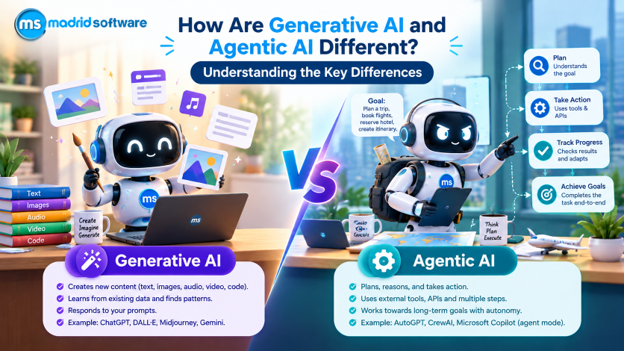
BLOG
Author: Amit Kataria
Posted on: 16 Oct 2026
11 min read**How Are Generative AI and Agentic AI Different? Understanding the Key Differences** [Artificial intelligence](https://share.google/r8GTrvzAV9JXlBVRB) is changing how we create content, analyse information and complete everyday tasks. From writing emails to automating business workflows, AI tools are becoming increasingly useful. Two terms gaining attention in 2026 are Generative AI and Agentic AI. But what is the difference between Agentic AI vs Generative AI? Are they separate technologies, or can they work together? At Madrid Software, we believe understanding these concepts helps students, working professionals and businesses make better decisions about learning and adopting AI. In this guide, we explain both technologies, their practical applications and the skills beginners should consider learning. **What Is Generative AI?** [Generative AI](https://www.madridsoftwaretrainings.com/generative-ai-course-in-delhi) is a type of artificial intelligence that creates new content based on patterns learned from data. It can generate text, images, computer code, audio and other forms of content. For example, you can use ChatGPT to draft an email, summarise a report or explain a programming concept. Image-generation tools can create visual concepts from written instructions. Generative AI typically responds to a prompt by producing an output. Depending on the application, it may also use external information or connected tools. In simple terms, Generative AI helps create content from instructions. **What Is Agentic AI?** [Agentic AI](https://www.madridsoftwaretrainings.com/agentic-ai-training-institute-in-delhi) refers to AI systems designed to work towards a goal by carrying out multiple steps. Depending on their capabilities, these systems can plan tasks, use approved tools, evaluate results and adjust their approach. Imagine a business needs a weekly sales report. An agentic AI system could retrieve authorised sales data, calculate selected metrics, identify changes and prepare a report for human review. Unlike a simple prompt-and-response interaction, this process involves coordinating several actions towards a defined outcome. In simple terms, Agentic AI helps complete tasks through a sequence of actions. Not every AI agent operates independently. Its capabilities depend on the tools, permissions, instructions and safeguards provided. **Agentic AI vs Generative AI: What Is the Difference?** The main difference is their purpose. Generative AI focuses on creating content, while Agentic AI focuses on completing tasks through a multi-step workflow. **Here are some practical examples:** ● Content creation: Generative AI drafts a blog introduction. Agentic AI could organise research, prepare a draft and submit it for review as part of an authorised workflow. ● Data analysis: Generative AI explains a chart. An AI agent could retrieve approved data, run an analysis and prepare a summary. ● Customer support: Generative AI drafts a response. An agentic system could check an order record and initiate an authorised next step. ● Software development: Generative AI suggests code. A coding agent may examine files, make proposed changes and run tests. These categories can overlap. Agentic AI systems often use generative models to interpret instructions, create content or help determine the next step. **Can Agentic AI and Generative AI Work Together?** Yes. Many modern AI applications combine both approaches. For example, an agentic system may collect data from an approved source, use analytical tools to calculate results and rely on a generative AI model to explain those findings in plain language. It can then assemble a report for review. In this situation, the agent coordinates the workflow, while the generative model helps produce the explanation. This combination can support business processes, research, reporting and customer service. However, the quality of the outcome depends on data accuracy, tool reliability and appropriate human oversight. **Advantages and Limitations of Both Technologies** Generative AI can help people draft content, summarise information, explore ideas and understand code. However, it can produce incorrect information, so important outputs need to be checked. Agentic AI can coordinate repetitive, multi-step tasks and connect different tools. At the same time, incorrect instructions, unreliable data or excessive permissions can lead to unintended actions. We recommend choosing the simplest approach that solves the problem. A basic content-generation tool may be sufficient for writing a description, while a multi-step agent may be more appropriate for a workflow involving several systems. **What Skills Should Beginners Learn for Agentic AI?** If you want to explore these technologies, start with the fundamentals rather than trying to learn every new AI tool at once. **1. Python Programming** Python is useful for automation, data processing and building AI applications. Start with variables, functions, data structures and basic programming logic. **2. Data Handling and SQL** Learn how to retrieve, organise and validate data. These skills are valuable when building AI applications that rely on external information. **3. Generative AI and Large Language Models** Understand prompting, model limitations, structured outputs and how large language models process instructions. **4. APIs and Workflow Automation** Learn how applications communicate and how tools can be connected to perform tasks. These concepts are particularly useful when developing agentic workflows. **5. Evaluation and Responsible AI** Understand how to test outputs, protect sensitive information, manage permissions and identify situations that require human approval. A useful beginner project could be a document-question-answering tool or a simple AI-assisted reporting application. Once you understand the fundamentals, you can explore more advanced workflows. **How Madrid Software Can Support Your AI Learning Journey** At Madrid Software, we encourage learners to build a foundation in programming, data handling and AI concepts before moving towards advanced applications. If you want to explore artificial intelligence, visit our [Artificial Intelligence Course in Delhi](https://www.madridsoftwaretrainings.com/artificial-intelligence-course-training-in-delhi) page to review the available course information. If you are more interested in Python, statistics, data analysis and machine learning, you can also explore our [Data Science Training Institute in Delhi](https://www.madridsoftwaretrainings.com/data-science-training-institute-in-delhi) page. We recommend comparing the curriculum, practical learning opportunities and available support before choosing a course. The right learning path depends on your existing knowledge and career goals. **Frequently Asked Questions** **What is the difference between Agentic AI and Generative AI?** Generative AI creates content such as text, images and code. Agentic AI focuses on completing tasks through multiple steps and may use tools to achieve a defined goal. **Is ChatGPT Generative AI or Agentic AI?** ChatGPT is widely known for its generative AI capabilities. Depending on the features available, it can also perform agent-like tasks using tools and multi-step workflows. **Is Agentic AI a type of Generative AI?** Not exactly. Generative AI describes content-generation capabilities, while Agentic AI describes systems designed to work towards goals. An agentic system may use a generative AI model as one of its components. **Which skills are useful for learning Agentic AI?** Python, APIs, data handling, AI fundamentals, large language models, workflow design and system evaluation are useful starting points. **Will Agentic AI replace human workers?** The impact will vary by industry and task. AI may automate certain activities and change existing workflows, but human judgement, oversight, communication and domain knowledge remain important. **Final Thoughts** The difference between Agentic AI vs Generative AI comes down to their primary purpose. Generative AI creates content, while Agentic AI coordinates actions towards a goal. In many applications, both work together. At Madrid Software, we believe that understanding AI fundamentals is a useful first step towards exploring these technologies