.png)
.png)





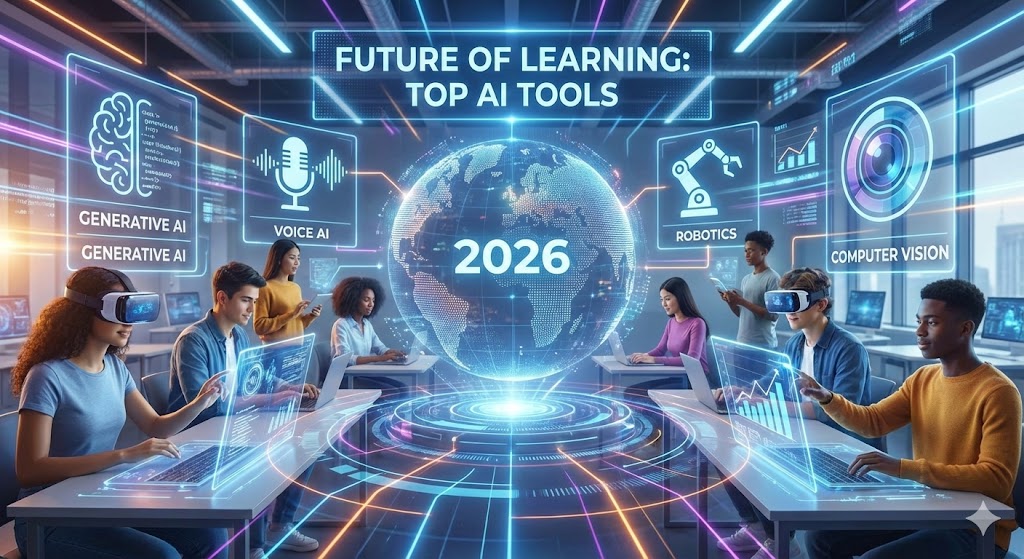
Top 10 AI Tools to Learn in 2026 to Boost Your Career
The AI Shift Is No Longer Coming — It’s Already Here
The way we work is being restructured in a way we have never seen before. Automation, machine learning, and generative ai are no longer stuck in research labs and the hands of the tech giants.
They have become integrated within everyday workflows. This is evident across industries, including marketing, design, finance, healthcare, HR, software development, and operations.
In 2026, among professionals who advance in their career in artificial intelligence, the key differentiator will often be the mastery of the right AI tools. The fast-growing and evolving tech field will contribute to the great divergence in the labor market, widening the gap between those who will thrive and those who will struggle.
Employers are no longer looking for degrees or years of experience. They are far more interested in role-defining problem-solvers who utilize the most effective AI tools to improve organizational efficiency, save costs, and achieve specific results.
This is evident in the growing hiring data. The presence of AI-assisted workflows in a job description is linked to higher compensation and quicker promotion opportunities compared to roles without AI.
The question is no longer if AI will affect your career. Instead, the question is: in order to remain relevant in the evolving tech field, which AI tools should you become proficient in? This is the area of great divergence.
Why Learning AI Tools in 2026 Is a Career Imperative?
AI Skills Are Becoming a Baseline, Not a Bonus
Employers are moving AI proficiency from ‘preferred skill’ to ‘expected capability’ for candidates. AI tools, both free and paid, in business operations range from content optimization and data analysis to design automation and code generation.
Over 68% of surveyed employers in 2025 reported the use of at least three different AI tools across departments. Employees utilizing free AI tools for automation reported a productivity boost of 30-45% over a 6-month period.
There are, therefore, clear distinctions in the labor market.
- Professionals leveraging AI to optimize productivity.
- Professionals stuck in the labor-intensive, manual process.
In 2026, only the former will continue to advance.
The Career Risk of Ignoring AI Tools
Stagnation Is the New Obsolescence
The greatest danger modern professionals will face, yet most do not recognize, is not complete automation that removes jobs. It is gradual, creeping, attrition of relevance.
When professionals utilizing AI complete tasks in half the time, with greater accuracy and more insightful analysis, the workflow of others becomes inefficient.
Let us examine this case where both applicants are equally qualified and possess the same level of experience.
-
One applicant spends time manually analyzing reports, making visuals, and writing reports.
-
The other applies the latest AI tools to automate, research, stimulate and improve creativity, and increase speed of execution.
How would you expect the outcome of this scenario to play out?
In today’s competitive landscape, candidates are expected to have experience with tools that enable and expedite the decision-making process.
This is particularly true for the areas of marketing, analytics, design, engineering, and operations. ai tools free
Mastering the use of AI is no longer an adventurous exercise; it is for career survival and progression.
What Makes an AI Tool Worth Learning in 2026
Not All AI Tools Create Career Value
The AI tools market is expanding tremendously with hundreds of tools released each year. However, the professional world only responds to a limited number of tools. The tools that will remain highly sought after in 2026 will have a combination of the following:
Workflow Integration – They fit into existing professional processes
Skill Amplification – They enhance human judgment, not replace it
Scalability – They grow in value as responsibilities increase
Starting with the free versions of any tool is common, and in the case of AI, this is particularly useful because it allows the user to build confidence and experiment in order to develop the desired basic skills before progressing to other, more sophisticated tools.
Top 10 AI Tools to Learn in 2026
1. Generative AI Platforms for Knowledge Work
Augmented intelligence platforms help knowledge workers streamline their workflow. These platforms assist with synthesizing research, composing reports, outlining strategies, and planning.
They help workers with communications and planning streamline the generational workflow. Knowledge workers who outperform their peers, lead in the depth and speed of their output.
2. AI-Powered Data Analysis Tools
The most current analytics tools can interpret, extract insights, and visualize patterns without the use of advanced coding. They are changing the function of analytics in finance, operations, HR, and marketing. These types of tools influence decreased reliance on specialized analysts and shifts of quicker cycle decisions.
3. AI Design and Creative Tools
Visual communication has always been the domain of designers. Now, everyone can create visually appealing communications with tools like draggan ai.
They allow marketers, branders, and product designers to create visual designs and communications with simple commands.
4. AI Video and Audio Production Tools
For the same reasons that visual communication did not belong to designers, so to the same reasons, video communication is the domain of designers.
The AI tools in video are in the same domain of assisting with the same kinds of complex activities—putting together the script, shooting the video, and editing the video. draggan ai editing tool
5. AI Coding and Development Assistants
The range of automation scripts, minor tweaks to websites, and logic building in applications provides functionality that even non-programmers appreciate. For programmers, they help minimize time wasted during debugging cycles and improve time to deploy applications.
By 2026, it will be commonplace to have assistance from AI in coding applications.
6. AI Productivity and Workflow Automation Tools
These assist in the management of monotonous, repetitive duties. Examples include automated scheduling, sorting of emails, prioritization of tasks, and the documentation of processes. For managers and team leads, these tools help in offloading the burdens that come with managing multifaceted tasks.
To be truly efficient, it require the intelligent integration of orchestrated systems, and not simply doing more tasks.
7. AI Marketing and SEO Tools
There is an increasingly large amount of automation taking place in search, content distribution, and optimization of performance. Behavioral forecasting and audience segmentation, along with these predictive tools, have become central to content and placement optimization.
Before implementing more scalable strategies, professionals can test many of the tools available to help with SEO and marketing.
8. AI HR and Recruitment Tools
Tools that assist in recruitment and hiring make the initial screening of resumes, assessment of requisite skills, and forecasting of performance outcomes the primary function of the tool. For HR professionals and managers, these tools can provide a more competitive managerial advantage.
There is a growing trend to move from hiring based on gut feelings to data-driven decisions.
9. AI Customer Experience Tools
The use of chatbots, sentiment analysis, and predictive support tools improve communication with clients. Customer journey managers improve response time and gain better understanding of user patterns and behaviors.
With AI, customer satisfaction improvements become easier.
10. AI Learning and Personal Development Tools
The acquisition of skills has improved with AI. Learning systems that personalize the experience modify content based on the user’s progress, the knowledge gaps, and the user’s goals. draggan ai editing tool
Learning is no longer a linear process. It is adaptive, targeted, and driven by AI.
Why Free AI Tools Are a Strategic Starting Point?
Low Risk, High Skill Accumulation
AI tools that are free and accessible are a starting point for many users. They are simple to use and have multiple advantages:
Experiment without financial commitment
Build portfolios demonstrating AI-enhanced work
Understand limitations before investing in premium solutions
Most users only need the free tools and a little time. Today's leaders mastered the simple free AI tools before moving on to more complex tools.
The primary factor is frequency of use and purpose.AI Tools and An Individual’s Career Growth
How AI Tools Directly Translate Into Career Growth?
From Skill Acquisition to Professional Leverage
Learning AI tools creates compounding benefits:
Tasks are completed faster
Output quality improves
Strategic thinking replaces manual effort
Strategic thinking, in which manual efforts are replaced by thinking through a task, improves.
Professionals who demonstrate AI proficiency most often and most easily transition into higher-impact roles because they are trusted with addressing more challenging and complex problems, driving cross-functional initiatives, and spearheading leadership roles. draggan ai editing tool
AI literacy and, consequently, a strong correlation to performance outcomes, will be seen more and more in reviews. It achieves this devoid of subjective elements referring to the effort surmised to be an ‘all-in’ contribution.
The Future Belongs to AI-Augmented Professionals
Human Judgment Enhanced by Machine Intelligence
AI tools are not replacing creativity, reasoning, or leadership. They are amplifying them. Combining human insight with intelligent systems will help the most successful professionals in 2026 to stand out. Knowing each tool will not guarantee success. Mixing human insight with intelligent systems will.
Mastering the best AI tools is not about chasing trends. It is about building endurance and relevance in a volatile job market.
Frequently Asked Questions :-
Q 1. What are AI tools?
AI tools are software applications that use Artificial Intelligence to perform tasks that normally require human intelligence. These tasks include writing, designing, data analytics, customer support, automation, and decision-making.
Q 2. What is AI tools?
AI tools refer to intelligent programs that learn from data and help users work faster, smarter, and more efficiently. They are widely used in business, marketing, education, and technology.
Q 3. What are the AI tools?
Some popular AI tools include: ● ChatGPT – content writing, emails, and problem-solving
● Grammarly – grammar and writing improvement
● Canva AI – graphic design and presentations
● Midjourney – AI image generation
● Jasper AI – marketing copywriting
● Power BI AI – data analysis and insights
Q 4. How to use AI tools?
To use AI tools, follow these basic steps:
- Choose the right AI tool for your task
- Create an account on the platform
- Enter clear instructions or prompts
- Review and edit the AI-generated output
- Apply the result to your work
Using AI tools properly saves time and improves productivity.
Q 5. Which AI tool can be used for drafting business communication?
The best AI tool for drafting business communication is ChatGPT. It helps in writing:
● Professional emails ● Business proposals ● Reports and presentations ● Client messages
Other useful tools include Grammarly (for polishing) and Jasper AI (for marketing communication).
