.png)
.png)





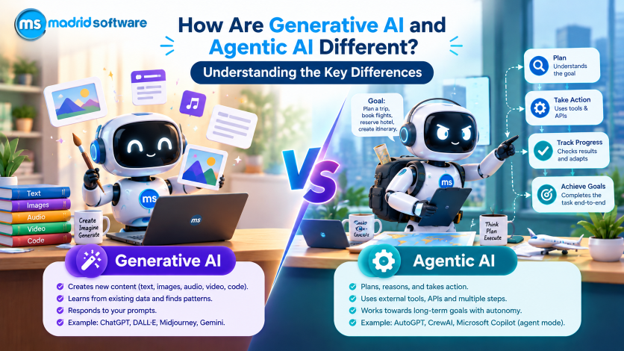
How Are Generative AI and Agentic AI Different? Understanding the Key Differences
Artificial intelligence is changing how we create content, analyse information and complete everyday tasks. From writing emails to automating business workflows, AI tools are becoming increasingly useful. Two terms gaining attention in 2026 are Generative AI and Agentic AI.
But what is the difference between Agentic AI vs Generative AI? Are they separate technologies, or can they work together?
At Madrid Software, we believe understanding these concepts helps students, working professionals and businesses make better decisions about learning and adopting AI. In this guide, we explain both technologies, their practical applications and the skills beginners should consider learning.
What Is Generative AI?
Generative AI is a type of artificial intelligence that creates new content based on patterns learned from data. It can generate text, images, computer code, audio and other forms of content.
For example, you can use ChatGPT to draft an email, summarise a report or explain a programming concept. Image-generation tools can create visual concepts from written instructions.
Generative AI typically responds to a prompt by producing an output. Depending on the application, it may also use external information or connected tools.
In simple terms, Generative AI helps create content from instructions.
What Is Agentic AI?
Agentic AI refers to AI systems designed to work towards a goal by carrying out multiple steps. Depending on their capabilities, these systems can plan tasks, use approved tools, evaluate results and adjust their approach.
Imagine a business needs a weekly sales report. An agentic AI system could retrieve authorised sales data, calculate selected metrics, identify changes and prepare a report for human review. Unlike a simple prompt-and-response interaction, this process involves coordinating several actions towards a defined outcome.
In simple terms, Agentic AI helps complete tasks through a sequence of actions. Not every AI agent operates independently. Its capabilities depend on the tools, permissions, instructions and safeguards provided.
Agentic AI vs Generative AI: What Is the Difference?
The main difference is their purpose. Generative AI focuses on creating content, while Agentic AI focuses on completing tasks through a multi-step workflow.
Here are some practical examples:
● Content creation: Generative AI drafts a blog introduction. Agentic AI could organise research, prepare a draft and submit it for review as part of an authorised workflow.
● Data analysis: Generative AI explains a chart. An AI agent could retrieve approved data, run an analysis and prepare a summary.
● Customer support: Generative AI drafts a response. An agentic system could check an order record and initiate an authorised next step.
● Software development: Generative AI suggests code. A coding agent may examine files, make proposed changes and run tests.
These categories can overlap. Agentic AI systems often use generative models to interpret instructions, create content or help determine the next step.
Can Agentic AI and Generative AI Work Together?
Yes. Many modern AI applications combine both approaches.
For example, an agentic system may collect data from an approved source, use analytical tools to calculate results and rely on a generative AI model to explain those findings in plain language. It can then assemble a report for review.
In this situation, the agent coordinates the workflow, while the generative model helps produce the explanation.
This combination can support business processes, research, reporting and customer service. However, the quality of the outcome depends on data accuracy, tool reliability and appropriate human oversight.
Advantages and Limitations of Both Technologies
Generative AI can help people draft content, summarise information, explore ideas and understand code. However, it can produce incorrect information, so important outputs need to be checked.
Agentic AI can coordinate repetitive, multi-step tasks and connect different tools. At the same time, incorrect instructions, unreliable data or excessive permissions can lead to unintended actions.
We recommend choosing the simplest approach that solves the problem. A basic content-generation tool may be sufficient for writing a description, while a multi-step agent may be more appropriate for a workflow involving several systems.
What Skills Should Beginners Learn for Agentic AI?
If you want to explore these technologies, start with the fundamentals rather than trying to learn every new AI tool at once.
1. Python Programming
Python is useful for automation, data processing and building AI applications. Start with variables, functions, data structures and basic programming logic.
2. Data Handling and SQL
Learn how to retrieve, organise and validate data. These skills are valuable when building AI applications that rely on external information.
3. Generative AI and Large Language Models
Understand prompting, model limitations, structured outputs and how large language models process instructions.
4. APIs and Workflow Automation
Learn how applications communicate and how tools can be connected to perform tasks. These concepts are particularly useful when developing agentic workflows.
5. Evaluation and Responsible AI
Understand how to test outputs, protect sensitive information, manage permissions and identify situations that require human approval.
A useful beginner project could be a document-question-answering tool or a simple AI-assisted reporting application. Once you understand the fundamentals, you can explore more advanced workflows.
How Madrid Software Can Support Your AI Learning Journey
At Madrid Software, we encourage learners to build a foundation in programming, data handling and AI concepts before moving towards advanced applications.
If you want to explore artificial intelligence, visit our Artificial Intelligence Course in Delhi page to review the available course information.
If you are more interested in Python, statistics, data analysis and machine learning, you can also explore our Data Science Training Institute in Delhi page.
We recommend comparing the curriculum, practical learning opportunities and available support before choosing a course. The right learning path depends on your existing knowledge and career goals.
Frequently Asked Questions
What is the difference between Agentic AI and Generative AI?
Generative AI creates content such as text, images and code. Agentic AI focuses on completing tasks through multiple steps and may use tools to achieve a defined goal.
Is ChatGPT Generative AI or Agentic AI?
ChatGPT is widely known for its generative AI capabilities. Depending on the features available, it can also perform agent-like tasks using tools and multi-step workflows.
Is Agentic AI a type of Generative AI?
Not exactly. Generative AI describes content-generation capabilities, while Agentic AI describes systems designed to work towards goals. An agentic system may use a generative AI model as one of its components.
Which skills are useful for learning Agentic AI?
Python, APIs, data handling, AI fundamentals, large language models, workflow design and system evaluation are useful starting points.
Will Agentic AI replace human workers?
The impact will vary by industry and task. AI may automate certain activities and change existing workflows, but human judgement, oversight, communication and domain knowledge remain important.
Final Thoughts
The difference between Agentic AI vs Generative AI comes down to their primary purpose. Generative AI creates content, while Agentic AI coordinates actions towards a goal. In many applications, both work together.
At Madrid Software, we believe that understanding AI fundamentals is a useful first step towards exploring these technologies
