.png)
.png)





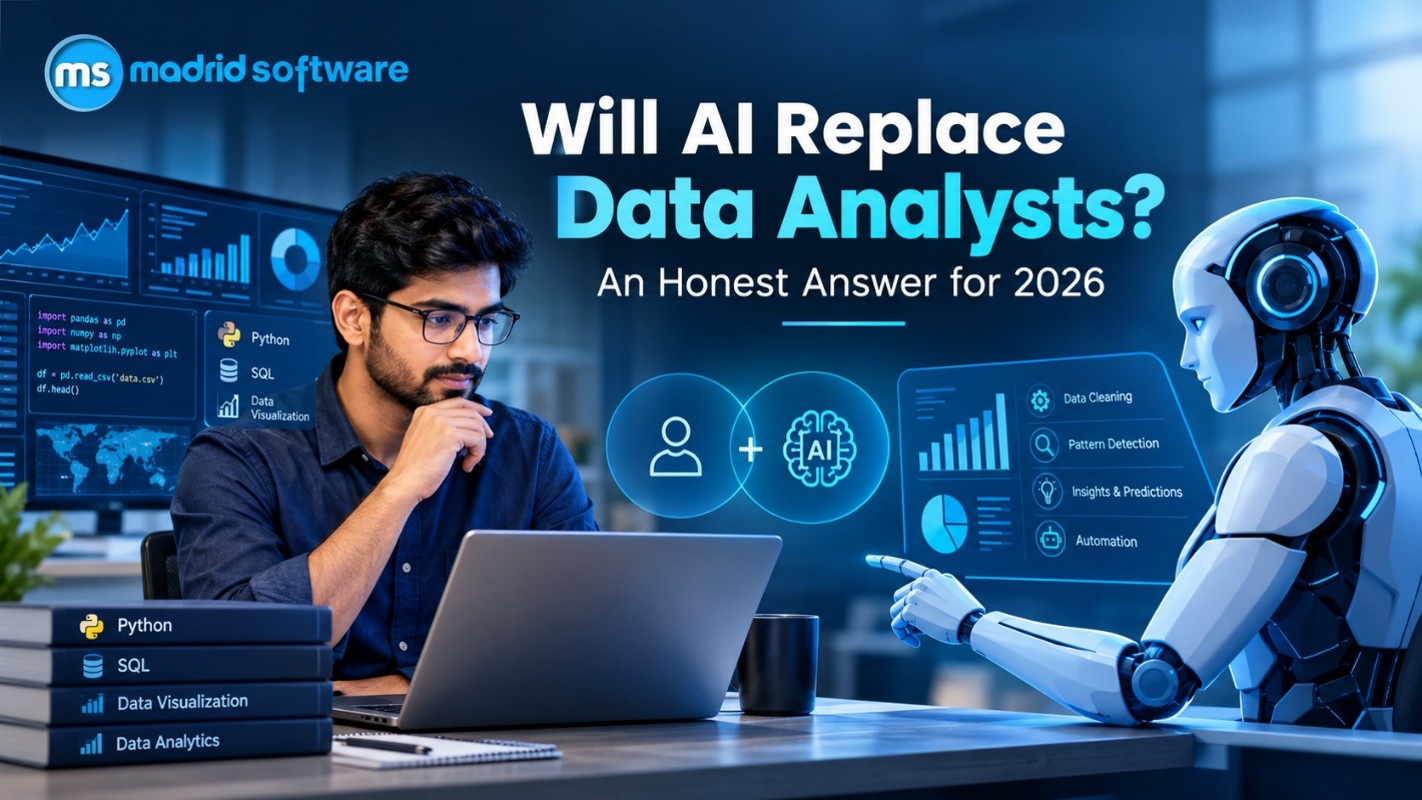
AI is changing data analytics fast, but it is not making analysts disappear. Think of it like the calculator and Excel. Both removed boring manual work, yet accountants and analysts still exist. They simply moved on to higher-value work.
The same is happening now. AI handles the repetitive parts of the job, and humans handle thinking, judgment and communication.
At Madrid Software, we train aspiring analysts in data analytics and generative AI, and we see this shift in the industry first-hand. Learners who combine strong fundamentals with AI tools are the ones getting noticed by employers.
What can AI already do in Data Analytics?
Generative AI and machine learning tools have become very good at structured, repeatable tasks.
Data Cleaning and Preparation
Data cleaning often takes a big share of an analyst's time. AI tools can now spot missing values, remove duplicates, fix formats and suggest transformations in seconds.
Writing SQL Queries and Python Code
You can type a question in plain English and get a working SQL query or a Python script using Pandas. This saves time, especially for routine data extraction and analysis.
Dashboards and Basic Reports
Business intelligence tools like Power BI and Tableau now include AI features. They can generate visualizations, summarize trends and answer questions about a dataset in natural language.
What Can't AI Do?
This is where human data analysts still have a clear advantage.
Understand Business Context
AI sees numbers. It does not know that sales dropped because of a supply issue, a festival season or a competitor's offer. Analysts connect data with real business situations.
Ask the Right Questions
Good analysis starts with a good question. Deciding what to analyze and why needs domain knowledge and curiosity. AI answers questions well, but it rarely knows which questions matter most.
Verification, Bias and Silent Errors
Common AI mistakes in analysis include joining tables at the wrong level (which duplicates revenue), filtering out NULL values without saying so, and averaging averages.
Spotting these needs a working knowledge of SQL, data modeling and statistics. Analysts also check whether the data itself is biased or incomplete, which a model cannot see from the table alone.
Tell the Story Behind the Data
Managers want a recommendation, not a chart. Data storytelling means explaining what changed, why it matters and what to do next, and then standing behind that advice. A company can automate the analysis. It cannot hand accountability to a tool.
How Is an Analyst's Workday Changing?
The tasks are the same, but the order of work has shifted. Compare how a routine request is handled:
• Starting the query: before, the analyst wrote the SQL from scratch. Now the analyst describes the question, gets a draft and reviews it line by line.
• Checking the result: before, errors showed up as failed queries. Now errors can hide in queries that run fine, so the analyst reconciles totals and row counts against a known source.
• Preparing the data: before, cleaning meant manual rules in Excel or Python. Now AI proposes the rules and the analyst confirms them against business logic.
• Delivering the answer: before, the report said what happened. Now, with the routine work faster, more of the time goes to explaining why it happened and what to do next.
The Risks of Using AI for Analysis
• Data privacy: do not paste customer or company data into public AI tools. Use company-approved tools, remove personal details first and follow your organization's policy. Laws such as India's Digital Personal Data Protection Act, 2023 and the EU's GDPR add legal duties.
• Wrong but plausible answers: models can produce confident results that are incorrect. Always test against a known total.
• Reproducibility: the same prompt can return different code on different days. Save and version the final query, not just the chat.
• Hidden bias: if the source data under-represents a group or period, an AI summary will repeat that gap without warning.
Skills You Need to Stay Relevant
If you want a secure career in data analytics, focus on these skills:
-
SQL: Still the foundation of data work.
-
Python: Especially Pandas, NumPy and Matplotlib for analysis and automation.
-
BI tools: Power BI or Tableau for dashboards.
-
Generative AI tools: Prompt writing, ChatGPT, Copilot and AI-assisted coding.
-
Statistics: Needed to judge whether AI-generated results make sense.
-
Data storytelling: Presenting insights in a simple, convincing way.
-
Domain knowledge: Understanding finance, e-commerce, healthcare or marketing makes you far more valuable.
How Freshers Can Prepare?
The timeframes below are rough estimates for steady part-time study. They vary by person.
• Months 1–2: learn Excel and SQL basics. Practice joins, filters and aggregation on real datasets.
• Months 3–4: learn Python for data analysis and basic statistics.
• Months 4–6: learn one BI tool and build two or three dashboards from public data.
• Throughout: use AI assistants to speed up practice, but verify every result yourself and note where the AI was wrong. That log is a strong interview talking point.
• Portfolio: publish three to five projects, such as sales analysis, customer churn or marketing performance, with the business question, method and recommendation clearly written.
• Join a structured program that teaches both core analytics and AI. For example, the Data Analytics with Generative AI course at Madrid Software, we cover these skills together, with hands-on projects.
Conclusion
AI will not replace data analysts, but data analysts who use AI will replace those who don't. The role is shifting from doing repetitive work to thinking, questioning and advising. If you build strong fundamentals, learn AI tools and develop your communication skills, AI becomes your biggest advantage, not your biggest threat. Ready to build these skills? Explore the Data Analytics with Generative AI course in Delhi at Madrid Software and start your journey toward a future-proof data career.
Frequently Asked Questions (FAQs)
Q 1. Will AI replace data analysts completely?
No. AI can automate tasks like data cleaning, basic queries and simple reports, but it cannot replace human judgment, business understanding or communication. Most companies still need analysts to guide decisions and verify AI output.
Q 2. Is data analytics still a good career in the AI era?
Yes. Businesses are collecting more data than ever, and they need people who can turn it into decisions. Analysts who know SQL, Python, BI tools and AI tools are in strong demand.
Q 3. Which data analyst skills are safe from AI?
Business understanding, critical thinking, data storytelling, stakeholder communication and domain expertise are hard to automate. Strong statistics knowledge also helps you check whether AI results are correct.
Q 4. Should I learn AI tools as a data analyst?
Yes. Learning tools like ChatGPT, Copilot and AI features in Power BI helps you work faster and handle bigger projects. Employers prefer analysts who can combine core analytics skills with AI tools.
Q 5. Can a fresher still become a data analyst in 2026?
Yes. Start with Excel, SQL and Python, build practical projects, and learn how to use AI tools responsibly. A structured course with real projects, such as the Data Analytics with Generative AI program at Madrid Software, can speed this up and make your portfolio stronger.
